<?xml version="1.0" encoding="utf-8"?><feed xmlns="http://www.w3.org/2005/Atom" ><generator uri="https://jekyllrb.com/" version="3.10.0">Jekyll</generator><link href="//alirezasn.ir/feed.xml" rel="self" type="application/atom+xml" /><link href="//alirezasn.ir/" rel="alternate" type="text/html" /><updated>2026-01-27T13:15:00-08:00</updated><id>//alirezasn.ir/feed.xml</id><title type="html">Personal Website</title><subtitle>Product Manager | PhD in Software</subtitle><author><name>Alireza Sadeghi-Nasab</name><email>sadeghinasab.alireza@gmail.com</email></author><entry><title type="html">PM Bible: The Only Bible You Need As a Product Manager!</title><link href="//alirezasn.ir/posts/2025/02/post-20/" rel="alternate" type="text/html" title="PM Bible: The Only Bible You Need As a Product Manager!" /><published>2025-08-02T00:00:00-07:00</published><updated>2025-08-02T00:00:00-07:00</updated><id>//alirezasn.ir/posts/2025/02/blog-post-20</id><content type="html" xml:base="//alirezasn.ir/posts/2025/02/post-20/"><![CDATA[<h1 id="preface">Preface</h1>
<p>Struggling to find the best product management courses or don’t have time to take them all? I’ve summarized over 110 top-rated PM courses into one free, accessible GitHub repository. Save hundreds of hours and thousands of dollars while leveling up your product game—fast.</p>

<h1 id="-introducing-the-pm-bible-your-shortcut-to-mastering-product-management">🧠 Introducing the PM Bible: Your Shortcut to Mastering Product Management</h1>

<p>Product management is an ever-evolving discipline. Whether you’re just breaking into the field or you’ve been shipping products for years, one thing remains true: <em>you never stop learning</em>. But keeping up with the best practices, new tools, frameworks, and skills can be overwhelming—not to mention expensive and time-consuming.</p>

<p>That’s why I created the <strong><a href="https://github.com/AlirezaSN/PM-Bible">PM Bible</a></strong>—a free, community-accessible repository that summarizes over <strong>110 of the most popular product management courses</strong> from platforms like Coursera, Udemy, LinkedIn Learning, Product School, Skillshare, and more.</p>

<p>In this post, I’ll walk you through what the PM Bible is, why I built it, and how it can save you <strong>over 400 hours</strong> of learning and <strong>thousands of dollars</strong> in course fees—while still delivering the most essential product management knowledge you need.</p>

<hr />

<h2 id="-what-is-the-pm-bible">📘 What is the PM Bible?</h2>

<p>The PM Bible is a <strong>comprehensive knowledge base of product management course summaries</strong>. Think of it as your personal product management learning assistant—one that has already done the hard work of watching the lectures, taking notes, and organizing the insights.</p>

<p>You’ll find concise summaries of courses from the most credible learning platforms including:</p>

<ul>
  <li>✅ <strong>Coursera</strong></li>
  <li>✅ <strong>Udemy</strong></li>
  <li>✅ <strong>LinkedIn Learning</strong></li>
  <li>✅ <strong>Pendo</strong></li>
  <li>✅ <strong>Pluralsight</strong></li>
  <li>✅ <strong>Skillshare</strong></li>
  <li>✅ <strong>LiveLessons</strong></li>
  <li>✅ <strong>Product School</strong></li>
  <li>✅ <strong>Oreilly</strong></li>
  <li>✅ <strong>Udacity</strong></li>
  <li>✅ <strong>Lynda</strong></li>
</ul>

<p>Each summary is provided as a standalone PDF, which means you can jump into exactly the topic you want without any friction.</p>

<hr />

<h2 id="-why-i-created-the-pm-bible">🎯 Why I Created the PM Bible</h2>

<p>As a product manager myself, I’ve been on the hunt for resources to level up my skills. Over time, I realized three major pain points:</p>

<ol>
  <li><strong>Time Constraints</strong>: Watching dozens of hours of course videos is unrealistic with a full-time job.</li>
  <li><strong>Repetition Across Courses</strong>: Many courses repeat the same fundamental concepts but don’t always present them in a compact, comparative way.</li>
  <li><strong>Cost Barrier</strong>: Subscribing to multiple platforms or buying individual courses adds up quickly—often without knowing if the content is worth it.</li>
</ol>

<p>So, I spent the last year going through <strong>over 110 courses</strong>, curating the most important takeaways, and condensing them into digestible PDFs for myself. Eventually, I realized: <em>Why not share this with the community?</em></p>

<p>Thus, the PM Bible was born.</p>

<hr />

<h2 id="-what-youll-find-inside">🔍 What You’ll Find Inside</h2>

<p>Each course summary is organized based on the original learning platform and is directly linked in the <a href="https://github.com/AlirezaSN/PM-Bible">repository</a>. A few examples of what you’ll discover:</p>

<h3 id="-strategy-and-fundamentals">🧩 Strategy and Fundamentals</h3>
<ul>
  <li><em>Product Strategy – Product School</em></li>
  <li><em>Digital Product Management – Coursera</em></li>
  <li><em>Product Management A-Z – Udemy</em></li>
</ul>

<h3 id="-tools-and-techniques">🛠 Tools and Techniques</h3>
<ul>
  <li><em>Agile Scrum Product Owner Certification – Udemy</em></li>
  <li><em>Product Roadmapping – Product School</em></li>
  <li><em>Wireframing for Product Managers – Lynda</em></li>
</ul>

<h3 id="-experiments-analytics-and-growth">🧪 Experiments, Analytics, and Growth</h3>
<ul>
  <li><em>Designing and Running Experiments – Lynda</em></li>
  <li><em>Product Analytics – Product School</em></li>
  <li><em>Product-Led Growth – Pendo</em></li>
</ul>

<h3 id="-emerging-topics">🤖 Emerging Topics</h3>
<ul>
  <li><em>AI for Product Management – Pendo</em></li>
  <li><em>Human Factors in AI – Coursera</em></li>
  <li><em>The Product Management for AI &amp; Data Science – Udemy</em></li>
</ul>

<h3 id="-career-preparation">👨‍💼 Career Preparation</h3>
<ul>
  <li><em>Product Manager Interview Practice – Udemy</em></li>
  <li><em>How to Get Hired as a PM – Udemy</em></li>
  <li><em>Mastering Job Interview English – Udemy</em></li>
</ul>

<p>With this structure, you can cherry-pick what matters most to you—whether you’re prepping for an interview, defining OKRs, building a roadmap, or launching a new product.</p>

<hr />

<h2 id="-how-much-time-and-money-can-you-save">⏳ How Much Time and Money Can You Save?</h2>

<p>Let’s break it down:</p>

<ul>
  <li><strong>Time Saved</strong>: On average, each course ranges from 3 to 10 hours. By summarizing 110+ courses, I’ve distilled <strong>400+ hours</strong> of material into crisp 5-10 page documents.</li>
  <li><strong>Money Saved</strong>: Most platforms charge anywhere between $10 to $300 per course. Collectively, that’s over <strong>$2,000+ in value</strong> if purchased individually.</li>
</ul>

<p>All of this knowledge is now freely available at your fingertips.</p>

<hr />

<h2 id="-who-is-this-for">👥 Who is This For?</h2>

<p>Whether you’re a <strong>complete beginner</strong> or a <strong>senior product manager</strong>, PM Bible is for:</p>

<ul>
  <li>💡 <strong>Aspiring PMs</strong>: Understand core concepts quickly and build confidence for your first role.</li>
  <li>📈 <strong>Current PMs</strong>: Sharpen your toolkit with advanced topics and emerging trends like AI in product management.</li>
  <li>🧑‍🏫 <strong>Educators &amp; Coaches</strong>: Use the summaries as a foundation for your training materials or workshops.</li>
  <li>🧪 <strong>Founders &amp; Entrepreneurs</strong>: Learn how to think like a product manager when building and launching your own products.</li>
</ul>

<hr />

<h2 id="-how-to-use-the-repository">🧭 How to Use the Repository</h2>

<p>The summaries are categorized by the course platform for easy navigation. Each folder contains PDF files titled by course name. Here’s how you can get started:</p>

<ol>
  <li><strong>Browse the repo</strong>: <a href="https://github.com/AlirezaSN/PM-Bible">github.com/AlirezaSN/PM-Bible</a></li>
  <li><strong>Pick your platform</strong>: Udemy, Coursera, LinkedIn, etc.</li>
  <li><strong>Open any PDF</strong> to read the summary in minutes.</li>
  <li><strong>Bookmark or download</strong> the summaries you need most.</li>
</ol>

<p>No login, no paywall, no hassle.</p>

<hr />

<h2 id="️-a-quick-disclaimer">⚠️ A Quick Disclaimer</h2>

<p>These are <strong>not full course replacements</strong>. They are original, independently created summaries designed to highlight key concepts, frameworks, and actionable insights.</p>

<p>If you find a course valuable based on the summary, I strongly encourage you to <strong>purchase or enroll in the full version</strong> to support the original creators and deepen your understanding.</p>

<hr />

<h2 id="️-want-to-support-the-project">❤️ Want to Support the Project?</h2>

<p>This project was built with passion and curiosity, and it’s totally free to use. If you’ve found it helpful and want to contribute, you can support the project with a small donation via Tether (USDT):</p>

<ul>
  <li><strong>TRC20</strong>: <code class="language-plaintext highlighter-rouge">TVfN5xqmfAPv9DfRf6LtJBFZTVoR3Q5bu5</code></li>
  <li><strong>BSC (BEP20)</strong>: <code class="language-plaintext highlighter-rouge">0xca03b64ea2a83c5d7832758b8730217b67a9fc42</code></li>
  <li><strong>ERC20</strong>: <code class="language-plaintext highlighter-rouge">0xca03b64ea2a83c5d7832758b8730217b67a9fc42</code></li>
</ul>

<p>Your support helps keep the content updated and available for others like you.</p>

<hr />

<h2 id="-lets-connect">📬 Let’s Connect</h2>

<p>Have feedback, ideas, or just want to say hi?</p>

<ul>
  <li>🌐 Website: <a href="https://alirezasn.ir">alirezasn.ir</a></li>
  <li>📧 Email: <a href="mailto:sadeghinasab.alireza@gmail.com">sadeghinasab.alireza@gmail.com</a></li>
  <li>💬 Telegram: <a href="https://t.me/alireza_sn">@alireza_sn</a></li>
</ul>

<hr />

<h2 id="-license-and-usage">🪪 License and Usage</h2>

<p>This project is licensed under <a href="https://creativecommons.org/licenses/by-nc-sa/4.0/">Creative Commons Attribution-NonCommercial-ShareAlike 4.0</a>. You’re free to share and adapt it for non-commercial purposes—with attribution.</p>

<hr />

<h2 id="-final-thoughts">🚀 Final Thoughts</h2>

<p>Product management is one of the most dynamic, interdisciplinary, and rewarding fields out there—but learning it doesn’t have to be slow or expensive.</p>

<p>With the <strong>PM Bible</strong>, I hope to give back to the community that taught me so much. If it helps even one person land a PM job or build a better product, it’s all been worth it.</p>

<p>👉 <a href="https://github.com/AlirezaSN/PM-Bible">Explore the PM Bible on GitHub</a></p>

<p>Happy building!</p>

<p>—
<em>Alireza Sadeghi-Nasab</em></p>]]></content><author><name>Alireza Sadeghi-Nasab</name><email>sadeghinasab.alireza@gmail.com</email></author><category term="product-management" /><category term="pn-learning" /><category term="product-management-resources" /><category term="product-management-career" /><category term="pm-skills" /><category term="lifelong-learning" /><category term="online-courses" /><category term="professional-development" /><category term="career-growth" /><summary type="html"><![CDATA[Preface Struggling to find the best product management courses or don’t have time to take them all? I’ve summarized over 110 top-rated PM courses into one free, accessible GitHub repository. Save hundreds of hours and thousands of dollars while leveling up your product game—fast.]]></summary></entry><entry><title type="html">Essential Vocabulary for Product, Project, and Agile Practitioners</title><link href="//alirezasn.ir/posts/2024/06/post-19/" rel="alternate" type="text/html" title="Essential Vocabulary for Product, Project, and Agile Practitioners" /><published>2024-06-14T00:00:00-07:00</published><updated>2024-06-14T00:00:00-07:00</updated><id>//alirezasn.ir/posts/2024/06/blog-post-19</id><content type="html" xml:base="//alirezasn.ir/posts/2024/06/post-19/"><![CDATA[<h1 id="preface">Preface</h1>
<p>Whether you’re an experienced professional or just starting out in the world of product management, project management, or agile software development, having a strong grasp of the specialized terminology can be invaluable. In this article, we’ll explore a comprehensive list of words, expressions, and action verbs related to these domains, designed to enhance your communication skills and deepen your understanding of these crucial fields.</p>

<h2 id="vocabularies">Vocabularies</h2>

<h3 id="product-management">Product Management:</h3>

<ul>
  <li>
    <p><strong>Product roadmap:</strong> A strategic plan outlining the vision, direction, and timeline for a product’s future development.</p>
  </li>
  <li>
    <p><strong>Minimum Viable Product (MVP):</strong> The most basic version of a product that can be released to customers to validate assumptions and gather feedback.</p>
  </li>
  <li>
    <p><strong>Product backlog:</strong> A prioritized list of features, bug fixes, and other work items that need to be addressed in a product.</p>
  </li>
  <li>
    <p><strong>User stories:</strong> Short, simple descriptions of a feature from the perspective of the end-user.</p>
  </li>
  <li>
    <p><strong>Wireframes:</strong> Low-fidelity visual representations of a product’s user interface.</p>
  </li>
  <li>
    <p><strong>A/B testing:</strong> Experiments comparing two versions of a product or feature to determine which performs better.</p>
  </li>
  <li>
    <p><strong>Iterate:</strong> To repeatedly refine and improve a product based on feedback and data.</p>
  </li>
  <li>
    <p><strong>Product life cycle:</strong> The series of phases a product goes through from conception to retirement.</p>
  </li>
  <li>
    <p><strong>Market fit:</strong> The degree to which a product satisfies a strong market demand.</p>
  </li>
  <li>
    <p><strong>Pivot:</strong> A substantial change in a product’s strategy or business model.</p>
  </li>
  <li>
    <p><strong>Feature roadmap:</strong> A plan that outlines the timeline and prioritization of specific features to be developed.</p>
  </li>
  <li>
    <p><strong>Persona:</strong> A fictional character representing a target user or customer segment.</p>
  </li>
</ul>

<h3 id="product-ownership">Product Ownership:</h3>

<ul>
  <li>
    <p><strong>Product vision:</strong> A clear and compelling description of what the product aims to achieve.</p>
  </li>
  <li>
    <p><strong>Stakeholder management:</strong> The process of identifying, engaging, and satisfying the needs of various stakeholders involved with a product.</p>
  </li>
  <li>
    <p><strong>Customer validation:</strong> The process of gathering feedback from customers to ensure the product meets their needs and expectations.</p>
  </li>
  <li>
    <p><strong>Prioritize:</strong> To determine the relative importance of tasks or features in the product backlog.</p>
  </li>
  <li>
    <p><strong>Groom:</strong> To refine and clarify items in the product backlog, ensuring they are well-defined and ready for development.</p>
  </li>
  <li>
    <p><strong>Release planning:</strong> The process of determining which features and functionality will be included in a specific product release.</p>
  </li>
  <li>
    <p><strong>Requirements gathering:</strong> The process of eliciting and documenting the needs and expectations of stakeholders for a product.</p>
  </li>
  <li>
    <p><strong>User acceptance testing (UAT):</strong> The process of having end-users or subject matter experts validate that a product meets their requirements.</p>
  </li>
  <li>
    <p><strong>Value proposition:</strong> A clear statement of the benefits and value a product offers to its target customers.</p>
  </li>
  <li>
    <p><strong>Buy-in:</strong> The commitment and support of stakeholders for a product or its direction.</p>
  </li>
</ul>

<h3 id="project-management">Project Management:</h3>

<ul>
  <li>
    <p><strong>Initiate:</strong> To formally start a new project or phase.</p>
  </li>
  <li>
    <p><strong>Scope:</strong> The sum of all work required to complete a project successfully.</p>
  </li>
  <li>
    <p><strong>Work breakdown structure (WBS):</strong> A hierarchical decomposition of the work to be executed in a project.</p>
  </li>
  <li>
    <p><strong>Milestone:</strong> A significant event or accomplishment marking progress in a project.</p>
  </li>
  <li>
    <p><strong>Risk management:</strong> The process of identifying, analyzing, and responding to potential risks that could impact a project.</p>
  </li>
  <li>
    <p><strong>Critical path:</strong> The sequence of activities that represents the longest path through a project, determining its earliest completion date.</p>
  </li>
  <li>
    <p><strong>Earned value management:</strong> A technique for measuring project performance by comparing the planned and actual work accomplished.</p>
  </li>
  <li>
    <p><strong>Gantt chart:</strong> A visual representation of project tasks and their planned and actual durations.</p>
  </li>
  <li>
    <p><strong>Resource allocation:</strong> The process of assigning and scheduling project resources (people, materials, equipment) to specific tasks.</p>
  </li>
  <li>
    <p><strong>Change management:</strong> The process of controlling and documenting changes to project scope, schedule, or requirements.</p>
  </li>
  <li>
    <p><strong>Lessons learned:</strong> The knowledge and insights gained from a project, which can be applied to future projects.</p>
  </li>
  <li>
    <p><strong>Project charter:</strong> A document that formally authorizes a project and outlines its objectives, scope, and stakeholders.</p>
  </li>
</ul>

<h3 id="scrum-framework">Scrum Framework:</h3>

<ul>
  <li>
    <p><strong>Sprint:</strong> A time-boxed period, typically 2-4 weeks, during which a specific set of work is completed.</p>
  </li>
  <li>
    <p><strong>Daily Scrum:</strong> A short, daily meeting where team members synchronize their work and plan for the day ahead.</p>
  </li>
  <li>
    <p><strong>Sprint backlog:</strong> A list of tasks or user stories the team commits to completing during a specific sprint.</p>
  </li>
  <li>
    <p><strong>Sprint planning:</strong> The event at the beginning of a sprint where the team determines the work to be done.</p>
  </li>
  <li>
    <p><strong>Sprint review:</strong> A meeting at the end of a sprint where the team demonstrates the completed work to stakeholders.</p>
  </li>
  <li>
    <p><strong>Sprint retrospective:</strong> A meeting at the end of a sprint where the team reflects on their process and identifies areas for improvement.</p>
  </li>
  <li>
    <p><strong>Scrum Master:</strong> The role responsible for facilitating Scrum practices and removing impediments for the team.</p>
  </li>
  <li>
    <p><strong>Product Increment:</strong> The sum of all completed work items from the current and previous sprints.</p>
  </li>
  <li>
    <p><strong>Velocity:</strong> A measure of the amount of work a team can complete during a sprint, used for planning and forecasting.</p>
  </li>
  <li>
    <p><strong>Definition of Done:</strong> The agreed-upon criteria that must be met for a work item to be considered complete.</p>
  </li>
  <li>
    <p><strong>Burn-down chart:</strong> A visual tool used to track the progress of work remaining in a sprint or release.</p>
  </li>
</ul>

<h3 id="agile-methodology">Agile Methodology:</h3>

<ul>
  <li>
    <p><strong>Agile manifesto:</strong> The foundational principles and values that guide agile software development.</p>
  </li>
  <li>
    <p><strong>Cross-functional team:</strong> A team composed of individuals with diverse skillsets necessary to complete project tasks.</p>
  </li>
  <li>
    <p><strong>Continuous integration:</strong> The practice of merging code changes frequently into a shared repository to detect integration issues early.</p>
  </li>
  <li>
    <p><strong>Continuous delivery:</strong> The practice of keeping code in a deployable state at all times, enabling frequent and reliable releases.</p>
  </li>
  <li>
    <p><strong>Kanban board:</strong> A visual representation of the workflow, displaying the progress of work items through various stages.</p>
  </li>
  <li>
    <p><strong>Timeboxing:</strong> The practice of allocating a fixed amount of time for a specific activity or task.</p>
  </li>
  <li>
    <p><strong>Lean development:</strong> A methodology that focuses on maximizing value and minimizing waste throughout the development process.</p>
  </li>
  <li>
    <p><strong>User story mapping:</strong> A technique for visually organizing and prioritizing user stories to align with the overall product vision.</p>
  </li>
  <li>
    <p><strong>Minimum Marketable Feature (MMF):</strong> The smallest set of functionality that provides value to customers and can be released independently.</p>
  </li>
  <li>
    <p><strong>Technical debt:</strong> The implied cost of additional rework caused by choosing an easy solution over a better approach.</p>
  </li>
  <li>
    <p><strong>Scaling agile:</strong> The process of applying agile principles and practices to larger organizations or projects beyond a single team.</p>
  </li>
</ul>

<h3 id="software-development">Software Development:</h3>

<ul>
  <li>
    <p><strong>Code review:</strong> The process of peers reviewing code changes to ensure quality, consistency, and adherence to best practices.</p>
  </li>
  <li>
    <p><strong>Refactoring:</strong> The process of restructuring existing code without changing its external behavior to improve its internal structure, readability, and maintainability.</p>
  </li>
  <li>
    <p><strong>Debugging:</strong> The process of identifying and resolving defects or errors in software code.</p>
  </li>
  <li>
    <p><strong>Unit testing:</strong> The practice of testing individual units or components of a software system to ensure they function as expected.</p>
  </li>
  <li>
    <p><strong>Integration testing:</strong> The process of testing the interaction between different components or systems.</p>
  </li>
  <li>
    <p><strong>Deployment:</strong> The process of releasing a software application or update to a production environment.</p>
  </li>
  <li>
    <p><strong>DevOps:</strong> A set of practices that combines software development (Dev) and IT operations (Ops) to shorten the development life cycle and provide continuous delivery of high-quality software.</p>
  </li>
  <li>
    <p><strong>Version control:</strong> The practice of managing changes to source code over time, allowing for tracking, collaboration, and reverting to previous versions.</p>
  </li>
  <li>
    <p><strong>Code repository:</strong> A centralized location where source code is stored, managed, and accessed by the development team.</p>
  </li>
  <li>
    <p><strong>Pair programming:</strong> An agile software development practice where two programmers work together on the same code, taking turns as the “driver” and “navigator.”</p>
  </li>
  <li>
    <p><strong>Continuous Monitoring:</strong> The practice of automatically monitoring the performance and health of software applications in production environments.</p>
  </li>
  <li>
    <p><strong>Technical debt:</strong> The implied cost of additional rework caused by choosing an easy solution over a better approach in software development.</p>
  </li>
</ul>

<h2 id="action-verbs">Action Verbs</h2>

<h3 id="product-management-1">Product Management:</h3>

<ul>
  <li>
    <p><strong>Develop/Build (a product roadmap):</strong> The act of creating and defining the strategic plan for a product’s future direction.</p>
  </li>
  <li>
    <p><strong>Validate (an MVP):</strong> The process of testing and gathering feedback on the minimum viable product.</p>
  </li>
  <li>
    <p><strong>Groom/Refine (the product backlog):</strong> The action of organizing, clarifying, and prioritizing items in the product backlog.</p>
  </li>
  <li>
    <p><strong>Conduct (user interviews or A/B testing):</strong> The process of gathering insights and data from users or running experiments.</p>
  </li>
  <li>
    <p><strong>Iterate (on a feature or design):</strong> The act of repeatedly refining and improving a product aspect based on feedback.</p>
  </li>
  <li>
    <p><strong>Analyze (user data):</strong> The process of studying and interpreting user behavior, metrics, and feedback to inform product decisions.</p>
  </li>
  <li>
    <p><strong>Define (product strategy):</strong> The act of establishing the overall direction, goals, and approach for a product.</p>
  </li>
  <li>
    <p><strong>Evangelize (the product vision):</strong> The process of promoting and generating enthusiasm for the product’s purpose and potential.</p>
  </li>
</ul>

<h3 id="product-ownership-1">Product Ownership:</h3>

<ul>
  <li>
    <p><strong>Articulate/Communicate (the product vision):</strong> The action of clearly expressing and sharing the overarching goal for the product.</p>
  </li>
  <li>
    <p><strong>Engage/Collaborate (with stakeholders):</strong> The process of actively involving and working with various stakeholders throughout the product development lifecycle.</p>
  </li>
  <li>
    <p><strong>Gather/Solicit (customer feedback):</strong> The act of actively seeking and collecting input from customers to inform product decisions.</p>
  </li>
  <li>
    <p><strong>Prioritize (backlog items):</strong> The process of determining the relative importance and order of work items in the product backlog.</p>
  </li>
  <li>
    <p><strong>Negotiate (requirements):</strong> The act of balancing and reconciling conflicting needs or priorities among stakeholders.</p>
  </li>
  <li>
    <p><strong>Advocate (for user needs):</strong> The process of representing and championing the interests of end-users within the product team.</p>
  </li>
  <li>
    <p><strong>Facilitate (decision-making):</strong> The act of guiding the team or stakeholders through the process of making informed choices.</p>
  </li>
</ul>

<h3 id="project-management-1">Project Management:</h3>

<ul>
  <li>
    <p><strong>Initiate/Kick off (a project):</strong> The action of formally starting a new project or phase.</p>
  </li>
  <li>
    <p><strong>Define (project scope):</strong> The process of determining and documenting the boundaries and deliverables of a project.</p>
  </li>
  <li>
    <p><strong>Identify/Assess (risks):</strong> The act of recognizing and evaluating potential risks that may impact the project.</p>
  </li>
  <li>
    <p><strong>Monitor/Track (progress):</strong> The process of actively observing and documenting the advancement of a project against predefined milestones or targets.</p>
  </li>
  <li>
    <p><strong>Mitigate (risks):</strong> The action of implementing strategies to reduce or eliminate the impact of identified risks.</p>
  </li>
  <li>
    <p><strong>Allocate (resources):</strong> The process of assigning and distributing the necessary people, materials, and budget for a project.</p>
  </li>
  <li>
    <p><strong>Manage (project constraints):</strong> The act of balancing and optimizing the scope, time, and cost constraints of a project.</p>
  </li>
  <li>
    <p><strong>Communicate (project status):</strong> The process of regularly sharing updates and information about a project’s progress with stakeholders.</p>
  </li>
</ul>

<h3 id="scrum-framework-1">Scrum Framework:</h3>

<ul>
  <li>
    <p><strong>Facilitate (the Daily Scrum):</strong> The act of leading and guiding the team through the daily stand-up meeting.</p>
  </li>
  <li>
    <p><strong>Commit (to the Sprint backlog):</strong> The process of the team agreeing to complete a specific set of work during the upcoming sprint.</p>
  </li>
  <li>
    <p><strong>Demonstrate/Showcase (completed work):</strong> The action of presenting the outcome of the sprint to stakeholders during the Sprint Review.</p>
  </li>
  <li>
    <p><strong>Retrospect/Reflect (on the process):</strong> The act of looking back on the team’s approach and identifying areas for improvement during the Sprint Retrospective.</p>
  </li>
  <li>
    <p><strong>Timebox (activities):</strong> The practice of allocating a fixed amount of time for specific activities or meetings within the Scrum framework.</p>
  </li>
  <li>
    <p><strong>Groom (the product backlog):</strong> The process of refining and clarifying product backlog items to ensure they are well-defined and ready for future sprints.</p>
  </li>
  <li>
    <p><strong>Increment (the product):</strong> The act of adding new functionality or features to the product at the end of each sprint.</p>
  </li>
</ul>

<h3 id="agile-methodology-1">Agile Methodology:</h3>

<ul>
  <li>
    <p><strong>Foster (collaboration):</strong> The process of actively encouraging and facilitating cooperation among team members.</p>
  </li>
  <li>
    <p><strong>Automate (processes):</strong> The act of implementing tools or scripts to streamline and optimize repetitive tasks or workflows.</p>
  </li>
  <li>
    <p><strong>Visualize (workflow):</strong> The process of creating visual representations, such as Kanban boards, to depict the progress of work items.</p>
  </li>
  <li>
    <p><strong>Adapt (to change):</strong> The ability to respond and adjust to changing requirements, priorities, or circumstances throughout the development process.</p>
  </li>
  <li>
    <p><strong>Inspect (work):</strong> The act of regularly reviewing and evaluating the quality and progress of work to identify areas for improvement.</p>
  </li>
  <li>
    <p><strong>Embrace (change):</strong> The willingness to accept and incorporate changes and feedback as part of the iterative development approach.</p>
  </li>
</ul>

<h3 id="software-development-1">Software Development:</h3>

<ul>
  <li>
    <p><strong>Write/Code (software):</strong> The act of creating and developing software applications or systems.</p>
  </li>
  <li>
    <p><strong>Refactor (code):</strong> The process of restructuring and improving the internal structure and quality of existing code without altering its external behavior.</p>
  </li>
  <li>
    <p><strong>Debug/Troubleshoot (issues):</strong> The action of identifying and resolving defects, errors, or problems in software code.</p>
  </li>
  <li>
    <p><strong>Test/Verify (functionality):</strong> The process of evaluating and confirming that software components or systems meet the specified requirements and behave as expected.</p>
  </li>
  <li>
    <p><strong>Deploy/Release (software):</strong> The act of making a software application or update available in a production environment for end-users.</p>
  </li>
  <li>
    <p><strong>Optimize (performance):</strong> The process of improving the speed, efficiency, and overall performance of software applications or systems.</p>
  </li>
  <li>
    <p><strong>Architect (solutions):</strong> The act of designing and structuring the overall framework, components, and interfaces of software systems.</p>
  </li>
  <li>
    <p><strong>Integrate (components):</strong> The process of combining and connecting different software modules or systems to work together as a cohesive unit.</p>
  </li>
</ul>

<h2 id="expressions-and-idioms">Expressions and Idioms</h2>

<h3 id="product-management-2">Product Management:</h3>

<ul>
  <li>
    <p><strong>Shipping [product feature]:</strong> Releasing or launching a new feature.</p>
  </li>
  <li>
    <p><strong>Putting out fires:</strong> Addressing urgent issues or problems as they arise.</p>
  </li>
  <li>
    <p><strong>Moving the needle:</strong> Making a significant impact or progress on a key metric or goal.</p>
  </li>
  <li>
    <p><strong>Throwing spaghetti at the wall:</strong> Testing multiple ideas or approaches to see what sticks.</p>
  </li>
  <li>
    <p><strong>Scratching your own itch:</strong> Building a product to solve a problem you’ve personally experienced.</p>
  </li>
  <li>
    <p><strong>Eating your own dog food:</strong> Using the product or service your company provides.</p>
  </li>
</ul>

<h3 id="product-ownership-2">Product Ownership:</h3>

<ul>
  <li>
    <p><strong>Wearing multiple hats:</strong> Taking on various roles and responsibilities within the product team.</p>
  </li>
  <li>
    <p><strong>Keeping the ball rolling:</strong> Ensuring progress and momentum on a project or initiative.</p>
  </li>
  <li>
    <p><strong>Being the voice of the customer:</strong> Representing and advocating for the needs and perspectives of end-users.</p>
  </li>
  <li>
    <p><strong>Building the plane while flying it:</strong> Continuously improving and evolving the product while it’s in use.</p>
  </li>
  <li>
    <p><strong>Connecting the dots:</strong> Identifying and understanding the relationships between various product features or requirements</p>
  </li>
</ul>

<h3 id="project-management-2">Project Management:</h3>

<ul>
  <li>
    <p><strong>Herding cats:</strong> The challenging task of coordinating and aligning diverse individuals or teams.</p>
  </li>
  <li>
    <p><strong>Scope creep:</strong> The gradual and uncontrolled expansion of a project’s scope beyond its original boundaries.</p>
  </li>
  <li>
    <p><strong>Hitting a roadblock:</strong> Encountering a significant obstacle or barrier that impedes progress.</p>
  </li>
  <li>
    <p><strong>Dropping the ball:</strong> Failing to complete a task or responsibility.</p>
  </li>
  <li>
    <p><strong>Keeping the plates spinning:</strong> Juggling multiple tasks or priorities simultaneously.</p>
  </li>
  <li>
    <p><strong>Burning the midnight oil:</strong> Working late or putting in extra hours to meet a deadline.</p>
  </li>
</ul>

<h3 id="scrum-framework-2">Scrum Framework:</h3>

<ul>
  <li>
    <p><strong>Spinning plates:</strong> Juggling multiple tasks or responsibilities simultaneously.</p>
  </li>
  <li>
    <p><strong>Being in the trenches:</strong> Being actively involved in the day-to-day work and challenges faced by the team.</p>
  </li>
  <li>
    <p><strong>Pulling the andon cord:</strong> Raising awareness of a problem or issue that requires immediate attention.</p>
  </li>
  <li>
    <p><strong>Hitting the ground running:</strong> Starting a new sprint or project with energy and momentum.</p>
  </li>
  <li>
    <p><strong>Keeping the scrum machine well-oiled:</strong> Ensuring the team’s processes and practices are running smoothly.</p>
  </li>
  <li>
    <p><strong>Burndown chart on fire:</strong> Making exceptional progress in completing the sprint backlog.</p>
  </li>
</ul>

<h3 id="agile-methodology-2">Agile Methodology:</h3>

<ul>
  <li>
    <p><strong>Failing fast:</strong> Quickly identifying and addressing issues or mistakes to minimize their impact.</p>
  </li>
  <li>
    <p><strong>Cutting corners:</strong> Compromising quality or best practices to meet deadlines or achieve short-term goals.</p>
  </li>
  <li>
    <p><strong>Drinking from the firehose:</strong> Being overwhelmed by a large amount of information or work.</p>
  </li>
  <li>
    <p><strong>Waterfall hangover:</strong> Lingering habits or mindsets from traditional, non-agile approaches.</p>
  </li>
  <li>
    <p><strong>Agile theater:</strong> Superficially adopting agile practices without fully embracing the underlying principles.</p>
  </li>
</ul>

<h3 id="software-development-2">Software Development:</h3>

<ul>
  <li>
    <p><strong>Code smell:</strong> Indicators in the source code that suggest potential issues or areas for improvement.</p>
  </li>
  <li>
    <p><strong>Yak shaving:</strong> Getting sidetracked or delayed by a series of seemingly insignificant tasks or issues.</p>
  </li>
  <li>
    <p><strong>Reinventing the wheel:</strong> Duplicating effort by creating something that already exists, rather than reusing existing solutions.</p>
  </li>
  <li>
    <p><strong>Pushing to production:</strong> Deploying code or updates to the live, production environment.</p>
  </li>
  <li>
    <p><strong>Spaghetti code:</strong> Overly complex and tangled source code that is difficult to maintain or understand.</p>
  </li>
  <li>
    <p><strong>Chasing waterfalls:</strong> Following a rigid, sequential development process instead of an iterative and incremental approach.</p>
  </li>
</ul>]]></content><author><name>Alireza Sadeghi-Nasab</name><email>sadeghinasab.alireza@gmail.com</email></author><category term="product-management" /><category term="product-ownership" /><category term="project-management" /><category term="agile" /><category term="scrum" /><category term="tech" /><category term="vocabulary" /><category term="ESL" /><category term="business-english" /><summary type="html"><![CDATA[Preface Whether you’re an experienced professional or just starting out in the world of product management, project management, or agile software development, having a strong grasp of the specialized terminology can be invaluable. In this article, we’ll explore a comprehensive list of words, expressions, and action verbs related to these domains, designed to enhance your communication skills and deepen your understanding of these crucial fields.]]></summary></entry><entry><title type="html">Case Study: Divar Service Suggestion in Chat</title><link href="//alirezasn.ir/posts/2024/02/post-18/" rel="alternate" type="text/html" title="Case Study: Divar Service Suggestion in Chat" /><published>2024-02-11T00:00:00-08:00</published><updated>2024-02-11T00:00:00-08:00</updated><id>//alirezasn.ir/posts/2024/02/blog-post-18</id><content type="html" xml:base="//alirezasn.ir/posts/2024/02/post-18/"><![CDATA[<h1 id="preface">Preface</h1>
<p>Some time ago, <a href="https://divar.ir/about">Divar Company</a> announced a task for the entrance interview for one of its positions, which I prepared in 4 days and sent to them. My answer to this task made me pass the first stage and reach the interview. In this post, I will explain about this task.</p>

<h2 id="what-is-divar">What is Divar?</h2>

<p><code class="language-plaintext highlighter-rouge">Divar</code> is a platform, started working on 11 July 2012 with the aim of buying and selling without online intermediaries (like <a href="https://frederick.craigslist.org">Craigslist</a> but in Iran). Now, it has over 50 milions of users and it covers various categories such as real estate, vehicles, digital goods, home and kitchen, services, entertainment and leisure, and recruitment and employment.</p>

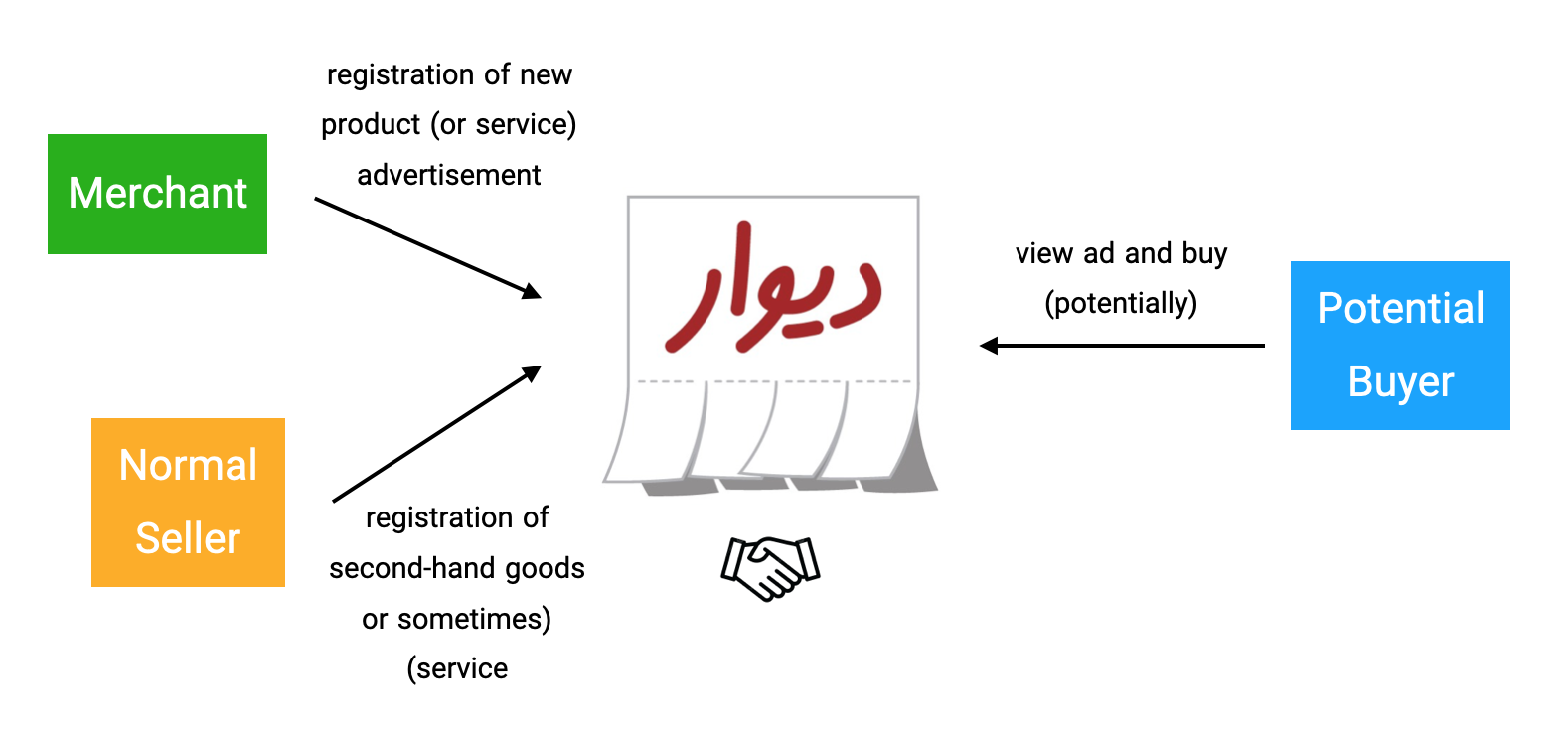
<p>If we want to take a general look at <code class="language-plaintext highlighter-rouge">Divar</code>, something like this happens in this platform:</p>

<p align="center">
<img src="https://alirezasn.ir/files/images/tasks/divar/overview.png" width="1578" height="736" />
</p>
<p align="center">
Divar - Overview
</p>

<h2 id="the-assignment">The Assignment</h2>

<h3 id="problem">Problem</h3>

<p>The interview task is as follows:</p>

<blockquote>
  <p>In the attached file, there is a list of users’ chats in Divar’s personal items category. Read them and write a list of your suggestions for providing the service on the Divar chat in order of priority, noting the frequency of repetition (send the tagged file along with the task answer).</p>
</blockquote>

<h3 id="input-dataset">Input Dataset</h3>

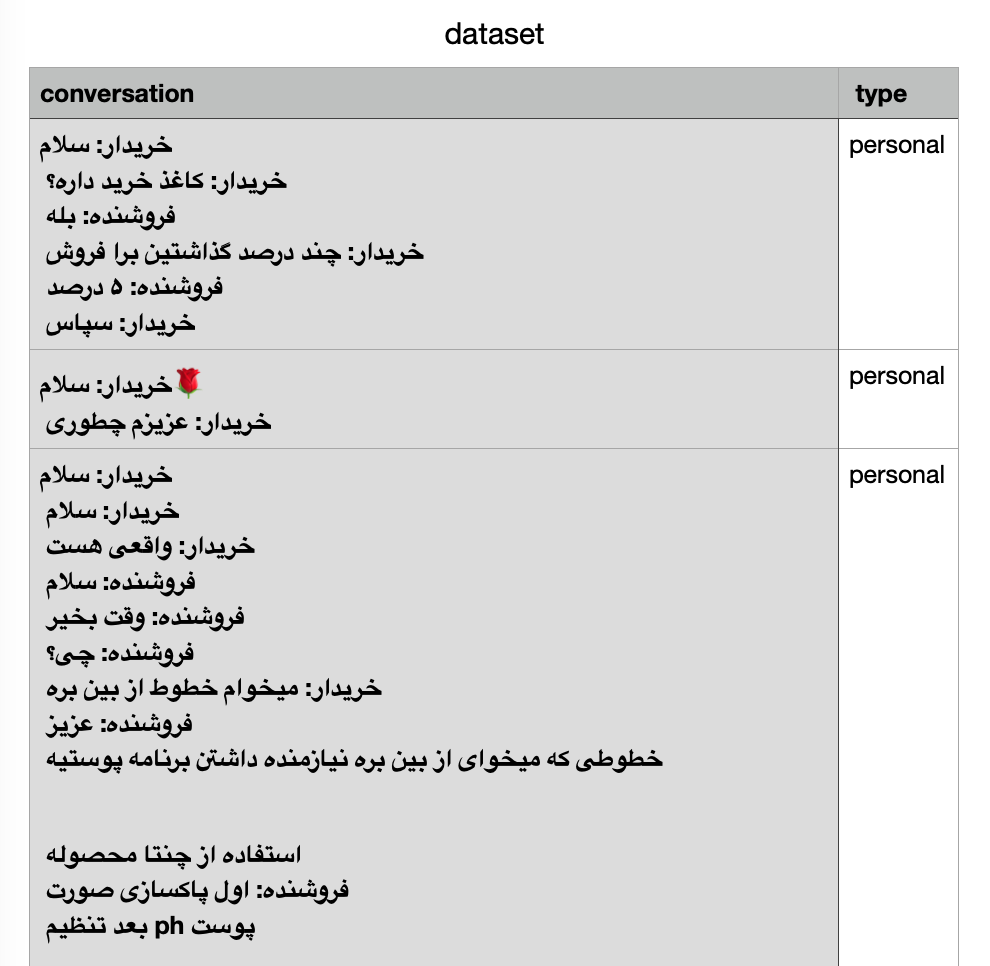
<p>The attached file was a CSV file containing two columns: <code class="language-plaintext highlighter-rouge">conversation</code> and <code class="language-plaintext highlighter-rouge">type</code>. Here is the sample screenshot of it:</p>

<p align="center">
<img src="https://alirezasn.ir/files/images/tasks/divar/dataset_sample.png" width="990" height="966" />
</p>
<p align="center">
Dataset Sample
</p>

<p>Let’s talk about the suggested solution.</p>

<h3 id="solution">Solution</h3>

<p>First of all, i implemented a script to get the frequency of each word in the chats. If you run this code (<code class="language-plaintext highlighter-rouge">python3 main.py</code>), it outputs a sorted csv file (<code class="language-plaintext highlighter-rouge">output.csv</code>) that shows the frequency of repetition of each word. It should be mentioned that to improve the quality of the output, stop words are removed from the output. I used the data set of <a href="https://github.com/ziaa/Persian-stopwords-collection/blob/master/Stopwords/shokri/stop-words.txt">this address</a> for the list of such words.</p>

<p>Here is the script:</p>

<div class="language-python highlighter-rouge"><div class="highlight"><pre class="highlight"><code><span class="c1"># -*- coding: utf-8 -*-
</span>
<span class="kn">import</span> <span class="nn">csv</span>
<span class="kn">from</span> <span class="nn">collections</span> <span class="kn">import</span> <span class="n">Counter</span>

<span class="c1">######################################################################
</span>
<span class="n">FILE_PATH</span> <span class="o">=</span> <span class="s">'dataset.csv'</span>
<span class="n">STOP_WORDS_FILE</span> <span class="o">=</span> <span class="s">'stop_words.txt'</span>
<span class="n">OUTPUT_FILE_PATH</span> <span class="o">=</span> <span class="s">'output.csv'</span>

<span class="c1">######################################################################
</span>
<span class="k">def</span> <span class="nf">get_stopwords</span><span class="p">(</span><span class="n">file_path</span><span class="p">):</span>
    <span class="k">with</span> <span class="nb">open</span><span class="p">(</span><span class="n">file_path</span><span class="p">,</span> <span class="s">'r'</span><span class="p">)</span> <span class="k">as</span> <span class="n">stopfile</span><span class="p">:</span>
        <span class="n">stopwords</span> <span class="o">=</span> <span class="n">stopfile</span><span class="p">.</span><span class="n">read</span><span class="p">().</span><span class="n">splitlines</span><span class="p">()</span>
    <span class="k">return</span> <span class="n">stopwords</span>

<span class="k">def</span> <span class="nf">count_word_frequency</span><span class="p">(</span><span class="n">file_path</span><span class="p">,</span> <span class="n">stopwords</span><span class="p">):</span>
    <span class="n">word_frequency</span> <span class="o">=</span> <span class="n">Counter</span><span class="p">()</span>
    <span class="k">with</span> <span class="nb">open</span><span class="p">(</span><span class="n">file_path</span><span class="p">,</span> <span class="s">'r'</span><span class="p">)</span> <span class="k">as</span> <span class="n">csvfile</span><span class="p">:</span>
        <span class="n">reader</span> <span class="o">=</span> <span class="n">csv</span><span class="p">.</span><span class="n">DictReader</span><span class="p">(</span><span class="n">csvfile</span><span class="p">)</span>
        <span class="k">for</span> <span class="n">row</span> <span class="ow">in</span> <span class="n">reader</span><span class="p">:</span>
            <span class="n">conversation</span> <span class="o">=</span> <span class="n">row</span><span class="p">[</span><span class="s">'conversation'</span><span class="p">]</span>
            <span class="n">words</span> <span class="o">=</span> <span class="n">conversation</span><span class="p">.</span><span class="n">split</span><span class="p">()</span>
            <span class="n">words</span> <span class="o">=</span> <span class="p">[</span><span class="n">word</span><span class="p">.</span><span class="n">lower</span><span class="p">()</span> <span class="k">for</span> <span class="n">word</span> <span class="ow">in</span> <span class="n">words</span> <span class="k">if</span> <span class="n">word</span><span class="p">.</span><span class="n">lower</span><span class="p">()</span> <span class="ow">not</span> <span class="ow">in</span> <span class="n">stopwords</span><span class="p">]</span>
            <span class="n">word_frequency</span><span class="p">.</span><span class="n">update</span><span class="p">(</span><span class="n">words</span><span class="p">)</span>
    <span class="k">return</span> <span class="n">word_frequency</span>

<span class="k">def</span> <span class="nf">write_to_csv</span><span class="p">(</span><span class="n">output_file</span><span class="p">,</span> <span class="n">word_freq</span><span class="p">):</span>
    <span class="k">with</span> <span class="nb">open</span><span class="p">(</span><span class="n">output_file</span><span class="p">,</span> <span class="s">'w'</span><span class="p">,</span> <span class="n">newline</span><span class="o">=</span><span class="s">''</span><span class="p">)</span> <span class="k">as</span> <span class="n">csvfile</span><span class="p">:</span>
        <span class="n">writer</span> <span class="o">=</span> <span class="n">csv</span><span class="p">.</span><span class="n">writer</span><span class="p">(</span><span class="n">csvfile</span><span class="p">)</span>
        <span class="n">writer</span><span class="p">.</span><span class="n">writerow</span><span class="p">([</span><span class="s">'Word'</span><span class="p">,</span> <span class="s">'Frequency'</span><span class="p">])</span>
        <span class="k">for</span> <span class="n">word</span><span class="p">,</span> <span class="n">frequency</span> <span class="ow">in</span> <span class="n">word_freq</span><span class="p">.</span><span class="n">items</span><span class="p">():</span>
            <span class="n">writer</span><span class="p">.</span><span class="n">writerow</span><span class="p">([</span><span class="n">word</span><span class="p">,</span> <span class="n">frequency</span><span class="p">])</span>

<span class="c1">######################################################################
</span>
<span class="n">stop_words_list</span> <span class="o">=</span> <span class="n">get_stopwords</span><span class="p">(</span><span class="n">STOP_WORDS_FILE</span><span class="p">)</span>
<span class="n">word_freq</span> <span class="o">=</span> <span class="n">count_word_frequency</span><span class="p">(</span><span class="n">FILE_PATH</span><span class="p">,</span> <span class="n">stop_words_list</span><span class="p">)</span>
<span class="n">sorted_word_freq</span> <span class="o">=</span> <span class="nb">dict</span><span class="p">(</span><span class="nb">sorted</span><span class="p">(</span><span class="n">word_freq</span><span class="p">.</span><span class="n">items</span><span class="p">(),</span> <span class="n">key</span><span class="o">=</span><span class="k">lambda</span> <span class="n">item</span><span class="p">:</span> <span class="n">item</span><span class="p">[</span><span class="mi">1</span><span class="p">],</span> <span class="n">reverse</span><span class="o">=</span><span class="bp">True</span><span class="p">))</span>

<span class="c1">######################################################################
</span>
<span class="n">write_to_csv</span><span class="p">(</span><span class="n">OUTPUT_FILE_PATH</span><span class="p">,</span> <span class="n">sorted_word_freq</span><span class="p">)</span>
<span class="k">print</span><span class="p">(</span><span class="sa">f</span><span class="s">"Word frequency data has been written to </span><span class="si">{</span><span class="n">OUTPUT_FILE_PATH</span><span class="si">}</span><span class="s">"</span><span class="p">)</span>
</code></pre></div></div>

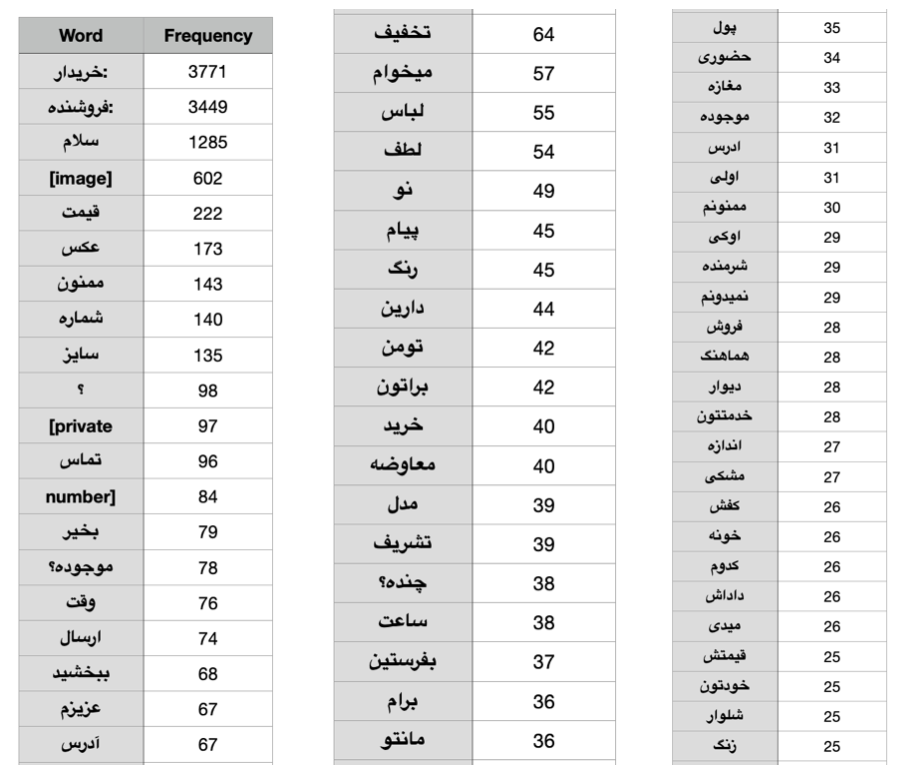
<p>The output CSV file should be something like this:</p>

<p align="center">
<img src="https://alirezasn.ir/files/images/tasks/divar/output_sample.png" width="908" height="778" />
</p>
<p align="center">
Output Sample
</p>

<h3 id="suggested-services">Suggested Services</h3>

<p>The following table shows the suggested services based on important and frequent keywords:</p>

<table>
  <thead>
    <tr>
      <th>Recommended Service Title</th>
      <th>Keywords (translated to English)</th>
    </tr>
  </thead>
  <tbody>
    <tr>
      <td>Payment (or earnest money)</td>
      <td>Price, Discount, Toman, Money, Deposit, Card, Cost, Earnest Money, How Much?, Bill</td>
    </tr>
    <tr>
      <td>Product more details view (PDP)</td>
      <td>Size?, New, Color, Quality, Model, Available?, Black, Centimeter</td>
    </tr>
    <tr>
      <td>Product Delivery</td>
      <td>Delivery, Address, Post, Transmission, Order, City, Home, Fare</td>
    </tr>
    <tr>
      <td>Ad information Completion</td>
      <td>Price, How Much?, Size?, New, Color, Model, Size, Centimeter, Material, Height, Photo</td>
    </tr>
    <tr>
      <td>Navigation</td>
      <td>Address, In-Person, Where?, City, Town, House, Passage</td>
    </tr>
    <tr>
      <td>Photo Selection (OS API)</td>
      <td>Photo, Gallery</td>
    </tr>
    <tr>
      <td>Contact the seller or buyer</td>
      <td>Number, Contact, Phone</td>
    </tr>
    <tr>
      <td>Audio to text conversion</td>
      <td>voice</td>
    </tr>
  </tbody>
</table>

<h3 id="prioritization">Prioritization</h3>

<p>The previous part was just a list of services. According to the task, we should also prioritize which is a challenging matter. I always make a simple formula to prioritize. I select N criterias. I give all of them a score from 1 to 10 (some of them need to be normalized). Then I add the average weight and the job is done. At least, if it is not true, there is some logic behind it. It’s better than gut feeling! Currently, we only have the word frequency variable in the chat here. Other variables such as business impact, technical effort, degree of dependence on each other, approximate cost of operationalization, etc. are among the things that we can consider, but since each of these requires the involvement of a high-ranking stakeholder in the organization which we dont’ have here, Therefore, we cannot use them here. So let’s go to the frequency of repeating keywords of each service and see how much they are used. Finally, the priority of implementing our services will be based on the total frequency. The output of the previous code has a defect, and that is that it calculates the frequency of similar words separately. For example, he gave a number for the word “buy” and for the word “bought” and “buying” Other frequencies, but the point is that we should consider these as one and add their frequencies together. So, I implemented a second script. If you run the <code class="language-plaintext highlighter-rouge">merger.py</code> code, it will create an output file named <code class="language-plaintext highlighter-rouge">output_merged.csv</code> that performs this merging process, and I also defined a configuration to delete those that are repeated below 20 times. In order to increase the output quality of these things in practice, Data Scientists normally use specialized libraries like <code class="language-plaintext highlighter-rouge">NLTK</code> and other things that I didn’t know and didn’t use them. I admit that there are some errors in the outputs, which can be ignored in the scope of this report!</p>

<p>Here is the merging script:</p>

<div class="language-python highlighter-rouge"><div class="highlight"><pre class="highlight"><code><span class="c1"># -*- coding: utf-8 -*-
</span>
<span class="kn">import</span> <span class="nn">csv</span>

<span class="c1">######################################################################
</span>
<span class="n">INPUT_FILE_PATH</span> <span class="o">=</span> <span class="s">'output.csv'</span>
<span class="n">OUTPUT_FILE_PATH</span> <span class="o">=</span> <span class="s">'output_merged.csv'</span>
<span class="n">FREQUENCY_THRESHOLD</span> <span class="o">=</span> <span class="mi">20</span> 

<span class="c1">######################################################################
</span>
<span class="k">def</span> <span class="nf">merge_similar_words</span><span class="p">(</span><span class="n">input_file_path</span><span class="p">):</span>
    <span class="n">word_frequency</span> <span class="o">=</span> <span class="p">{}</span>
    <span class="k">with</span> <span class="nb">open</span><span class="p">(</span><span class="n">input_file_path</span><span class="p">,</span> <span class="s">'r'</span><span class="p">)</span> <span class="k">as</span> <span class="n">csvfile</span><span class="p">:</span>
        <span class="n">reader</span> <span class="o">=</span> <span class="n">csv</span><span class="p">.</span><span class="n">DictReader</span><span class="p">(</span><span class="n">csvfile</span><span class="p">)</span>
        <span class="k">for</span> <span class="n">row</span> <span class="ow">in</span> <span class="n">reader</span><span class="p">:</span>
            <span class="n">word</span> <span class="o">=</span> <span class="n">row</span><span class="p">[</span><span class="s">'Word'</span><span class="p">]</span>
            <span class="n">frequency</span> <span class="o">=</span> <span class="nb">int</span><span class="p">(</span><span class="n">row</span><span class="p">[</span><span class="s">'Frequency'</span><span class="p">])</span>
            <span class="n">found</span> <span class="o">=</span> <span class="bp">False</span>
            <span class="k">for</span> <span class="n">key</span> <span class="ow">in</span> <span class="n">word_frequency</span><span class="p">:</span>
                <span class="k">if</span> <span class="n">word</span> <span class="ow">in</span> <span class="n">key</span> <span class="ow">or</span> <span class="n">key</span> <span class="ow">in</span> <span class="n">word</span><span class="p">:</span>
                    <span class="n">word_frequency</span><span class="p">[</span><span class="n">key</span><span class="p">]</span> <span class="o">+=</span> <span class="n">frequency</span>
                    <span class="n">found</span> <span class="o">=</span> <span class="bp">True</span>
                    <span class="k">break</span>
            <span class="k">if</span> <span class="ow">not</span> <span class="n">found</span><span class="p">:</span>
                <span class="n">word_frequency</span><span class="p">[</span><span class="n">word</span><span class="p">]</span> <span class="o">=</span> <span class="n">frequency</span>
    <span class="k">return</span> <span class="n">word_frequency</span>

<span class="k">def</span> <span class="nf">write_to_csv</span><span class="p">(</span><span class="n">output_file</span><span class="p">,</span> <span class="n">word_freq</span><span class="p">):</span>
    <span class="k">with</span> <span class="nb">open</span><span class="p">(</span><span class="n">output_file</span><span class="p">,</span> <span class="s">'w'</span><span class="p">,</span> <span class="n">newline</span><span class="o">=</span><span class="s">''</span><span class="p">)</span> <span class="k">as</span> <span class="n">csvfile</span><span class="p">:</span>
        <span class="n">writer</span> <span class="o">=</span> <span class="n">csv</span><span class="p">.</span><span class="n">writer</span><span class="p">(</span><span class="n">csvfile</span><span class="p">)</span>
        <span class="n">writer</span><span class="p">.</span><span class="n">writerow</span><span class="p">([</span><span class="s">'Word'</span><span class="p">,</span> <span class="s">'Frequency'</span><span class="p">])</span>
        <span class="k">for</span> <span class="n">word</span><span class="p">,</span> <span class="n">frequency</span> <span class="ow">in</span> <span class="n">word_freq</span><span class="p">.</span><span class="n">items</span><span class="p">():</span>
            <span class="n">writer</span><span class="p">.</span><span class="n">writerow</span><span class="p">([</span><span class="n">word</span><span class="p">,</span> <span class="n">frequency</span><span class="p">])</span>

<span class="c1">######################################################################
</span>
<span class="n">merged_word_freq</span> <span class="o">=</span> <span class="n">merge_similar_words</span><span class="p">(</span><span class="n">INPUT_FILE_PATH</span><span class="p">)</span>
<span class="n">filtered_word_freq</span> <span class="o">=</span> <span class="p">{</span><span class="n">word</span><span class="p">:</span> <span class="n">freq</span> <span class="k">for</span> <span class="n">word</span><span class="p">,</span> <span class="n">freq</span> <span class="ow">in</span> <span class="n">merged_word_freq</span><span class="p">.</span><span class="n">items</span><span class="p">()</span> <span class="k">if</span> <span class="n">freq</span> <span class="o">&gt;=</span> <span class="n">FREQUENCY_THRESHOLD</span><span class="p">}</span>
<span class="n">sorted_word_freq</span> <span class="o">=</span> <span class="nb">dict</span><span class="p">(</span><span class="nb">sorted</span><span class="p">(</span><span class="n">filtered_word_freq</span><span class="p">.</span><span class="n">items</span><span class="p">(),</span> <span class="n">key</span><span class="o">=</span><span class="k">lambda</span> <span class="n">item</span><span class="p">:</span> <span class="n">item</span><span class="p">[</span><span class="mi">1</span><span class="p">],</span> <span class="n">reverse</span><span class="o">=</span><span class="bp">True</span><span class="p">))</span>

<span class="c1">######################################################################
</span>
<span class="n">write_to_csv</span><span class="p">(</span><span class="n">OUTPUT_FILE_PATH</span><span class="p">,</span> <span class="n">sorted_word_freq</span><span class="p">)</span>
<span class="k">print</span><span class="p">(</span><span class="sa">f</span><span class="s">"Merged and sorted word frequency data has been written to </span><span class="si">{</span><span class="n">OUTPUT_FILE_PATH</span><span class="si">}</span><span class="s">"</span><span class="p">)</span>
</code></pre></div></div>

<p>The table below is the sorted table of suggested services based on the frequency of repetition of keywords tagged to each service:</p>

<table>
  <thead>
    <tr>
      <th>Recommended Service Title</th>
      <th>Keywords (translated to English)</th>
      <th>Frequency</th>
    </tr>
  </thead>
  <tbody>
    <tr>
      <td>Ad information Completion</td>
      <td>Price, How Much?, Size?, New, Color, Model, Size, Centimeter, Material, Height, Photo</td>
      <td>1016</td>
    </tr>
    <tr>
      <td>Product more details view (PDP)</td>
      <td>Size?, New, Color, Quality, Model, Available?, Black, Centimeter</td>
      <td>873</td>
    </tr>
    <tr>
      <td>Payment (or earnest money)</td>
      <td>Price, Discount, Toman, Money, Deposit, Card, Cost, Earnest Money, How Much?, Bill</td>
      <td>693</td>
    </tr>
    <tr>
      <td>Product Delivery</td>
      <td>Delivery, Address, Post, Transmission, Order, City, Home, Fare</td>
      <td>414</td>
    </tr>
    <tr>
      <td>Contact the seller or buyer</td>
      <td>Number, Contact, Phone</td>
      <td>410</td>
    </tr>
    <tr>
      <td>Photo Selection (OS API)</td>
      <td>Photo, Gallery</td>
      <td>320</td>
    </tr>
    <tr>
      <td>Navigation</td>
      <td>Address, In-Person, Where?, City, Town, House, Passage</td>
      <td>255</td>
    </tr>
    <tr>
      <td>Audio to text conversion</td>
      <td>voice</td>
      <td>21</td>
    </tr>
  </tbody>
</table>

<h3 id="evaluation">Evaluation</h3>

<p>After we implemented and functionally tested one or more of these suggested services and finally released them, We have to montitor them. We can do a series of qualitative and quantitative work to evaluate feature adoption:</p>

<ul>
  <li>
    <p>Quantitative work: in order to know whether the released service is working properly or not, we can deal a bit with data! This is both from a technical point of view (for example, check <code class="language-plaintext highlighter-rouge">Sentry</code> Log or <code class="language-plaintext highlighter-rouge">Crashlytics</code> to see if the system is stable or not) and from a product and business point of view. For example, do some CRO (conversion rate optimization) to see how much drop we have on each funnel in the considered journey(s) and Those who have a drop that doesn’t fit with reason, what is the reason (we have to combine it with the qualitative work that I will say below). The survey is also the answer for those who went to the end of the funnel. Of course, there is a challenge because here we are dealing with external services and we don’t have any data about their funnels either. As a result, we have to have continuous interaction with them here.</p>
  </li>
  <li>
    <p>Qualititative work: In the previous part, when we came to the conclusion that a funnel is not working well, here it comes the qualititative work.We have to take out a sample of those who got stuck in each funnel and see what was their pain that got them stuck. Or at all, those who we showed the options to but did not use, we have to ask them what was the reason.</p>
  </li>
</ul>

<p>The evaluation output should become a series of actions to take and improve the product in next iterations.</p>]]></content><author><name>Alireza Sadeghi-Nasab</name><email>sadeghinasab.alireza@gmail.com</email></author><category term="interview-task" /><category term="product-discovery" /><category term="product-delivery" /><category term="data-analytics" /><category term="prioritization" /><category term="product-metrics" /><summary type="html"><![CDATA[Preface Some time ago, Divar Company announced a task for the entrance interview for one of its positions, which I prepared in 4 days and sent to them. My answer to this task made me pass the first stage and reach the interview. In this post, I will explain about this task.]]></summary></entry><entry><title type="html">Case Study: Pomodoro Timer Application</title><link href="//alirezasn.ir/posts/2023/09/post-17/" rel="alternate" type="text/html" title="Case Study: Pomodoro Timer Application" /><published>2023-09-01T00:00:00-07:00</published><updated>2023-09-01T00:00:00-07:00</updated><id>//alirezasn.ir/posts/2023/09/blog-post-17</id><content type="html" xml:base="//alirezasn.ir/posts/2023/09/post-17/"><![CDATA[<h1 id="preface">Preface</h1>
<p>The Pomodoro Technique is a time management method developed by Francesco Cirillo in the late 1980s. The technique is designed to help improve focus, productivity, and overall work efficiency by breaking work into focused intervals, followed by short breaks. The name “Pomodoro” (Italian for “tomato”) was inspired by the tomato-shaped kitchen timer that Cirillo initially used to track his work intervals. In this post, I’ll investigate and add a feature to <a href="https://play.google.com/store/apps/details?id=com.pomodrone.app&amp;hl=en&amp;gl=US">Pomodoro Timer Application</a>.</p>

<h2 id="what-is-the-pomodoro-technique">What is the Pomodoro Technique?</h2>

<p>The Pomodoro Technique is a time management method developed by Francesco Cirillo in the late 1980s. The technique is designed to help improve focus, productivity, and overall work efficiency by breaking work into focused intervals, followed by short breaks. The name “Pomodoro” (Italian for “tomato”) was inspired by the tomato-shaped kitchen timer that Cirillo initially used to track his work intervals.</p>

<p>Here’s how the Pomodoro Technique works:</p>

<ul>
  <li>
    <p>Choose a Task: Select a task or project that you want to work on.</p>
  </li>
  <li>
    <p>Set a Timer: Set a timer for a specific interval, traditionally 25 minutes, which is known as a “Pomodoro.” During this time, you focus solely on the chosen task and work on it with full concentration.</p>
  </li>
  <li>
    <p>Work: Work on the task until the timer goes off. Avoid distractions and interruptions during this period.</p>
  </li>
  <li>
    <p>Take a Short Break: Once the Pomodoro timer rings, take a short break of about 5 minutes. This break allows you to relax and recharge.</p>
  </li>
  <li>
    <p>Repeat: After the break, start another Pomodoro by setting the timer again and continuing to work on the task.</p>
  </li>
  <li>
    <p>Longer Break: After completing a set number of Pomodoros (usually four), take a longer break of around 15 to 30 minutes. This longer break helps prevent burnout and allows for deeper relaxation.</p>
  </li>
</ul>

<p>The Pomodoro Technique follows the cycle of focused work intervals followed by short breaks. The idea is to maintain high levels of focus and productivity during the work intervals, knowing that a break is coming up. This technique leverages the principles of time blocking and provides a structured way to manage your work time effectively.</p>

<p>Key benefits of the Pomodoro Technique include:</p>

<ul>
  <li>
    <p>Improved focus and concentration.</p>
  </li>
  <li>
    <p>Enhanced productivity and efficiency.</p>
  </li>
  <li>
    <p>Regular breaks that can prevent burnout and mental fatigue.</p>
  </li>
  <li>
    <p>Increased awareness of how time is spent on tasks.</p>
  </li>
  <li>
    <p>The technique is adaptable and can be customized based on personal preferences and work habits.</p>
  </li>
</ul>

<p>While the traditional Pomodoro interval is 25 minutes, you can adjust the intervals to suit your working style and the nature of the tasks. Many digital tools and apps are available to help individuals implement the Pomodoro Technique and manage their work and breaks more efficiently.</p>

<h2 id="pomodoro-timer-product-review">Pomodoro Timer Product Review</h2>

<p>The product is a very light and simple implementation for implementing the Pomodoro technique. In this section, we will review its features:</p>

<ol>
  <li>
    <p>Displaying the onboarding pages: As soon as the program is opened for the first time, 6 onboarding pages are displayed to the user as a slide. The purpose of displaying these pages is to familiarize with the Pomodoro technique.</p>
  </li>
  <li>
    <p>Timer display: This product contains 2 pages in total. On the first page (main page) the Pomodoro timer is shown and in the lower part of it, you can simply specify whether this timer is for a short, long break or to complete a task. The product timer, similar to the timer of other products, includes the functions of stopping and resetting.</p>
  </li>
  <li>
    <p>Settings: On another page of this product, the user can change the settings related to the product. As it was said in the introduction, this technique has the ability to be personalized and the reason why such a part is embedded will also be mentioned. The settings on this page generally include two categories of specific settings related to the Pomodoro technique and specific product settings, each of which I will explain:</p>

    <ol>
      <li>
        <p>Time interval settings: In this section, the user can set the task timer, short break time, and long break time by setting a numerical value.</p>
      </li>
      <li>
        <p>Color theme: In this section, the user can set the background color theme of the application from among the predefined colors.</p>
      </li>
      <li>
        <p>Sound theme: In this section, the user can specify whether the sound played after the end of each timer is an alarm sound or a notification. By choosing each option, the sound of each one is also played so that the user can better choose an option depending on his taste. By default, the alarm sound is selected.</p>
      </li>
      <li>
        <p>Other settings: These settings include the following:</p>

        <ol>
          <li>
            <p>Ability to set the number of pomodoros up to a long break (default is 4)</p>
          </li>
          <li>
            <p>Ability to set daily goal (default is 8)</p>
          </li>
          <li>
            <p>Ability to vibrate after each timer ends (default is active)</p>
          </li>
          <li>
            <p>Ability to automatically start breaks (default is enabled)</p>
          </li>
          <li>
            <p>Ability to automatically start pomodoros (default is disabled)</p>
          </li>
          <li>
            <p>Ability to display notifications (default disabled)</p>
          </li>
          <li>
            <p>Ability to keep the phone screen on (default is active)</p>
          </li>
        </ol>
      </li>
      <li>
        <p>Other things: In the footer section of the program, there are 3 functions that are not related to the settings, but are included in this page:</p>

        <ol>
          <li>
            <p>Rating the app (via Google Play or the internal stores of the mobile phone manufacturer)</p>
          </li>
          <li>
            <p>Ability to send comments via email</p>
          </li>
          <li>
            <p>Getting to know the program and how to use it (which shows the same onboarding pages)</p>
          </li>
        </ol>
      </li>
    </ol>
  </li>
</ol>

<h2 id="data-collection-and-review-to-understand-the-quality-of-user-experience">Data Collection and Review to Understand the Quality of User Experience</h2>

<p>The following data may be stored and reviewed in order to understand the quality of users’ experience. The use of each data is written in front of it:</p>

<ul>
  <li>
    <p>User feedback: In order to understand the level of user satisfaction and their requested improvement points</p>
  </li>
  <li>
    <p>Recorded crashes: in order to understand the stability of the program and fix problematic points</p>
  </li>
  <li>
    <p>User preferences values: In order to optimize the default values</p>
  </li>
  <li>
    <p>The number and length of user sessions: in order to understand the general usage habits of users and their level of engagement</p>
  </li>
  <li>
    <p>Abandonment rate: In order to understand potential usability problems.</p>
  </li>
  <li>
    <p>Number of Daily Goals Completed: To understand how productive users are</p>
  </li>
</ul>

<h2 id="investigating-a-web-tool-for-analytical-data-collection-and-analysis">Investigating a Web tool for Analytical Data Collection and Analysis</h2>

<p>In order to collect and analyze analytical data, the Google Analytics tool is recommended because it is both free and all the data from the previous section can be collected and checked with it. In general, the following 4 categories can be done with this tool, which are useful for understanding the user experience:</p>

<ul>
  <li>
    <p>Event tracking: for example session exit rate, configuration values, timer start and end times</p>
  </li>
  <li>
    <p>Duration of each session: It is done automatically in this tool</p>
  </li>
  <li>
    <p>Setting goals and tracking conversions: You can set and monitor goals and conversions in this tool in a personalized way, for example, the number of completed Pomodoro sessions.</p>
  </li>
  <li>
    <p>User behavior analysis: This is also done automatically in this tool. For example, demographic and user behavior flow reports</p>
  </li>
</ul>

<h2 id="analysis-and-design-of-a-feature">Analysis and Design of a Feature</h2>

<p>According to the metrics mentioned in the second part, the following features can be added to the application. Most of these features are obtained by comparing competitors. The metric directly related to the feature is written:</p>

<ul>
  <li>
    <p>Ability to create and share tasks with colleagues -&gt; increase engagement and number of users</p>
  </li>
  <li>
    <p>Ability to count user streaks and share them -&gt; increase engagement</p>
  </li>
  <li>
    <p>Ability to integrate with calendar or ToDo-List services -&gt; increase engagement and number of users</p>
  </li>
  <li>
    <p>Ability to view your statistics such as progress -&gt; increase engagement and productivity</p>
  </li>
  <li>
    <p>Ability to integrate with background sounds and songs -&gt; increase engagement and productivity</p>
  </li>
  <li>
    <p>Ability to define challenge and achievement in order to motivate the user -&gt; increase engagement</p>
  </li>
</ul>

<p>Feature number 2 (counting user streaks and its sharing) has been selected for analysis and design. It should be noted that this feature can be analyzed and implemented both on a heavy scale, which requires the definition of the user concept and the implementation of the prerequisites on the service side, and it can also be considered on a light scale, which is only stored locally in the app. In this report, only the light scale is investigated.</p>

<ul>
  <li>
    <p>Feature Name: Ability to record and share user streaks</p>
  </li>
  <li>
    <p>Cause and Purpose: This gamification feature creates a sense of accomplishment and uses psychology to maintain habits. The visual display and sharing of this feature and its records helps maintain and increase streaks and gives a sense of satisfaction to the user. It also encourages users to use the app continuously and increases their engagement.</p>
  </li>
  <li>
    <p>Target group: all application users</p>
  </li>
  <li>
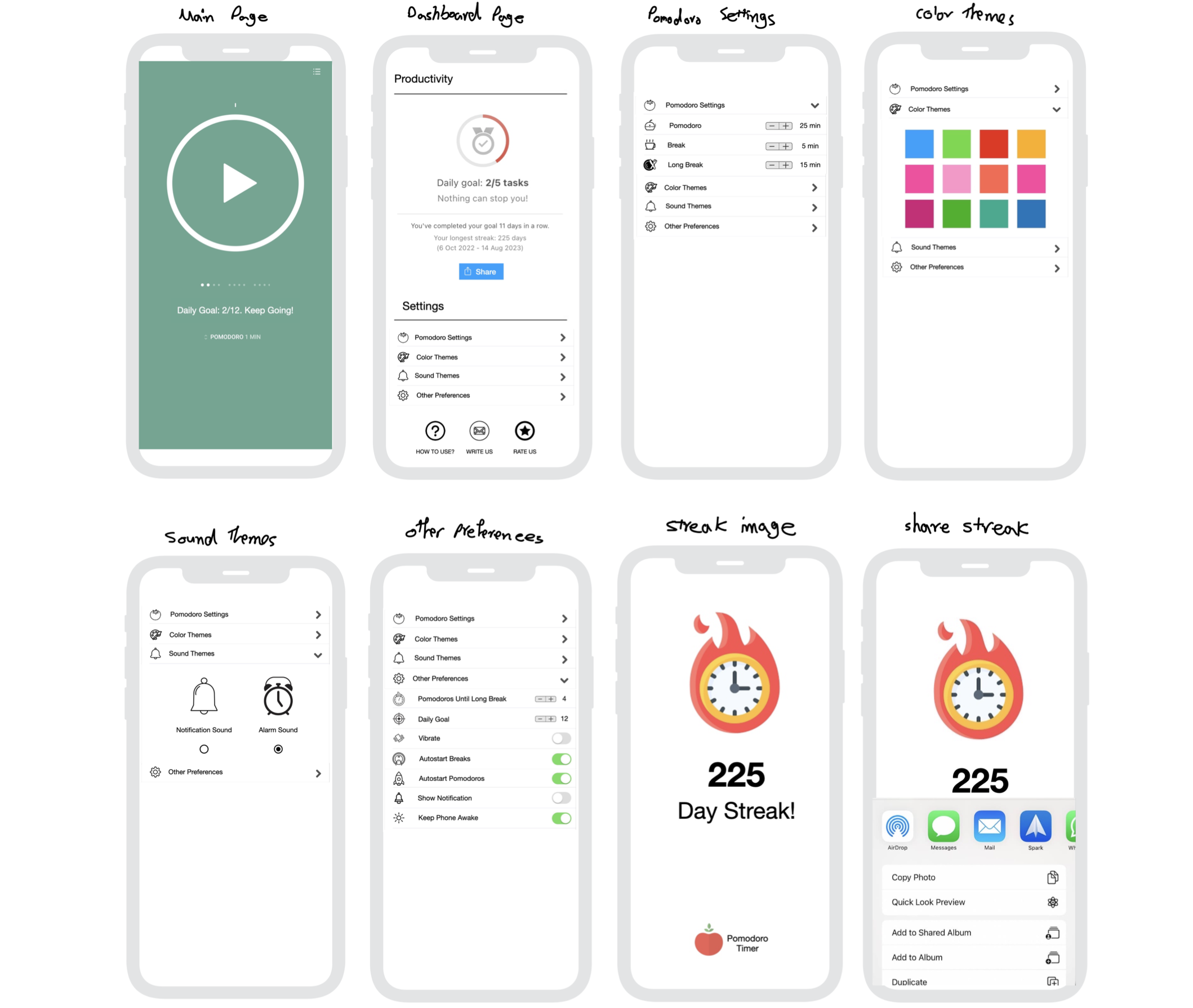
    <p>Feature Description: According to the following designs, both the home page and the settings will be changed, the description of which is as follows:</p>

    <ul>
      <li>
        <p>On the main page, the number of remaining daily goals is notified to the user, just according to the displayed text. No action is defined on this text and it only has a display aspect on the user’s side.</p>
      </li>
      <li>
        <p>In the settings page, a general redesign is done and this page is changed from just displaying settings to a multi-user page. According to the design, in the first section, the amount of the daily goal is achieved and the user’s remaining as well as his maximum streak along with its historical period are displayed. The streak calculation method is that if the user completes his daily goals for 2 or more consecutive days, the start and end intervals are stored locally on the device, and if the number of days in a row increases, the stored end date is updated. The amount of the streak is also obtained in a simple way from the difference between the end date and the beginning date. If the user does not reach his daily goal in one day, that streak will end and the streak number will be zero. Now, if the terminated streak has more days than the previously terminated streak, that streak will be stored and displayed as the maximum streak recorded by the user.</p>
      </li>
      <li>
        <p>If the user taps the max share button of the streak, an image matching the attached image is created and the user can share it. The panel that is displayed for sharing is the default panel of the operating system.</p>
      </li>
      <li>
        <p>According to the explanations given regarding the redesign of the settings page, the settings items with the same categories as before are displayed in the new implementation in the form of expand &amp; collapse. This task will not change the functional logic of any of the settings.</p>
      </li>
    </ul>
  </li>
  <li>
    <p>Designs: According to the explanations given in the previous section, the designs will be as follows:</p>
  </li>
</ul>

<p align="center">
<img src="https://alirezasn.ir/files/images/tasks/pomodoro/designs.png" width="2000" height="1690" />
</p>
<p align="center">
Pomodoro Designs
</p>

<p>It should be noted that the designs were designed with the style guide of the iOS platform, but they can be easily converted to the Android style guide.</p>

<ul>
  <li>Task estimate: The estimate for this feature is according to the following table:</li>
</ul>

<table>
  <thead>
    <tr>
      <th>SubTask Title</th>
      <th>Platform</th>
      <th>Estimate (in hours)</th>
    </tr>
  </thead>
  <tbody>
    <tr>
      <td>Display text on the main page</td>
      <td>Android</td>
      <td>2</td>
    </tr>
    <tr>
      <td>implementation of streak (logic and display)</td>
      <td>Android</td>
      <td>15</td>
    </tr>
    <tr>
      <td>Ability to share the maximum streak</td>
      <td>Android</td>
      <td>12</td>
    </tr>
    <tr>
      <td>Redesign application settings</td>
      <td>Android</td>
      <td>20</td>
    </tr>
    <tr>
      <td><strong>Total</strong></td>
      <td>–</td>
      <td>49</td>
    </tr>
  </tbody>
</table>

<p>It is noted again that the scope of changes of this feature has only been seen on the client side (Android) and the review and analysis on the scope service (backend) or other platforms has been avoided. It should also be noted that the above numbers are considered for a mid-level developer, and if you have a junior or senior developer, these numbers will be multiplied. It should be noted that these numbers are only a rough estimate of the product manager, and finally, the final numbers will be received and recorded from the developer in the estimation session before the start of the sprint. According to the total recorded estimates (49 hours), it is possible to implement and test this feature in a normal two-week sprint.</p>

<h2 id="conclusion">Conclusion</h2>

<p>Considering that a user story must be INVEST, considering its independence, it can be said that the story analyzed in the settings section has many complications and can be considered as its negative point. If, for example, we have limited development resources or time to market, this feature can be enabled by placing a medal or trophy icon next to the settings icon and tapping on it will show the exact same productivity section in a popup. and so, in this way, the settings page remains unchanged.</p>]]></content><author><name>Alireza Sadeghi-Nasab</name><email>sadeghinasab.alireza@gmail.com</email></author><category term="design-analysis" /><category term="product-discovery" /><category term="product-delivery" /><category term="estimation" /><category term="user-story" /><category term="product-metrics" /><summary type="html"><![CDATA[Preface The Pomodoro Technique is a time management method developed by Francesco Cirillo in the late 1980s. The technique is designed to help improve focus, productivity, and overall work efficiency by breaking work into focused intervals, followed by short breaks. The name “Pomodoro” (Italian for “tomato”) was inspired by the tomato-shaped kitchen timer that Cirillo initially used to track his work intervals. In this post, I’ll investigate and add a feature to Pomodoro Timer Application.]]></summary></entry><entry><title type="html">Harnessing the Power of C4 Model for Knowledge Management in Organizations: A Comprehensive Guide</title><link href="//alirezasn.ir/posts/2023/06/post-16/" rel="alternate" type="text/html" title="Harnessing the Power of C4 Model for Knowledge Management in Organizations: A Comprehensive Guide" /><published>2023-06-24T00:00:00-07:00</published><updated>2023-06-24T00:00:00-07:00</updated><id>//alirezasn.ir/posts/2023/06/blog-post-16</id><content type="html" xml:base="//alirezasn.ir/posts/2023/06/post-16/"><![CDATA[<h1 id="preface">Preface</h1>
<p>In today’s fast-paced business environment, effective knowledge management is crucial for organizations to stay ahead of the curve. One approach that has gained traction in recent years is the C4 Model, a visual notation technique for software architecture. In this blog post, we will explore the C4 Model, its components, and how it can be applied to manage knowledge within an organization. By the end of this comprehensive guide, you will have a better understanding of the C4 Model and its potential use cases in knowledge management.</p>

<h2 id="what-is-the-c4-model">What is the C4 Model?</h2>

<p>The C4 Model, developed by Simon Brown, is a hierarchical approach to visualizing software architecture. It consists of four levels of abstraction, each focusing on a different aspect of the system:</p>

<ol>
  <li>
    <p><strong>Context:</strong> This level provides a high-level view of the system, its users, and external dependencies. It helps stakeholders understand the system’s purpose and scope.</p>
  </li>
  <li>
    <p><strong>Containers:</strong> This level zooms in on the system’s components, such as web applications, databases, and microservices. It shows how these components interact and communicate with each other.</p>
  </li>
  <li>
    <p><strong>Components:</strong> This level dives deeper into the containers, breaking them down into smaller, more manageable parts. It highlights the relationships between these parts and their responsibilities.</p>
  </li>
  <li>
    <p><strong>Code:</strong> The final level focuses on the implementation details, such as classes, interfaces, and functions. It provides a granular view of the system’s inner workings.</p>
  </li>
</ol>

<h2 id="using-the-c4-model-for-knowledge-management">Using the C4 Model for Knowledge Management</h2>

<p>Now that we have a basic understanding of the C4 Model let’s explore how it can be applied to knowledge management within an organization.</p>

<h3 id="context-defining-the-knowledge-landscape">Context: Defining the Knowledge Landscape</h3>

<p>The first step in using the C4 Model for knowledge management is to create a context diagram that outlines the organization’s knowledge landscape. This includes identifying the various sources of knowledge, such as documents, databases, and human expertise, as well as the stakeholders who interact with this knowledge, such as employees, customers, and partners.</p>

<p>By visualizing the knowledge landscape, organizations can gain a better understanding of the flow of information and identify potential bottlenecks or gaps in knowledge sharing. This high-level view also helps stakeholders align their goals and expectations, ensuring that everyone is on the same page.</p>

<p>To create a context diagram, organizations can use tools like draw.io, Lucidchart, or Microsoft Visio. These tools allow users to create visual representations of the knowledge landscape, including the various sources of knowledge and the stakeholders who interact with them.</p>

<h3 id="containers-organizing-knowledge-repositories">Containers: Organizing Knowledge Repositories</h3>

<p>The next step is to create a container diagram that represents the organization’s knowledge repositories. These repositories can include wikis, document management systems, intranets, and other tools used to store and share information.</p>

<p>The container diagram should illustrate how these repositories interact and communicate with each other, as well as their relationships with the stakeholders identified in the context diagram. This helps organizations identify redundancies, streamline their knowledge management processes, and ensure that information is easily accessible to those who need it.</p>

<p>When creating a container diagram, organizations should consider the following factors:</p>

<ul>
  <li>
    <p>The types of knowledge repositories used within the organization</p>
  </li>
  <li>
    <p>The relationships between these repositories (e.g., how they share information or collaborate)</p>
  </li>
  <li>
    <p>The access controls and permissions for each repository (e.g., who can view, edit, or delete information)</p>
  </li>
</ul>

<h3 id="components-breaking-down-knowledge-assets">Components: Breaking Down Knowledge Assets</h3>

<p>With the knowledge repositories in place, organizations can now focus on breaking down their knowledge assets into smaller, more manageable components. This can include categorizing documents, tagging content with relevant metadata, and creating knowledge maps that outline the relationships between different pieces of information.</p>

<p>By breaking down knowledge assets into components, organizations can make it easier for employees to find and access the information they need, reducing the time spent searching for answers and increasing overall productivity.</p>

<p>To break down knowledge assets into components, organizations can use techniques such as:</p>

<ul>
  <li>
    <p>Taxonomies: Create a hierarchical classification system for organizing documents and other knowledge assets based on their content, purpose, or other relevant criteria.</p>
  </li>
  <li>
    <p>Metadata: Add descriptive information to knowledge assets, such as keywords, categories, or author names, to make them more easily discoverable.</p>
  </li>
  <li>
    <p>Knowledge maps: Develop visual representations of the relationships between different pieces of information, helping employees understand how different knowledge assets are connected.</p>
  </li>
</ul>

<h3 id="code-implementing-knowledge-management-best-practices">Code: Implementing Knowledge Management Best Practices</h3>

<p>The final step in applying the C4 Model to knowledge management is to implement best practices at the code level. This can include adopting standardized naming conventions, creating templates for common document types, and implementing version control systems to track changes to knowledge assets.</p>

<p>By focusing on the details at the code level, organizations can ensure that their knowledge management processes are consistent, efficient, and easy to maintain.</p>

<p>Some best practices to consider when implementing knowledge management at the code level include:</p>

<ul>
  <li>
    <p>Standardized naming conventions: Establish a consistent naming scheme for documents and other knowledge assets, making it easier for employees to locate and identify relevant information.</p>
  </li>
  <li>
    <p>Templates: Create templates for common document types, such as meeting minutes, project plans, or technical specifications, to ensure consistency and streamline the creation process.</p>
  </li>
  <li>
    <p>Version control: Implement version control systems, such as Git or Subversion, to track changes to knowledge assets and maintain a history of revisions.</p>
  </li>
</ul>

<h2 id="conclusion">Conclusion</h2>

<p>The C4 Model, while originally designed for software architecture, can be a powerful tool for managing knowledge within an organization. By applying the principles of the C4 Model to knowledge management, organizations can create a clear, structured, and efficient approach to storing, sharing, and accessing information.</p>

<p>By defining the knowledge landscape, organizing repositories, breaking down assets, and implementing best practices, organizations can harness the power of the C4 Model to improve their knowledge management processes and ultimately drive better decision-making, innovation, and growth.</p>

<p align="center">
<img src="https://c4model.com/img/c4-overview.png" width="800" height="450" />
</p>
<p align="center">
photo from <a href="https://c4model.com">c4model.com</a>
</p>]]></content><author><name>Alireza Sadeghi-Nasab</name><email>sadeghinasab.alireza@gmail.com</email></author><category term="C4-model" /><category term="knowledge-management" /><category term="organizational-knowledge" /><category term="software-architecture" /><category term="collaboration" /><summary type="html"><![CDATA[Preface In today’s fast-paced business environment, effective knowledge management is crucial for organizations to stay ahead of the curve. One approach that has gained traction in recent years is the C4 Model, a visual notation technique for software architecture. In this blog post, we will explore the C4 Model, its components, and how it can be applied to manage knowledge within an organization. By the end of this comprehensive guide, you will have a better understanding of the C4 Model and its potential use cases in knowledge management.]]></summary></entry><entry><title type="html">Courses I have Attended so far [Constantly updating …]</title><link href="//alirezasn.ir/posts/2023/03/post-14/" rel="alternate" type="text/html" title="Courses I have Attended so far [Constantly updating …]" /><published>2023-03-25T00:00:00-07:00</published><updated>2023-03-25T00:00:00-07:00</updated><id>//alirezasn.ir/posts/2023/03/blog-post-14</id><content type="html" xml:base="//alirezasn.ir/posts/2023/03/post-14/"><![CDATA[<h1 id="preface">Preface</h1>
<p>When it comes to personal development, education is one of the most valuable investments one can make. Attending a course may seem like a small undertaking, but it can have a profound impact on a person’s personal and professional growth. There are numerous benefits to participating in courses ranging from acquiring new skills to networking opportunities. Courses can help individuals to increase their knowledge, enhance their credibility, and boost their career prospects. In this fast-paced world, individuals who are willing to learn and adapt have a competitive edge, and attending a course is one of the best ways to do so. Here, I listed the courses i’ve attended so far.</p>

<h2 id="1-digital-product-management">1. Digital Product Management</h2>

<p>👨‍🏫 Institute: <a href="https://bozhan.school">Bozhan School</a></p>

<p>🔬 Type: In-Person &amp; Online</p>

<p>⏱ Duration: ~5 months</p>

<p>🗣 Language: Persian</p>

<p>The Digital Product Management course offered by Bozhan School is a comprehensive program designed to provide participants with a broad range of skills and knowledge required to succeed as a product manager in the digital industry. The course is conducted by experienced professionals who have years of experience in digital product management, and covers topics such as product strategy, user research, product development, product marketing, and analytics. Through interactive learning activities such as case studies, group projects, and real-world simulations, participants will gain hands-on experience in managing digital products. Upon completion of the program, participants will be equipped with the essential tools and best practices needed to manage the product lifecycle from ideation to launch, as well as analyze and optimize digital products for long term success. Whether you have experience in digital product management or are looking to transition into the field, this course is an excellent opportunity to gain the knowledge and skills necessary to excel in your career.</p>

<p>🌐 Click <a href="https://bozhan.school/courses/productmanagement/">HERE</a> to see more information about the course.</p>

<h2 id="2-introduction-to-product-management">2. Introduction to Product Management</h2>

<p>👨‍🏫 Institute: <a href="https://maktabkhooneh.org">MaktabKhooneh</a></p>

<p>🔬 Type: Online</p>

<p>⏱ Duration: ~26h</p>

<p>🗣 Language: Persian</p>

<p>Product management is an interdisciplinary field and job that requires the acquisition of sufficient knowledge and skills. In addition, changes in the business environment and technology happen at a high speed and there are not enough educational resources available. What should be done in such a situation? How can you get acquainted with the modern and practical science of management and start working as a product manager?</p>

<p>In this section, we are going to introduce the product management training course and then explain the benefits of participating in the training courses for you, our regular companions and science lovers. If you are thinking of learning management skills and role-playing in the field of technology and production, marketing and business and product strategies, stay with us until the end of the content and follow the product management training course.
In this article, as a supplement to the product management training course, we first give a general definition of product management. Then we will get acquainted with the basic concepts of this field of work and finally we will tell you what topics will be examined at the end of the product management training course and what concepts will be mastered by the participants in this class of training courses.</p>

<p>🌐 Click <a href="https://maktabkhooneh.org/course/آموزش-مقدماتی-مدیریت-محصول-mk784/#property">HERE</a> to see more information about the course.</p>

<h2 id="3-product-management-fundamentals">3. Product Management Fundamentals</h2>

<p>👨‍🏫 Institute: <a href="https://www.oreilly.com">OReilly</a></p>

<p>🔬 Type: Online</p>

<p>⏱ Duration: ~1h 20m</p>

<p>🗣 Language: English</p>

<p>Positioned at the intersection of business, design, and technology, product management has emerged as one of the most critical business roles of the 21st century. But what does a product manager actually do? What impact can a great product manager have on an organization? And how do you know what makes a product manager great in the first place? This video covers the fundamentals of product management—what it is, who does it, and how it varies from organization to organization. It offers a new model for understanding the communication, organization, research and execution (CORE) connective skills of product management and provides actionable guidelines for succeeding in product management in any organization of any size.</p>

<ul>
  <li>
    <p>Understand the key responsibilities and CORE connective skills of product management</p>
  </li>
  <li>
    <p>Discover the ways different organizations describe and structure the product management role</p>
  </li>
  <li>
    <p>Explore the critical differences between product management “in theory” and “on-the-ground”</p>
  </li>
  <li>
    <p>Master the principles that guide successful product management</p>
  </li>
</ul>

<p>🌐 Click <a href="https://www.oreilly.com/library/view/product-management-fundamentals/9781491989760/">HERE</a> to see more information about the course.</p>

<h2 id="4-communicating-with-confidence">4. Communicating with Confidence</h2>

<p>👨‍🏫 Institute: <a href="https://www.linkedin.com/learning/">LinkedIn</a></p>

<p>🔬 Type: Online</p>

<p>⏱ Duration: ~1h 16m</p>

<p>🗣 Language: English</p>

<p>Most people are afraid of speaking in public, but effective oral communication is a key skill in business. Jeff Ansell provides simple communication tools, strategies, and tips that are easy to use and produce immediate results. He’ll help you sound more confident, use body and language to better express ideas, and overcome anxiety. In the last chapter of the course, all these concepts are brought together in two real-world coaching exercises that will help you see the techniques in action.</p>

<p>🌐 Click <a href="https://www.linkedin.com/learning/communicating-with-confidence">HERE</a> to see more information about the course.</p>

<h2 id="5-agile-foundations">5. Agile Foundations</h2>

<p>👨‍🏫 Institute: <a href="https://www.linkedin.com/learning/">LinkedIn</a></p>

<p>🔬 Type: Online</p>

<p>⏱ Duration: ~1h 35m</p>

<p>🗣 Language: English</p>

<p>Teams that embrace an agile mindset are often better able to respond to customer feedback and shifting business needs—and have a bit more fun in the process. Interested in bringing the principles of agile to your team? This course can help. Join Doug Rose as he steps through the fundamental concepts you need to know to start thinking like an agile team. Doug goes over the values and principles covered in the agile manifesto, as well as how to enhance communication with user stories and cross-functional teams. Discover how to respond to change the agile way, explore popular agile frameworks, and learn about the common roles on an agile team. Along the way, Doug provides you with some exercises that can help boost your team’s agility and productivity.</p>

<p>🌐 Click <a href="https://www.linkedin.com/learning/agile-foundations">HERE</a> to see more information about the course.</p>

<h2 id="6-becoming-a-great-product-owner">6. Becoming a Great Product Owner</h2>

<p>👨‍🏫 Institute: <a href="https://www.pluralsight.com">Pluralsight</a></p>

<p>🔬 Type: Online</p>

<p>⏱ Duration: ~58m</p>

<p>🗣 Language: English</p>

<p>Have you ever wondered how you can communicate more effectively with your team? In this course, Becoming a Great Product Owner, you’ll learn how you can better collaborate with your team so you can be sure that you and your team are working together as effectively as possible.</p>

<p>First, you’ll learn the basics of Product Ownership and how your role as a Product Owner fits into the context of a broader agile team. Next, you’ll discover why the Product Owner is often the best suited in the organization to identify untapped opportunities to create business value as well as the importance of communicating those opportunities effectively to the rest of the organization. Finally, you’ll learn techniques for encouraging better communication and collaboration with your team, so you can be sure that the best ideas are always brought to the table.</p>

<p>When you’re finished with this course, you’ll have the skills and knowledge of Product Ownership needed to help your team bring the best possible product to market.</p>

<p>🌐 Click <a href="https://www.pluralsight.com/courses/becoming-great-product-owner">HERE</a> to see more information about the course.</p>

<h2 id="7-getting-started-with-remote-product-management">7. Getting Started with Remote Product Management</h2>

<p>👨‍🏫 Institute: <a href="https://www.pluralsight.com">Pluralsight</a></p>

<p>🔬 Type: Online</p>

<p>⏱ Duration: ~1h 11m</p>

<p>🗣 Language: English</p>

<p>Thousands of companies were forced to work remotely due to global health conditions. Most of these companies were caught off-guard and were not equipped to make the new set-up work. In this course, Getting Started with Remote Product Management, you’ll learn how to adapt to this new way of working. First, you’ll take a look at your old routine and identify how to tweak it to suit your new work set-up. Next, you’ll see how you can make sure that collaboration and communication for product development is done effectively even when working remotely. Lastly, you’ll learn how to manage yourself - how to be disciplined and ensure your personal wellness when working from home. When you’re finished with this course, you will be able to effectively bridge the gap between business and tech through the new and altered processes and work dynamics of working remotely.</p>

<p>🌐 Click <a href="https://www.pluralsight.com/courses/remote-product-management-getting-started">HERE</a> to see more information about the course.</p>

<h2 id="8-scrum-product-backlog-management-the-essentials">8. Scrum Product Backlog Management The Essentials</h2>

<p>👨‍🏫 Institute: <a href="https://www.skillshare.com/en/">Skillshare</a></p>

<p>🔬 Type: Online</p>

<p>⏱ Duration: ~17m</p>

<p>🗣 Language: English</p>

<p>A class on how to manage the Product Backlog in Scrum effectively. Basic knowledge of Scrum is helpful.</p>

<p>You will learn how to:</p>

<ul>
  <li>
    <p>Discover user stories (high level and detailed)</p>
  </li>
  <li>
    <p>Create an initial product backlog, based on a product vision</p>
  </li>
  <li>
    <p>Prioritize and refine the product backlog</p>
  </li>
  <li>
    <p>Plan the sprint</p>
  </li>
  <li>
    <p>Deal with the backlog during and after the sprint</p>
  </li>
</ul>

<p>Not only will you learn the theoretical concepts of Product Backlog Management – the class explains all concepts by following a coherent example.</p>

<p>🌐 Click <a href="https://www.skillshare.com/en/classes/Scrum-Product-Backlog-Management-The-Essentials/1683336147">HERE</a> to see more information about the course.</p>

<h2 id="9-unconscious-bias">9. Unconscious Bias</h2>

<p>👨‍🏫 Institute: <a href="https://www.linkedin.com/learning/">LinkedIn</a></p>

<p>🔬 Type: Online</p>

<p>⏱ Duration: ~28m</p>

<p>🗣 Language: English</p>

<p>To some degree, we are all biased. Our experiences shape who we are, and our dimensions of diversity—race, ethnicity, gender, height, weight, sexual orientation, place of birth, and other factors—impact the lens through which we view the world. In this course, through compelling examples that explore the most common forms of unconscious bias and its implications, diversity expert Stacey Gordon teaches you to recognize and acknowledge your own biases when making decisions, engaging with colleagues, and working effectively in today’s organizations. Stacey reveals the most common forms of unconscious bias—affinity bias, halo bias, perception bias, confirmation bias, and group think—and teaches you the skills to effectively address them.</p>

<p>Learning objectives</p>

<ul>
  <li>
    <p>Recognize when unconscious bias occurs and why it’s important to understand.</p>
  </li>
  <li>
    <p>Explore how unconscious bias is relevant in the business worlds.</p>
  </li>
  <li>
    <p>Identify three strategies to counteract potential unconscious bias.</p>
  </li>
  <li>
    <p>Define confirmation bias.</p>
  </li>
  <li>
    <p>Review the meaning of the Halo Effect.</p>
  </li>
  <li>
    <p>Explore the effects groupthink can have in a professional setting.</p>
  </li>
</ul>

<p>🌐 Click <a href="https://www.linkedin.com/learning/unconscious-bias-14822310/why-identify-your-bias?autoplay=true">HERE</a> to see more information about the course.</p>

<h2 id="10-agile-foundations">10. Agile Foundations</h2>

<p>👨‍🏫 Institute: <a href="https://www.oreilly.com">OReilly</a></p>

<p>🔬 Type: Online</p>

<p>⏱ Duration: ~4h</p>

<p>🗣 Language: English</p>

<p>Agile Foundations Complete Video Coursewill teach you what you need to know to fully understand the concepts of Agile and Scrum. Through screencasts and live training, you will explore the fundamentals of Agile techniques, how Scrum leverages Agile principles to improve project performance, the specifics of the Scrum framework, how to experience amazing benefits with Scrum today, and real-world situations, like transitioning and common pitfalls. Even though the concept of Scrum itself is easy to explain, the application is often difficult. Real-world success stories across various industries will help you see how scrum fits each unique situation.</p>

<p>This title includes:</p>

<ul>
  <li>
    <p>More than 4 hours of complete video training</p>
  </li>
  <li>
    <p>Video exercises so you can practice your knowledge</p>
  </li>
  <li>
    <p>Quizzes to help you learn and retain concepts</p>
  </li>
  <li>
    <p>Hands-on exercises to help you retain key knowledge</p>
  </li>
</ul>

<p>Topics include:</p>

<ul>
  <li>
    <p>Basics of Scrum</p>
  </li>
  <li>
    <p>Agile Manifesto and Principles</p>
  </li>
  <li>
    <p>Strategic Direction with vision statements and product roadmaps</p>
  </li>
  <li>
    <p>Scrum Roles, artifacts, and events</p>
  </li>
  <li>
    <p>Estimating and Setting Appropriate Expectations</p>
  </li>
  <li>
    <p>Scrum in Action</p>
  </li>
  <li>
    <p>Inspect and Adapt</p>
  </li>
</ul>

<p>🌐 Click <a href="https://www.oreilly.com/library/view/agile-foundations-livelessons/9780134578347/">HERE</a> to see more information about the course.</p>

<h2 id="11-wireframing-for-product-managers">11. Wireframing for Product Managers</h2>

<p>👨‍🏫 Institute: <a href="https://www.linkedin.com/learning/">Lynda (LinkedIn Learning)</a></p>

<p>🔬 Type: Online</p>

<p>⏱ Duration: ~1h 1m</p>

<p>🗣 Language: English</p>

<p>Break into product management. Learn how to conceptualize your ideas with simple sketches, and refine them into interactive wireframes, mockups, and prototypes. Kick start the project management process. Learn how to conceptualize your ideas with simple sketches, and refine them into interactive wireframes, mockups, and prototypes. Instructor Evan Kimbrell explains how to build out ideas for a website and a mobile app using nothing more than a pen and paper. Then he turns to tools like POP and Balsamiq to communicate more complex features and interactions. Finally, he reverse-engineers one of the world’s most popular sites—YouTube—so you can see how effective sketches translate into first-class products.</p>

<p>🌐 Click <a href="https://www.linkedin.com/learning/wireframing-for-product-managers">HERE</a> to see more information about the course.</p>

<h2 id="12-using-questions-to-foster-critical-thinking-and-curiosity">12. Using Questions to Foster Critical Thinking and Curiosity</h2>

<p>👨‍🏫 Institute: <a href="https://www.linkedin.com/learning/">LinkedIn Learning</a></p>

<p>🔬 Type: Online</p>

<p>⏱ Duration: ~31m</p>

<p>🗣 Language: English</p>

<p>The one trait many successful leaders share is their natural curiosity and desire to learn. We are all innately curious—so why is it that some people seem to discover more answers and lead a more empowering life than others? Put simply, they tend to think critically and ask the right questions. In this course, learn how to leverage the power of questions to move your team, leadership, and career to the next level. Join Joshua Miller as he spells out the benefits of getting curious and shares how to empower yourself through questions. Discover social media’s role in asking questions, why certain types of questions can lead to dead ends, how to effectively answer questions that are directed at you, and more.</p>

<p>So much is missed by not raising your hand, your voice, or your platform. Upon completing this course, you’ll have a better understanding of how to use questions to seize opportunities and open doors.</p>

<p>🌐 Click <a href="https://www.linkedin.com/learning/using-questions-to-foster-critical-thinking-and-curiosity">HERE</a> to see more information about the course.</p>

<h2 id="13-product-management---building-a-product-roadmap">13. Product Management - Building a Product Roadmap</h2>

<p>👨‍🏫 Institute: <a href="https://www.linkedin.com/learning/">LinkedIn Learning</a></p>

<p>🔬 Type: Online</p>

<p>⏱ Duration: ~48m</p>

<p>🗣 Language: English</p>

<p>A roadmap is a simple but powerful tool for product development. A strong product roadmap supports your business objectives and product strategy. It can help you make decisions and answer critical questions. For example, how do you decide which projects to pursue, and which to defer until later? How can you know which projects will be important a few months from now, when the market is changing so quickly? And how do you get all the diverse groups in your organization aligned behind one particular plan?</p>

<p>This course shows how to build a product roadmap for your business—and gain critical stakeholder buy-in. See examples of what roadmaps might look like, and spend time learning the tools and techniques necessary to map the projects for your specific organization. Instructors Teg Grenager and Eldad Persky show you how to create strong, dynamic roadmaps that can help ensure that your team is working on the right projects at the right time.</p>

<p>🌐 Click <a href="https://www.linkedin.com/learning/product-management-building-a-product-roadmap">HERE</a> to see more information about the course.</p>

<h2 id="14-product-management---building-a-product-strategy">14. Product Management - Building a Product Strategy</h2>

<p>👨‍🏫 Institute: <a href="https://www.linkedin.com/learning/">LinkedIn Learning</a></p>

<p>🔬 Type: Online</p>

<p>⏱ Duration: ~1h 5m</p>

<p>🗣 Language: English</p>

<p>Behind every successful product there is a clear strategic vision that takes both market and customer needs into account. Essentially, strategy is the set of choices a company makes in order to achieve its objectives. These choices include which products to develop, which market segments to focus on, how to differentiate, how to price, how to position, and more. Product leaders are the guardians of a company’s strategy. While many people and teams can contribute to developing a strategy, product leaders need to articulate it and ensure that it’s done in a way that is applicable for day-to-day decision-making. This course lays out how to develop an effective product strategy. Instructors Eldad Persky and Teg Grenager walk through a step-by-step process for creating a smart, thoughtful strategy, and explain how to build support for it. Plus, they go over how to maintain and implement your strategy.</p>

<p>🌐 Click <a href="https://www.linkedin.com/learning/product-management-building-a-product-strategy">HERE</a> to see more information about the course.</p>

<h2 id="15-optimized-training-for-product-owner-certification">15. Optimized Training for Product Owner Certification</h2>

<p>👨‍🏫 Institute: <a href="https://www.udemy.com">Udemy</a></p>

<p>🔬 Type: Online</p>

<p>⏱ Duration: ~33m</p>

<p>🗣 Language: English</p>

<p>Here I will orientate you to pass the Product Owner Certification assessment. It will consist of good references to drive your training for real knowledge on Scrum methodologies and Product Owner role. At the same time you will be provided with a large database of exams that is sufficiently broad and complex to encompass the diversity of questions you might be asked in the real exam. These practice tests contain more than 600 questions</p>

<p>You want to get certified as a Product Owner to boost your career, while reducing the cost from a 1300 USD course to this bundle, and have the orientation to acquire the proper knowledge about Product Owner role.</p>

<p>What is your challenge?</p>

<ul>
  <li>The relevant certifications require a solid knowledge of the Scrum Framework and the role of the Product Owner (the passing score is 85% for PSPO I ).</li>
</ul>

<p>Who this course is for:</p>

<ul>
  <li>Product Owners, Scrum Masters, Dev Ops, Project Managers</li>
</ul>

<p>🌐 Click <a href="https://www.udemy.com/course/productowner-pspo/">HERE</a> to see more information about the course.</p>

<h2 id="16-project-management-foundations">16. Project Management Foundations</h2>

<p>👨‍🏫 Institute: <a href="https://www.linkedin.com/learning/">LinkedIn Learning</a></p>

<p>🔬 Type: Online</p>

<p>⏱ Duration: ~3h 32m</p>

<p>🗣 Language: English</p>

<p>Project management is a set of techniques that anyone can apply to achieve goals and make projects more successful. Project management can be used to guide small, simple projects as well as complex enterprise-wide initiatives. Bonnie Biafore has always been fascinated by how things work and how to make things work better. In this course, she explains the fundamentals of project management, from establishing project goals and objectives and building a project plan to managing resources and work, meeting deadlines, and closing the project. Along the way, she provides tips for communicating, holding meetings, keeping a project on track, and gaining customer acceptance. The course also provides an overview of the changes introduced in the Project Management Institute’s A Guide to the Project Management Body of Knowledge Seventh Edition. This course provides exercises for most videos based on a healthcare/IT case study project.</p>

<p>Learning objectives</p>

<ul>
  <li>
    <p>Identify the definition of project management.</p>
  </li>
  <li>
    <p>Explore the similarities and differences between traditional and agile project management.</p>
  </li>
  <li>
    <p>Explore the fundamentals of analyzing project stakeholders.</p>
  </li>
  <li>
    <p>Examine the best ways to identify a project goal and objectives.</p>
  </li>
  <li>
    <p>Examine strategies to gather requirements.</p>
  </li>
  <li>
    <p>Identify the fundamentals of developing a project budget.</p>
  </li>
  <li>
    <p>Distinguish the best ways to craft a quality plan.</p>
  </li>
  <li>
    <p>Discover the best steps to take when determining the processes for procuring resources.</p>
  </li>
  <li>
    <p>Explore the fundamentals of developing a project schedule.</p>
  </li>
  <li>
    <p>Examine approaches for monitoring and controlling progress and performance.</p>
  </li>
</ul>

<p>🌐 Click <a href="https://www.linkedin.com/learning/project-management-foundations-15528659/deliver-successful-projects">HERE</a> to see more information about the course.</p>

<h2 id="17-technology-for-product-managers">17. Technology for Product Managers</h2>

<p>👨‍🏫 Institute: <a href="https://www.linkedin.com/learning/">LinkedIn Learning</a></p>

<p>🔬 Type: Online</p>

<p>⏱ Duration: ~47m</p>

<p>🗣 Language: English</p>

<p>Product managers must know technology basics. They need to have the vocabulary to speak to engineers, UX designers, and executives-and translate messages between these very different stakeholders. A product manager should know how the internet works, how front end differs from back end, what the major programming languages are, and why web and mobile developers are so in demand. This course provides an overview of the basics, including terminology and trends that will affect your work and collaboration with your team.</p>

<p>Instructor Cole Mercer reviews the fundamental building blocks of modern software applications-from the web that connects all the working parts, to the data, users, and the build tools that developers use every day. He discusses the differences between desktop, web, and mobile development, and reviews the role of version control systems in deployment and release.</p>

<p>🌐 Click <a href="https://www.linkedin.com/learning/technology-for-product-managers">HERE</a> to see more information about the course.</p>

<h2 id="18-product-management-continuous-product-discovery-2023">18. Product Management: Continuous Product Discovery 2023</h2>

<p>👨‍🏫 Institute: <a href="https://www.udemy.com">Udemy</a></p>

<p>🔬 Type: Online</p>

<p>⏱ Duration: ~1h 52m</p>

<p>🗣 Language: English</p>

<p>What you’ll learn:</p>

<ul>
  <li>
    <p>How to implement continuous product discovery activities at your workplace</p>
  </li>
  <li>
    <p>Approaches for connecting discovery activities with your product roadmap</p>
  </li>
  <li>
    <p>Get 16 MIRO discovery templates with guidance on how to adapt them to your workplace</p>
  </li>
  <li>
    <p>Decode the popular “Double Diamond” framework</p>
  </li>
  <li>
    <p>Understand which discovery methodology to use and when</p>
  </li>
</ul>

<p>🌐 Click <a href="https://www.udemy.com/course/product-discovery-course/">HERE</a> to see more information about the course.</p>

<h2 id="19-becoming-a-product-manager-a-complete-guide">19. Becoming a Product Manager: A Complete Guide</h2>

<p>👨‍🏫 Institute: <a href="https://www.linkedin.com/learning/">LinkedIn Learning</a></p>

<p>🔬 Type: Online</p>

<p>⏱ Duration: ~10h 58m</p>

<p>🗣 Language: English</p>

<p>What does a product manager actually do? What kind of product manager roles are out there, and how do they differ from project management? In this course, get answers to those questions—and more—as you learn about the different tools and techniques needed to successfully coordinate all aspects of product development. Instructors Cole Mercer and Evan Kimbrell go over the major phases of the product lifecycle and discuss how approaches like agile, scrum, and kanban actually work in real-world situations. Plus, learn how to address real user needs, approach customer development, run MVP experiments, sketch out mobile apps, work with your stakeholders, and much more.</p>

<p>🌐 Click <a href="https://www.linkedin.com/learning/becoming-a-product-manager-a-complete-guide">HERE</a> to see more information about the course.</p>

<h2 id="20-product-management-for-the-enterprise">20. Product Management for the Enterprise</h2>

<p>👨‍🏫 Institute: <a href="https://www.oreilly.com">OReilly</a></p>

<p>🔬 Type: Online</p>

<p>⏱ Duration: ~1h 25m</p>

<p>🗣 Language: English</p>

<p>Enterprise software product management is one of the most sought-after skills in technology today. This tutorial provides an insider’s tip sheet on how to do this work with clarity and confidence. Whether you’re coming into PM from another business function, another field of software (like the consumer web), or from outside of the technology industry entirely, this course shows you exactly what you need to know to build, scale, and manage software products for the enterprise. You’ll explore how PMs discover customer needs and pain points, gather market intelligence, and determine what needs to be built. You’ll pick up the keys to working with your development and executive teams, and see why great product managers are not an organization’s sheepdogs, but their truth-tellers. You’ll learn what success means for your product and how product managers should think about their future career plans.</p>

<ul>
  <li>
    <p>Get an insider’s look at what enterprise software product managers are and what they do</p>
  </li>
  <li>
    <p>Explore the important differences between an enterprise PM versus a consumer PM</p>
  </li>
  <li>
    <p>Learn the critical, tactical skills every enterprise software PM must have to succeed</p>
  </li>
  <li>
    <p>Understand how the rise of SaaS radically transformed the product management function</p>
  </li>
  <li>
    <p>Discover the secrets of planning, building, and shipping winning enterprise products</p>
  </li>
</ul>

<p>Blair Reeves is a Product Principal at SAS Software who previously held senior product management roles at Demandware (now a Salesforce company) and IBM. A speaker, writer, and consultant on product management in enterprise software, Blair is a graduate of the University of Virginia and holds an MBA from Duke University.</p>

<p>🌐 Click <a href="https://www.oreilly.com/library/view/product-management-for/9781491989500/">HERE</a> to see more information about the course.</p>

<h2 id="21-become-a-product-manager--learn-the-skills--get-the-job">21. Become a Product Manager | Learn the Skills &amp; Get the Job</h2>

<p>👨‍🏫 Institute: <a href="https://www.udemy.com">Udemy</a></p>

<p>🔬 Type: Online</p>

<p>⏱ Duration: ~12h 56m</p>

<p>🗣 Language: English</p>

<p>The most updated and complete Product Management course on Udemy! You’ll learn the skills that make up the entire Product Management job and process: from ideation to market research, to UX wireframing to prototyping, technology, metrics, and finally to building the product with user stories, project management, scoping, and leadership. We even have interviews with real life PMs, Q&amp;A sessions with students, and a comprehensive guide to preparing and interviewing for a Product Management job.</p>

<p>The demand for Product Management is increasing at an insane rate. More and more companies are finally figuring out how important this discipline and this role is to their success. 
But how exactly do you get into the field? There aren’t any degrees in Product Management &amp; there are no certifications. Most Product Managers get into the field through luck or connections. That ends here - we’ll get you up to date on ALL the skills you need to learn Product Management AND have the best chance at getting the job you want. There’s no more ambiguity to it. We’ll show you what you need to know and what you have to do - all taught from a Product Management insider.
Students aren’t required to know anything beforehand - we’ll teach you the fundamentals, how to apply them, how to develop into an advanced product manager, and finally how to maximize your chances to get a job as a Product Manager.</p>

<p>🌐 Click <a href="https://www.udemy.com/course/become-a-product-manager-learn-the-skills-get-a-job/">HERE</a> to see more information about the course.</p>

<h2 id="22-get-hired-as-a-product-manager--applying--interviewing">22. Get Hired as a Product Manager | Applying &amp; Interviewing</h2>

<p>👨‍🏫 Institute: <a href="https://www.udemy.com">Udemy</a></p>

<p>🔬 Type: Online</p>

<p>⏱ Duration: ~9h 30m</p>

<p>🗣 Language: English</p>

<p>Do you want to become a Product Manager?</p>

<p>If so, you’ll have to navigate the notoriously difficult application and interview process.
Take home case studies, brain teasers, and multiple rounds of interviews are typical if you want to get hired for any Product position. How you tackle these hiring challenges makes all the difference, and we’re here to guide you through the entire process step-by-step. A successful Product Management application doesn’t just consist of knowing the right answers and what questions to expect. To truly maximize your chances of landing the role, we took a holistic approach to the entire process: finding suitable roles, building your brand prior to applying, submitting applications, getting the interview, researching companies pre-interview, acing the interview, completing take-home work, and then deciding on the best offer.</p>

<p>What’s included in the course?</p>

<p>We’ll take you through the entire process for finding, applying to, and acing the interview for a Product Management position. We’ll cover:</p>

<ul>
  <li>
    <p>How to think like and get inside the mindset of a Product Manager before you even start the process</p>
  </li>
  <li>
    <p>How to find the right companies &amp; positions to apply for</p>
  </li>
  <li>
    <p>How to optimize your resume / C.V., and cover letter for getting Product Manager interviews</p>
  </li>
  <li>
    <p>How to research and prepare for each Product Manager interview</p>
  </li>
  <li>
    <p>How to complete case studies and take-home work, if needed</p>
  </li>
  <li>
    <p>How to tackle the big 5 types of Product Manager interview question types: behavioral, product creation, estimation, analytical, &amp; instructional</p>
  </li>
  <li>
    <p>How to impress your interviewers by reverse interviewing them and ask good questions</p>
  </li>
  <li>
    <p>How to follow-up post interview and spot any red flags that might change your mind about the role</p>
  </li>
  <li>
    <p>How to hit the ground running when you do get a job offer and start your Product Manager role</p>
  </li>
</ul>

<p>Included as bonuses:</p>

<ul>
  <li>
    <p>A full mock interview (Apple) with walkthrough instruction from beginning to end</p>
  </li>
  <li>
    <p>2 interviews with students that recently were hired as a Product Manager where they share insider tips</p>
  </li>
  <li>
    <p>A full interview with a Product team lead in charge of hiring for all Product Roles</p>
  </li>
  <li>
    <p>A full walkthrough of Product Creation / Design question (1 hour long)</p>
  </li>
</ul>

<p>This course is perfect for those applying to their first Product Manager role, as well as anyone interested in transitioning internally to Product AND existing Product Managers who want to apply for a new Product role either internally or externally.</p>

<p>🌐 Click <a href="https://www.udemy.com/course/get-hired-as-a-product-manager-applying-interviewing/">HERE</a> to see more information about the course.</p>

<h2 id="23-understanding-user-requirements-the-key-to-product-success">23. Understanding User Requirements: The Key to Product Success</h2>

<p>👨‍🏫 Institute: <a href="https://www.udemy.com">Udemy</a></p>

<p>🔬 Type: Online</p>

<p>⏱ Duration: ~1h 15m</p>

<p>🗣 Language: English</p>

<p>Unleash the Power of User-Centered Design with Understanding User Requirements: The Key to Product Success. Say goodbye to missed opportunities and hello to successful product launches with our ultimate guide to user requirements. Discover the secret to capturing user requirements and turning them into tangible, real solutions.</p>

<p>This course is a step-by-step approach to refining your client’s needs and creating better user experiences. Gain a deeper understanding of functional and non-functional requirements, and learn several techniques for requirements gathering that will set your product apart from the rest. No more misunderstandings between clients, product owners, and developers.</p>

<p>Join us on this exciting journey and take your product management skills to the next level. Whether you’re a Product Owner, Scrum Master, Project Manager, or simply involved in the development of products or services, this course is for you.</p>

<p>🌐 Click <a href="https://www.udemy.com/course/understanding-user-requirements-the-key-to-product-success/">HERE</a> to see more information about the course.</p>

<h2 id="24-agile-product-planning-the-foundation-for-product-managers">24. Agile Product Planning: The Foundation for Product Managers</h2>

<p>👨‍🏫 Institute: <a href="https://www.udemy.com">Udemy</a></p>

<p>🔬 Type: Online</p>

<p>⏱ Duration: ~1h 0m</p>

<p>🗣 Language: English</p>

<p>Do you want to build valuable products that your customers or end-users need? Do you want to define product objectives, vision, and roadmap? Are you interested to learn different Agile product planning tools &amp; techniques? If yes, you have come to the right place.</p>

<p>This course will prepare you to create a customer-centric, strategic plan for your products. It will equip you with templates, tools, or techniques to create an Agile Product Vision, Objectives, and Roadmap. This course will also help you understand your customers better to develop your product with users in mind. Highly recommended for Product Managers, Product Owners, Product Leaders, Release Train Engineers, Scrum Masters, Engineers, System and Solution Architects, and other Agile and Lean practitioners. You will learn directly from an Agile Product Management expert and a published author.</p>

<p>🌐 Click <a href="https://www.udemy.com/course/agile-product-planning/">HERE</a> to see more information about the course.</p>

<h2 id="25-product-manager-in-2022-cheat-sheet-to-becoming-top-1">25. Product Manager in 2022: Cheat sheet to becoming top 1%</h2>

<p>👨‍🏫 Institute: <a href="https://www.udemy.com">Udemy</a></p>

<p>🔬 Type: Online</p>

<p>⏱ Duration: ~1h 45m</p>

<p>🗣 Language: English</p>

<p>4 facts that inspired this course</p>

<ul>
  <li>
    <p>99% of PM courses are too theoretical and will not get you results. This is my main issue.</p>
  </li>
  <li>
    <p>Only truly exceptional PMs add value. All other PMs have a negative impact on a business.</p>
  </li>
  <li>
    <p>Too much focus on buzzwords, frameworks and process but little focus on driving actual results.</p>
  </li>
  <li>
    <p>Hard work seems to have gone out of fashion. I want to change this.</p>
  </li>
</ul>

<p>5 reasons you should embark on this journey with me</p>

<ul>
  <li>
    <p>This course is like summarizing a 1000 page book in 10 pages.</p>
  </li>
  <li>
    <p>This is a no-BS course. All irrelevant buzzwords and concepts have been cut out.</p>
  </li>
  <li>
    <p>I have condensed all my best advise into a few intense hours of learning.</p>
  </li>
  <li>
    <p>This course only optimize for one thing: Driving real-world and significant results.</p>
  </li>
  <li>
    <p>If this will not give you results, nothing will.</p>
  </li>
  <li>
    <p>This will not take long to complete, but you will start getting results.</p>
  </li>
</ul>

<p>🌐 Click <a href="https://www.udemy.com/course/product-manager-in-2022-cheat-sheet-to-becoming-top-1/">HERE</a> to see more information about the course.</p>

<h2 id="26-product-management-basics-certification-course">26. Product Management Basics Certification Course</h2>

<p>👨‍🏫 Institute: <a href="https://www.productledcertified.com">Product-Led Certified</a></p>

<p>🔬 Type: Online</p>

<p>⏱ Duration: ~2h 50m</p>

<p>🗣 Language: English</p>

<p>Regardless of a company’s industry, size, or the product they sell, software connects their business to the world—and the people building and managing that software play a key role in driving the business forward. In the past, product managers often measured success using a single criteria: Did the feature ship? Today, this no longer cuts it. Product managers must not only deliver on customers’ needs, but do so in ways that impact business outcomes like revenue and customer retention. How do they do this? With data over gut feel, continuous iteration, and a focus on business objectives from the onset. Building on those themes, this course will cover fundamentals of the product manager role and explain best practices through the lens of the Product Management Life Cycle.</p>

<p>Who should take this course?</p>

<p>This course is designed for anyone who wants to learn more about the product manager role and core product management use cases. Whether you’re looking to make a career shift, recently started in a product manager role, or have been working in product at a growing startup or traditional business, this course will help you get to the next level—or get started—as a product manager.</p>

<p>This course covers:</p>

<ul>
  <li>
    <p>An overview of the product manager role and who they partner with</p>
  </li>
  <li>
    <p>Common challenges in product management—and how to overcome them</p>
  </li>
  <li>
    <p>A deep dive into each phase of the Product Management Life Cycle: Discover, Validate, Build, * Launch, Evaluate, and Iterate</p>
  </li>
  <li>
    <p>Best practices and strategies that can be applied at each phase of the life cycle</p>
  </li>
  <li>
    <p>How to build products that deliver customer and business value</p>
  </li>
</ul>

<p>What to expect:</p>

<ul>
  <li>
    <p>Curriculum developed by product managers, for product managers</p>
  </li>
  <li>
    <p>Engaging, instructor-led videos that you can view at your own pace</p>
  </li>
  <li>
    <p>Real-world examples from companies across industries</p>
  </li>
  <li>
    <p>Exercises to help you apply what you’ve learned throughout the course</p>
  </li>
  <li>
    <p>Optional exam to check your knowledge and earn a certification badge</p>
  </li>
</ul>

<p>🌐 Click <a href="https://www.productledcertified.com/product-management-basics">HERE</a> to see more information about the course.</p>

<h2 id="27-product-strategy-micro-certification">27. Product Strategy Micro-Certification</h2>

<p>👨‍🏫 Institute: <a href="https://productschool.com">Product School</a></p>

<p>🔬 Type: Online</p>

<p>⏱ Duration: ~2h</p>

<p>🗣 Language: English</p>

<p>The difference between a good and a great product lies in your Product Strategy, answering vital questions like: Who’s the product for? What benefits does it offer? How does it further company objectives?</p>

<p>Enroll in our Product Strategy Micro-Certification to learn how to construct and implement a successful strategy. You’ll explore how to effectively communicate your plan and gain a proven formula to devise a top-tier Product Strategy. This course offers a comprehensive learning experience featuring videos, interactive readings, exercises, and a case study, all designed to bolster your skills. Empower yourself to avoid failed launches and enhance your Product Management career.</p>

<p>This micro-certification is divided into 3 modules:</p>

<ol>
  <li>
    <p>Building a Product Strategy</p>
  </li>
  <li>
    <p>Communicating a Product Strategy</p>
  </li>
  <li>
    <p>Crafting an advanced Product Strategy</p>
  </li>
</ol>

<p>Throughout the micro-certification you will have access to videos, interactive content, reading material, resources, and quizzes to help you absorb and retain the learnings better.</p>

<p>🌐 Click <a href="https://productschool.teachable.com/p/productstrategy">HERE</a> to see more information about the course.</p>

<h2 id="28-product-led-growth-micro-certification">28. Product-Led Growth Micro-Certification</h2>

<p>👨‍🏫 Institute: <a href="https://productschool.com">Product School</a></p>

<p>🔬 Type: Online</p>

<p>⏱ Duration: ~2h</p>

<p>🗣 Language: English</p>

<p>Product-Led Growth (PLG) has changed the game for Product Managers and the companies that hire them. The Product role is increasingly tied to growth metrics, meaning that PMs now have the opportunity to weigh-in on strategic decisions that could impact your entire organization.</p>

<p>Product School has partnered with Gainsight PX to create a crash course on how to deploy PLG strategies to drive durable growth and make more effective, data-driven decisions. Throughout the course, you will learn how to apply PLG principles through a case study that will put you in the driver’s seat as Growth Product Manager at a video conferencing product. Upon completion, you’ll have both a practical and theoretical understanding of PLG, and will receive the Product-Led Growth Micro-Certification.</p>

<p>🌐 Click <a href="https://productschool.teachable.com/p/plg">HERE</a> to see more information about the course.</p>

<h2 id="29-product-analytics-micro-certification">29. Product Analytics Micro-Certification</h2>

<p>👨‍🏫 Institute: <a href="https://productschool.com">Product School</a></p>

<p>🔬 Type: Online</p>

<p>⏱ Duration: ~1h 30m</p>

<p>🗣 Language: English</p>

<p>Every decision Product Managers make begins and ends with data. Without data, you’re just grasping in the dark. With data, you can ensure you’re using your resources to build things people actually want.</p>

<p>To harness the power of data, you need more than just raw information. You need to understand how to analyze the data you have to extract meaningful insights. That’s why Product School has partnered with Mixpanel — the industry-leading self-serve product analytics tool — to teach you how to do data analytics right.</p>

<p>At the end of the course, you’ll understand how to use and apply data to make better decisions at every stage of the product lifecycle. Plus, upon completion, you’ll receive the Product Analytics Micro-Certification!</p>

<p>🌐 Click <a href="https://productschool.teachable.com/p/productanalytics">HERE</a> to see more information about the course.</p>

<h2 id="30-product-led-certification-course">30. Product-led Certification Course</h2>

<p>👨‍🏫 Institute: <a href="https://www.productledcertified.com">Product-Led Certified</a></p>

<p>🔬 Type: Online</p>

<p>⏱ Duration: ~3h</p>

<p>🗣 Language: English</p>

<p>What do the most successful companies like Zoom, Tesla, and Walmart have in common? They’re all product-led organizations with product-led employees, and they represent the future of business. The business world has been ablaze with talk of “product-led growth” over the last few years, and the most successful product managers put the product at the center of their companies to influence organizational priorities and build better customer experiences. This course takes an interactive look at the fundamentals of being a product-led product manager at your organization, including and beyond product-led growth, and prepares you to apply product-led strategies to your business.</p>

<p>Who should take this course?</p>

<p>This course is designed for product managers and business leaders who want to deepen their understanding of product-led methodologies and start applying product-led strategies to elevate their careers and their organizations. Whether you’re transitioning from a sales-led model or launching a new product, this course can help you understand the value of and best practices for becoming a product-led product manager.</p>

<p>This course covers:</p>

<ul>
  <li>
    <p>Leveraging your product to solve key challenges across every part of the business</p>
  </li>
  <li>
    <p>Breaking down data silos and using product insights to inform strategies up to the executive level</p>
  </li>
  <li>
    <p>Driving growth by putting your product at the center of the customer experience</p>
  </li>
  <li>
    <p>Employing product-led growth tactics to empower sales teams</p>
  </li>
</ul>

<p>What to expect:</p>

<ul>
  <li>
    <p>Product-led tactics you can start implementing at your own organization</p>
  </li>
  <li>
    <p>Best practices for improving launches, feature adoption, user onboarding, and more</p>
  </li>
  <li>
    <p>Real-world examples from product-led companies</p>
  </li>
  <li>
    <p>Exercises to help you solidify learnings and plan your own product-led strategy</p>
  </li>
  <li>
    <p>Insights from industry leaders and product-led experts</p>
  </li>
  <li>
    <p>Engaging, instructor-led videos that you can view at your own pace</p>
  </li>
  <li>
    <p>Optional Pendo self-guided tours to see product-led tactics in action</p>
  </li>
</ul>

<p>🌐 Click <a href="https://www.productledcertified.com/get-started">HERE</a> to see more information about the course.</p>

<h2 id="31-product-owner-certification---pspo-1">31. Product Owner Certification - PSPO-1</h2>

<p>👨‍🏫 Institute: <a href="https://www.udemy.com">Udemy</a></p>

<p>🔬 Type: Online</p>

<p>⏱ Duration: ~4h</p>

<p>🗣 Language: English</p>

<p>During this course, I will give you an in-depth understanding of the Scrum framework, and teach my 15 years of industry experience; I will talk about the job opportunities in the market and how to prepare for the Product Owner Interview.</p>

<p>Topics covered during this course :</p>

<ul>
  <li>
    <p>Scrum in detail using Scrum Guide 2020</p>
  </li>
  <li>
    <p>Scrum Values and Pillars</p>
  </li>
  <li>
    <p>Roles</p>
  </li>
  <li>
    <p>Scrum Events</p>
  </li>
  <li>
    <p>Artifacts</p>
  </li>
  <li>
    <p>Pro tips for the exam</p>
  </li>
  <li>
    <p>Business stories/industry experience</p>
  </li>
  <li>
    <p>Scrum Case study</p>
  </li>
  <li>
    <p>Job opportunities</p>
  </li>
  <li>
    <p>How to prepare for the Product Owner interview</p>
  </li>
  <li>
    <p>How to start a Scrum career with ZERO Experience</p>
  </li>
  <li>
    <p>Preparation before, during, and after the PSPO-1 exam</p>
  </li>
  <li>
    <p>Simulation tests/Quizzes.</p>
  </li>
</ul>

<p>🌐 Click <a href="https://www.udemy.com/course/product-owner-certification-pspo-1/">HERE</a> to see more information about the course.</p>

<h2 id="32-product-manager-interview-preparation-course">32. Product Manager Interview Preparation Course</h2>

<p>👨‍🏫 Institute: <a href="https://www.udacity.com">Udacity</a></p>

<p>🔬 Type: Online</p>

<p>⏱ Duration: ~3h</p>

<p>🗣 Language: English</p>

<p>Ace your Product Manager interviews and prove your qualifications by understanding how to answer key strategic, technical and practical product questions. Watch experienced Product Managers go through mock strategy and technical interviews, as well as share insights about the PM interview process.</p>

<p>🌐 Click <a href="https://www.udacity.com/course/product-manager-interview-preparation--ud034?autoenroll=true#">HERE</a> to see more information about the course.</p>

<h2 id="33-product-roadmapping-micro-certification-prc">33. Product Roadmapping Micro-Certification (PRC)</h2>

<p>👨‍🏫 Institute: <a href="https://productschool.com">Product School</a></p>

<p>🔬 Type: Online</p>

<p>⏱ Duration: ~2h</p>

<p>🗣 Language: English</p>

<p>Effective Roadmapping not only acts as the North Star for your product teams but also allows you as a Product Manager to communicate the product vision and strategy to your stakeholders and customers. Building and maintaining effective Roadmaps allows you as a product manager to keep everyone aligned on the product’s direction, timeline and goals.</p>

<p>Product School has partnered with Productboard to create a micro-certification on how to build and maintain effective Roadmaps. Throughout the certification, you will learn the importance of Roadmaps as well as how to build Roadmaps considering different audiences in mind through a case study that will put you in the driver’s seat as a Product Manager at a messaging product. Upon completion, you’ll have both a practical and theoretical understanding of Product Roadmapping, and will receive the Product Roadmapping Micro-Certification.</p>

<p>🌐 Click <a href="https://productschool.teachable.com/p/roadmapping">HERE</a> to see more information about the course.</p>

<h2 id="34-project-management-essentials-certified-pmectm">34. Project Management Essentials Certified (PMEC)TM</h2>

<p>👨‍🏫 Institute: <a href="https://www.msicertified.com">The Management and Strategy Institute (MSI)</a></p>

<p>🔬 Type: Online</p>

<p>⏱ Duration: ~2h</p>

<p>🗣 Language: English</p>

<p>The Project Management Essentials Certification, designed exclusively for the Management and Strategy Institute, will provide you with a basic understanding of Project Management principles.  This Free Project Management Certification course includes the study material and the online certification exam.  This innovative certification is designed for individuals with no prior knowledge or experience in Project Management.</p>

<p>A “project” is a temporary endeavor designed to produce a unique product, service or result.  Project managers have the responsibility of planning and proper execution of a project.  Using the included study material, you’ll learn why some projects fail while others are successful.  You’ll learn the  stages of Project Management – Initiating, Planning, Executing, Monitoring, and Closing.</p>

<p>Having our Free Project Management Certification on your resumé can show potential employers you have a general understanding of the importance of Project Management and the steps necessary to ensure a project is successful.  This certification has no project requirement.  It is available to anyone who has the time and ambition to learn project management principles.  All study material is completed 100% online and can be done from home or work.</p>

<p>This certification is perfect for individuals who are looking to learn more about Project Management.  This certification program consists of a 20-minute training program and a 15-question certification exam.  Upon completion of the exam, you will have immediate access to a digital certificate showing your certification status.  Because we are offering this course for free, it does not include a physical certificate or transcripts unless you order the upgrade.</p>

<p>🌐 Click <a href="https://www.msicertified.com/project-management/project-management-essentials-certified/">HERE</a> to see more information about the course.</p>

<h2 id="35-ai-for-product-management-course">35. AI for Product Management Course</h2>

<p>👨‍🏫 Institute: <a href="https://www.productledcertified.com">Product-Led Certified</a></p>

<p>🔬 Type: Online</p>

<p>⏱ Duration: ~2h</p>

<p>🗣 Language: English</p>

<p>AI technology has existed for years, but its influence has increased exponentially with the rise and accessibility of generative AI tools. And while AI is set to impact nearly every area of a company, it has an especially powerful application for product teams. Product managers (PMs) have evolved from a role focused on shipping features to a strategic, cross-functional role that impacts the future of the business. As modern PMs are focused on driving business outcomes, AI can help them achieve those outcomes faster and more effectively. This course explores AI’s place in product management—including how to leverage AI throughout the development life cycle, best practices for building AI-powered features, and why product managers should view AI as a strategic tool, not a threat.</p>

<p>This course is designed for anyone who wants to learn how product managers and organizations can utilize AI in their product development practices and to build AI-powered features. Whether you’ve never used AI tools before or are already leveraging AI in your day-to-day, this course aims to educate product professionals on the opportunities AI brings and share actionable use cases and tactics.</p>

<p>Core AI use cases for businesses with software or digital experiences
Best practices for building AI-powered features and functionality
How AI can transform and elevate the product-led organization
Applying AI tools and use cases to accelerate product value and business growth</p>

<p>🌐 Click <a href="https://www.productledcertified.com/ai-for-product-management">HERE</a> to see more information about the course.</p>

<h2 id="36-interpersonal-communication">36. Interpersonal Communication</h2>

<p>👨‍🏫 Institute: <a href="https://www.linkedin.com/learning/">LinkedIn</a></p>

<p>🔬 Type: Online</p>

<p>⏱ Duration: ~1h</p>

<p>🗣 Language: English</p>

<p>Communicating effectively isn’t an innate talent that some people have and others don’t—it’s something that anyone can learn and practice. In this course, learn strategies that can help you hone and master your interpersonal communication skills. Join personal branding and career expert Dorie Clark as she shares techniques for getting your message across effectively in the workplace, and explains how to tackle potential communication challenges with your colleagues and supervisor. She also discusses how to grapple with tricky situations, taking you through how to handle interruptions, and respond to critical feedback.</p>

<p>🌐 Click <a href="https://www.linkedin.com/learning/interpersonal-communication-22638889/build-your-interpersonal-communication-skills">HERE</a> to see more information about the course.</p>

<h2 id="37-speaking-confidently-and-effectively">37. Speaking Confidently and Effectively</h2>

<p>👨‍🏫 Institute: <a href="https://www.linkedin.com/learning/">LinkedIn</a></p>

<p>🔬 Type: Online</p>

<p>⏱ Duration: ~30m</p>

<p>🗣 Language: English</p>

<p>The ability to present yourself and communicate well is crucial in any work environment. In this course, adapted from the podcast How to Be Awesome at Your Job, learn how to build on your presentation skills to gain a competitive advantage in your career. Professional speaker Diane DiResta shares tips and tricks for leveling up your presentations and boosting your executive presence. Learn how to craft your presentations around what’s important to the audience to ensure that you’re only sharing the most impactful information. Discover how to shift your focus away from yourself to conquer your fear of speaking. Plus, get strategies for ensuring that your body, tone, and words are giving off one consistent message; planning for your worst-case scenario and establishing recovery strategies; handling tough questions; and more.</p>

<p>🌐 Click <a href="https://www.linkedin.com/learning/speaking-confidently-and-effectively/great-speaking-skills-are-a-must-have">HERE</a> to see more information about the course.</p>

<h2 id="38-strategic-thinking">38. Strategic Thinking</h2>

<p>👨‍🏫 Institute: <a href="https://www.linkedin.com/learning/">LinkedIn</a></p>

<p>🔬 Type: Online</p>

<p>⏱ Duration: ~40m</p>

<p>🗣 Language: English</p>

<p>Strategic thinking is a valuable skill for everyone in an organization, and it becomes more essential as you ascend the ladder. In this practical course, professor and author Dorie Clark guides you through building a habit of thinking strategically. Dorie shows you how to set the stage for strategic thinking by asking yourself the right questions, making time to be strategic, getting strategic about your career, and more. Dorie highlights ways you can develop your strategic thinking, including considering the future, learning from the past, and creating an informed strategy. She explains how to implement strategic thinking with your team and measure your success. Plus, Dorie goes over treating strategic thinking as an ongoing process and handling problems when they occur. Learn how to make strategic thinking a habit that works for you!</p>

<p>🌐 Click <a href="https://www.linkedin.com/learning/strategic-thinking-22616141/welcome-to-strategic-thinking">HERE</a> to see more information about the course.</p>

<h2 id="39-cultivating-a-growth-mindset">39. Cultivating a Growth Mindset</h2>

<p>👨‍🏫 Institute: <a href="https://www.linkedin.com/learning/">LinkedIn</a></p>

<p>🔬 Type: Online</p>

<p>⏱ Duration: ~1h</p>

<p>🗣 Language: English</p>

<p>Mindset is a choice. People with a growth mindset—who choose to believe that talent and ability can grow—experience better performance, focus, and success. You have the power to change your mindset. The key is learning how to make the shift. This course shows you how. Executive coach Gemma Leigh Roberts introduces real-life examples of individuals and organizations who have successfully adopted a growth mindset, as well as the latest research from the fields of performance psychology. She boils down the lessons into practical advice you can apply to reach your own potential. Plus, get tips to stay motivated and help you navigate change successfully.</p>

<p>🌐 Click <a href="https://www.linkedin.com/learning/cultivating-a-growth-mindset">HERE</a> to see more information about the course.</p>

<h2 id="40-essentials-of-team-collaboration">40. Essentials of Team Collaboration</h2>

<p>👨‍🏫 Institute: <a href="https://www.linkedin.com/learning/">LinkedIn</a></p>

<p>🔬 Type: Online</p>

<p>⏱ Duration: ~30m</p>

<p>🗣 Language: English</p>

<p>The best teams don’t wait for someone to tell them what to do. Instead, they work together to set themselves up for success. In this course, learn how teams can collaborate more effectively. Discover how to ask key questions, clarify expectations, and ensure everyone is kept in sync. Find out how a team can refine its purpose, use one another’s preferred communication modes, and solicit and incorporate feedback, helping members collaborate proactively—with or without managerial oversight.</p>

<p>🌐 Click <a href="https://www.linkedin.com/learning/essentials-of-team-collaboration">HERE</a> to see more information about the course.</p>

<h2 id="41-goal-setting-objectives-and-key-results-okrs">41. Goal Setting: Objectives and Key Results (OKRs)</h2>

<p>👨‍🏫 Institute: <a href="https://www.linkedin.com/learning/">LinkedIn</a></p>

<p>🔬 Type: Online</p>

<p>⏱ Duration: ~35m</p>

<p>🗣 Language: English</p>

<p>Get started with objectives and key results (OKRs), the popular management methodology for goal setting that can encourage collaboration and alignment, clarify priorities, and empower employees to do their best work. Instructor Jessie Withers walks through the concepts behind OKRs, how to design OKRs for groups, and how to implement the framework across an organization. Jessie also discusses how to manage OKRs throughout the year, measure results, and create a culture of accountability.</p>

<p>🌐 Click <a href="https://www.linkedin.com/learning/goal-setting-objectives-and-key-results-okrs">HERE</a> to see more information about the course.</p>

<h2 id="42-critical-thinking">42. Critical Thinking</h2>

<p>👨‍🏫 Institute: <a href="https://www.linkedin.com/learning/">LinkedIn</a></p>

<p>🔬 Type: Online</p>

<p>⏱ Duration: ~1h</p>

<p>🗣 Language: English</p>

<p>Critical thinking is the ability to think reflectively and independently in order to make thoughtful decisions. By focusing on root-cause issues critical thinking helps you avoid future problems that can result from your actions. In this course, leadership trainer and expert Mike Figliuolo outlines a series of techniques to help you develop your critical thinking skills. He reveals how to define the problem you’re trying to solve and then provides a number of critical thinking tools such as blowing up the business, asking the 5 whys and the 7 so whats, exploring the 80/20 rule, and more. He also provides guidance on how to develop this skill across your whole team.</p>

<p>🌐 Click <a href="https://www.linkedin.com/learning/critical-thinking/welcome-to-critical-thinking">HERE</a> to see more information about the course.</p>

<h2 id="43-communication-foundations-2018">43. Communication Foundations (2018)</h2>

<p>👨‍🏫 Institute: <a href="https://www.linkedin.com/learning/">LinkedIn</a></p>

<p>🔬 Type: Online</p>

<p>⏱ Duration: ~1.5h</p>

<p>🗣 Language: English</p>

<p>Learn how to communicate more effectively. Your communication skills affect your career prospects, the value you bring to your company, and the likelihood of your promotion. This course helps you communicate better in a variety of professional situations, including meetings, email messages, pitches, and presentations. Instructors Tatiana Kolovou and Brenda Bailey-Hughes introduce the four building blocks of communication—people, message, context, and listening—and show how they apply in different circumstances. Through the use of vignettes and applied tools, the course shows how to build this core competency and communicate in a way that effectively and professionally conveys your message.</p>

<p>🌐 Click <a href="https://www.linkedin.com/learning/communication-foundations-2018-2/foundations-of-communication">HERE</a> to see more information about the course.</p>

<h2 id="44-communication-for-product-managers">44. Communication for Product Managers</h2>

<p>👨‍🏫 Institute: <a href="https://www.linkedin.com/learning/">LinkedIn</a></p>

<p>🔬 Type: Online</p>

<p>⏱ Duration: ~1h</p>

<p>🗣 Language: English</p>

<p>As a product manager, you serve as the diplomat of the product team. You’re tasked with communicating with stakeholders inside the product team, outside the product team, and even outside the company. By understanding how to communicate with each of these stakeholders in terms of what they care about, you’ll be able to build better products and get more accomplished.</p>

<p>In this course, Jay Clouse reviews the roles and responsibilities of the typical product team and explains the nuances of communicating with each group of stakeholders, including senior leaders, company partners such as sales and marketing, and customers themselves. The course includes real-life scenarios that show these communication strategies in action during phases of product management—including customer discovery, road mapping, and sprint planning.</p>

<p>🌐 Click <a href="https://www.linkedin.com/learning/communication-for-product-managers">HERE</a> to see more information about the course.</p>

<h2 id="45-agile-testing">45. Agile Testing</h2>

<p>👨‍🏫 Institute: <a href="https://www.linkedin.com/learning/">LinkedIn</a></p>

<p>🔬 Type: Online</p>

<p>⏱ Duration: ~1h</p>

<p>🗣 Language: English</p>

<p>Learn how to create higher-quality software at a faster clip by implementing agile testing in your organization. Throughout this course, instructor Ash Coleman helps you boost your understanding of the role and methods of software testers, as well as how testing can enhance your agile workflow. To kick things off, Ash goes over the role of the tester in agile teams, detailing how testers govern, monitor, and encourage quality practices. Next, she steps through the agile testing approach and pinpoints where testers can add value. She also helps to acquaint you with key testing processes and responsibilities, including bug tracking; explores both manual testing and test automation; and discusses how continuous integration can be incorporated into the mix.</p>

<p>🌐 Click <a href="https://www.linkedin.com/learning/agile-testing-2">HERE</a> to see more information about the course.</p>

<h2 id="46-introduction-agile--scrum-for-product-owners">46. Introduction Agile &amp; Scrum For Product Owners</h2>

<p>👨‍🏫 Institute: <a href="https://www.udemy.com">Udemy</a></p>

<p>🔬 Type: Online</p>

<p>⏱ Duration: ~7h</p>

<p>🗣 Language: English</p>

<p>Many students use this UNOFFICIAL course will help prepare for the Scrum.org PSPO I exam. But you use this UNOFFICIAL course to prepare for any exam that requires you to know the Agile principles and to understand the Scrum Guide.</p>

<p>The terms Scrum Open, Professional Scrum, Professional Scrum Master, Professional Scrum Product Owner, PSM I, PSPO I, PSPO 1, etc. represent the protected brand of Scrum.org.</p>

<p>🌐 Click <a href="https://www.udemy.com/course/agile-scrum-product-owner-certification-preparation/?couponCode=ST13MT40224">HERE</a> to see more information about the course.</p>

<h2 id="47-designing-and-running-experiments-for-product-managers">47. Designing and Running Experiments for Product Managers</h2>

<p>👨‍🏫 Institute: <a href="https://www.linkedin.com/learning/">Lynda (LinkedIn Learning)</a></p>

<p>🔬 Type: Online</p>

<p>⏱ Duration: ~1.5h</p>

<p>🗣 Language: English</p>

<p>What does a product manager actually do? What kind of product manager roles are out there, and how do they differ from project management? In this course, get answers to those questions—and more—as you learn about the different tools and techniques needed to successfully coordinate all aspects of product development. Instructors Cole Mercer and Evan Kimbrell go over the major phases of the product lifecycle and discuss how approaches like agile, scrum, and kanban actually work in real-world situations. Plus, learn how to address real user needs, approach customer development, run MVP experiments, sketch out mobile apps, work with your stakeholders, and much more.</p>

<p>🌐 Click <a href="https://www.linkedin.com/learning/becoming-a-product-manager-a-complete-guide">HERE</a> to see more information about the course.</p>

<h2 id="48-product-innovation-for-product-managers">48. Product Innovation for Product Managers</h2>

<p>👨‍🏫 Institute: <a href="https://www.linkedin.com/learning/">Lynda (LinkedIn Learning)</a></p>

<p>🔬 Type: Online</p>

<p>⏱ Duration: ~1h 10m</p>

<p>🗣 Language: English</p>

<p>In order for a company to expand into new markets and continuously grow their business, they must innovate. As a product manager, understanding how to approach each stage of the product innovation process—from identifying the right problem to launching and scaling—is key. In this course, Karen Holst walks through this process, sharing practical strategies and tools that can help you facilitate the creation of valuable new products. Karen shares how to better understand your company’s ecosystem and approach the different phases of innovation, including preparation and discovery, creating ideas, testing and prototyping, and launching and scaling.</p>

<p>🌐 Click <a href="https://www.linkedin.com/learning/product-innovation-for-product-managers">HERE</a> to see more information about the course.</p>

<h2 id="49-customer-development-for-product-managers">49. Customer Development for Product Managers</h2>

<p>👨‍🏫 Institute: <a href="https://www.linkedin.com/learning/">Lynda (LinkedIn Learning)</a></p>

<p>🔬 Type: Online</p>

<p>⏱ Duration: ~1h 2m</p>

<p>🗣 Language: English</p>

<p>Great products are built from a strong understanding of customer needs. As a product manager, you’re tasked with identifying those customer needs so that you’re able to direct the creation of products that make your customers’ lives a bit easier. In this course, discover how to leverage the customer development process to validate your assumptions and create products customers will truly love—without spending all your precious time or money. Learn how to craft your own problem hypothesis, perform user research, create surveys and analyze the results, and conduct effective user interviews.</p>

<p>🌐 Click <a href="https://www.linkedin.com/learning/product-management-customer-development">HERE</a> to see more information about the course.</p>

<h2 id="50-customer-development-first-steps-for-product-managers">50. Customer Development First Steps for Product Managers</h2>

<p>👨‍🏫 Institute: <a href="https://www.linkedin.com/learning/">Lynda (LinkedIn Learning)</a></p>

<p>🔬 Type: Online</p>

<p>⏱ Duration: ~1h 35m</p>

<p>🗣 Language: English</p>

<p>What does a product manager actually do? What kind of product manager roles are out there, and how do they differ from project management? In this course, get answers to those questions—and more—as you learn about the different tools and techniques needed to successfully coordinate all aspects of product development. Instructors Cole Mercer and Evan Kimbrell go over the major phases of the product lifecycle and discuss how approaches like agile, scrum, and kanban actually work in real-world situations. Plus, learn how to address real user needs, approach customer development, run MVP experiments, sketch out mobile apps, work with your stakeholders, and much more.</p>

<p>🌐 Click <a href="https://www.linkedin.com/learning/becoming-a-product-manager-a-complete-guide">HERE</a> to see more information about the course.</p>

<h2 id="51-competitive-and-market-analysis-for-product-managers">51. Competitive and Market Analysis for Product Managers</h2>

<p>👨‍🏫 Institute: <a href="https://www.linkedin.com/learning/">Lynda (LinkedIn Learning)</a></p>

<p>🔬 Type: Online</p>

<p>⏱ Duration: ~1h 7m</p>

<p>🗣 Language: English</p>

<p>What does a product manager actually do? What kind of product manager roles are out there, and how do they differ from project management? In this course, get answers to those questions—and more—as you learn about the different tools and techniques needed to successfully coordinate all aspects of product development. Instructors Cole Mercer and Evan Kimbrell go over the major phases of the product lifecycle and discuss how approaches like agile, scrum, and kanban actually work in real-world situations. Plus, learn how to address real user needs, approach customer development, run MVP experiments, sketch out mobile apps, work with your stakeholders, and much more.</p>

<p>🌐 Click <a href="https://www.linkedin.com/learning/becoming-a-product-manager-a-complete-guide">HERE</a> to see more information about the course.</p>

<h2 id="52-agile-product-owner-role-foundations">52. Agile Product Owner Role Foundations</h2>

<p>👨‍🏫 Institute: <a href="https://www.linkedin.com/learning/">Lynda (LinkedIn Learning)</a></p>

<p>🔬 Type: Online</p>

<p>⏱ Duration: ~1h 25m</p>

<p>🗣 Language: English</p>

<p>Learn what it takes to be the product owner on an agile project team. This course clarifies the role of the product owner and looks at the mindset, techniques, and competencies critical to being successful in the job. Angela Wick defines the typical collaborators, the product roadmap and minimum viable product, and your touch points in the agile workflow, including planning, prototyping, user research, sprints, and backlog refinement. Plus, learn about the average day in the life of a product owner and get clarity on common myths: that planning, a clear scope, and documentation get in the way of agile development.</p>

<p>🌐 Click <a href="https://www.linkedin.com/learning/agile-product-owner-role-foundations">HERE</a> to see more information about the course.</p>

<h2 id="53-agile-software-development">53. Agile Software Development</h2>

<p>👨‍🏫 Institute: <a href="https://www.linkedin.com/learning/">Lynda (LinkedIn Learning)</a></p>

<p>🔬 Type: Online</p>

<p>⏱ Duration: ~1h 55m</p>

<p>🗣 Language: English</p>

<p>The agile approach—which emphasizes continuous delivery and improvement, collaboration, and openness to change—can help professionals enhance both their productivity and the quality of their final products. In this course, learn the fundamentals of agile for software developers, as well as why this approach is uniquely suited for software engineering. Instructor Shashi Shekhar discusses key principles of the agile approach from the perspective of developers. He then reviews scrum—a hugely popular agile framework—and discusses scrum principles, roles, and events. He also looks at how you can complement your scrum implementation with Kanban; takes a deep dive into extreme programming (XP); and shares how you can apply XP to be more effective and efficient in a development team. Throughout this course, Shashi shares practical examples that can help reinforce the concepts covered in this course.</p>

<p>🌐 Click <a href="https://www.linkedin.com/learning/agile-software-development">HERE</a> to see more information about the course.</p>

<h2 id="54-product-analytics-and-ai">54. Product Analytics and AI</h2>

<p>👨‍🏫 Institute: <a href="https://www.coursera.org/">Coursera</a></p>

<p>🔬 Type: Online</p>

<p>⏱ Duration: ~14h</p>

<p>🗣 Language: English</p>

<p>Few capabilities focus agile like a strong analytics program. Such a program determines where a team should focus from one agile iteration (sprint) to the next. Successful analytics are rarely hard to understand and are often startling in their clarity. In this course, developed at the Darden School of Business at the University of Virginia, you’ll learn how to build a strong analytics infrastructure for your team, integrating it with the core of your drive to value.</p>

<p>🌐 Click <a href="https://www.coursera.org/learn/uva-darden-agile-analytics/">HERE</a> to see more information about the course.</p>

<h2 id="55-agile-meets-design-thinking">55. Agile Meets Design Thinking</h2>

<p>👨‍🏫 Institute: <a href="https://www.coursera.org/">Coursera</a></p>

<p>🔬 Type: Online</p>

<p>⏱ Duration: ~9h</p>

<p>🗣 Language: English</p>

<p>Despite everyone’s good intentions, hard work and solid ideas, too many teams end up creating products that no one wants, no one can use, and no one buys. But it doesn’t have to be this way. Agile and design thinking offer a different–and effective–approach to product development, one that results in valuable solutions to meaningful problems. In this course, you’ll learn how to determine what’s valuable to a user early in the process–to frontload value–by focusing your team on testable narratives about the user and creating a strong shared perspective. This course is supported by the Batten Institute at UVA’s Darden School of Business. The Batten Institute’s mission is to improve the world through entrepreneurship and innovation: www.batteninstitute.org.</p>

<p>🌐 Click <a href="https://www.coursera.org/learn/uva-darden-getting-started-agile">HERE</a> to see more information about the course.</p>

<h2 id="56-agile-planning-for-software-products">56. Agile Planning for Software Products</h2>

<p>👨‍🏫 Institute: <a href="https://www.coursera.org/">Coursera</a></p>

<p>🔬 Type: Online</p>

<p>⏱ Duration: ~12h</p>

<p>🗣 Language: English</p>

<p>This course covers the techniques required to break down and map requirements into plans that will ultimately drive software production.</p>

<p>Upon successful completion of this course, you will be able to:</p>

<ul>
  <li>
    <p>Create effective plans for software development</p>
  </li>
  <li>
    <p>Map user requirements to developer tasks</p>
  </li>
  <li>
    <p>Assess and plan for project risks</p>
  </li>
  <li>
    <p>Apply velocity-driven planning techniques</p>
  </li>
  <li>
    <p>Generate work estimates for software products</p>
  </li>
</ul>

<p>🌐 Click <a href="https://www.coursera.org/learn/agile-planning-for-software-products">HERE</a> to see more information about the course.</p>

<h2 id="57-client-needs-and-software-requirements">57. Client Needs and Software Requirements</h2>

<p>👨‍🏫 Institute: <a href="https://www.coursera.org/">Coursera</a></p>

<p>🔬 Type: Online</p>

<p>⏱ Duration: ~12h</p>

<p>🗣 Language: English</p>

<p>This course covers practical techniques to elicit and express software requirements from client interactions.</p>

<p>Upon successful completion of this course, you will be able to:</p>

<ul>
  <li>
    <p>Create clear requirements to drive effective software development</p>
  </li>
  <li>
    <p>Visualize client needs using low-fidelity prototypes</p>
  </li>
  <li>
    <p>Assess and plan for project risks</p>
  </li>
  <li>
    <p>Maximize the effectiveness of client interactions</p>
  </li>
  <li>
    <p>Adapt to changing product requirements</p>
  </li>
</ul>

<p>🌐 Click <a href="https://www.coursera.org/learn/client-needs-and-software-requirements">HERE</a> to see more information about the course.</p>

<h2 id="58-digital-product-management-modern-fundamentals">58. Digital Product Management: Modern Fundamentals</h2>

<p>👨‍🏫 Institute: <a href="https://www.coursera.org/">Coursera</a></p>

<p>🔬 Type: Online</p>

<p>⏱ Duration: ~11h</p>

<p>🗣 Language: English</p>

<p>This Specialization is intended for both current and new product managers working in digital who want to apply a portfolio of modern practices to developing their products and teams. Through five courses, you will cover applications of product design, hypothesis-driven development and agile, all at the heart of modern product management.</p>

<p>Learners will go from idea to testable product hypotheses to team charter over the course of the specialization - essentially, the preparation a product manager spinning up a new program would execute. Specifically, you’ll draft a focal positioning statement, personas, jobs-to-be-done, value proposition hypotheses, user stories, and integrate them into a team charter.</p>

<p>🌐 Click <a href="https://www.coursera.org/specializations/uva-darden-digital-product-management">HERE</a> to see more information about the course.</p>

<h2 id="59-human-factors-in-ai">59. Human Factors in AI</h2>

<p>👨‍🏫 Institute: <a href="https://www.coursera.org/">Coursera</a></p>

<p>🔬 Type: Online</p>

<p>⏱ Duration: ~17h</p>

<p>🗣 Language: English</p>

<p>This third and final course of the AI Product Management Specialization by Duke University’s Pratt School of Engineering focuses on the critical human factors in developing AI-based products.  The course begins with an introduction to human-centered design and the unique elements of user experience design for AI products.  Participants will then learn about the role of data privacy in AI systems, the challenges of designing ethical AI, and approaches to identify sources of bias and mitigate fairness issues.  The course concludes with a comparison of human intelligence and artificial intelligence, and a discussion of the ways that AI can be used to both automate as well as assist human decision-making.</p>

<p>🌐 Click <a href="https://www.coursera.org/learn/human-factors-in-artificial-intelligence">HERE</a> to see more information about the course.</p>

<h2 id="60-hypothesis-driven-development">60. Hypothesis-Driven Development</h2>

<p>👨‍🏫 Institute: <a href="https://www.coursera.org/">Coursera</a></p>

<p>🔬 Type: Online</p>

<p>⏱ Duration: ~10h</p>

<p>🗣 Language: English</p>

<p>To deliver agile outcomes, you have to do more than implement agile processes- you have to create focus around what matters to your user and constantly test your ideas. This is easier said than done, but most of today’s high-functioning innovators have a strong culture of experimentation. In this course, you’ll learn how to identify the right questions at the right time, and pair them with the right methods to do just enough testing to make sure you minimize waste and maximize the outcomes you create with your user. This course is supported by the Batten Institute at UVA’s Darden School of Business. The Batten Institute’s mission is to improve the world through entrepreneurship and innovation: www.batteninstitute.org.</p>

<p>🌐 Click <a href="https://www.coursera.org/learn/uva-darden-agile-testing">HERE</a> to see more information about the course.</p>

<h2 id="61-introduction-to-software-product-management">61. Introduction to Software Product Management</h2>

<p>👨‍🏫 Institute: <a href="https://www.coursera.org/">Coursera</a></p>

<p>🔬 Type: Online</p>

<p>⏱ Duration: ~4h</p>

<p>🗣 Language: English</p>

<p>This course highlights the importance and role of software product management. It also provides an overview of the specialization, as well as its goals, structure, and expectations. The course explains the value of process, requirements, planning, and monitoring in producing better software.</p>

<p>🌐 Click <a href="https://www.coursera.org/learn/introduction-to-software-product-management">HERE</a> to see more information about the course.</p>

<blockquote>
  <p>🤓 This list will be updated over time …</p>
</blockquote>

<h2 id="62-machine-learning-foundations-for-product-managers">62. Machine Learning Foundations for Product Managers</h2>

<p>👨‍🏫 Institute: <a href="https://www.coursera.org/">Coursera</a></p>

<p>🔬 Type: Online</p>

<p>⏱ Duration: ~15h</p>

<p>🗣 Language: English</p>

<p>In this first course of the AI Product Management Specialization offered by Duke University’s Pratt School of Engineering, you will build a foundational understanding of what machine learning is, how it works and when and why it is applied.  To successfully manage an AI team or product and work collaboratively with data scientists, software engineers, and customers you need to understand the basics of machine learning technology.  This course provides a non-coding introduction to machine learning, with focus on the process of developing models, ML model evaluation and interpretation, and the intuition behind common ML and deep learning algorithms.  The course will conclude with a hands-on project in which you will have a chance to train and optimize a machine learning model on a simple real-world problem.</p>

<p>🌐 Click <a href="https://www.coursera.org/learn/machine-learning-foundations-for-product-managers">HERE</a> to see more information about the course.</p>

<h2 id="63-software-product-management-capstone">63. Software Product Management Capstone</h2>

<p>👨‍🏫 Institute: <a href="https://www.coursera.org/">Coursera</a></p>

<p>🔬 Type: Online</p>

<p>⏱ Duration: ~19h</p>

<p>🗣 Language: English</p>

<p>In this six-week capstone course, you will gain practical management experience in a safe, simulated software production setting. You will apply Agile practices and techniques to conquer industry-inspired challenges. Interacting with a realistic client, you will discern what they want and express what they truly need in software requirements to drive software production. Upon completing the capstone, you will be prepared to advance your career as a confident software product management professional.</p>

<p>🌐 Click <a href="https://www.coursera.org/learn/software-product-management-capstone">HERE</a> to see more information about the course.</p>

<h2 id="64-reviews--metrics-for-software-improvements">64. Reviews &amp; Metrics for Software Improvements</h2>

<p>👨‍🏫 Institute: <a href="https://www.coursera.org/">Coursera</a></p>

<p>🔬 Type: Online</p>

<p>⏱ Duration: ~8h</p>

<p>🗣 Language: English</p>

<p>This course covers techniques for monitoring your projects in order to align client needs, project plans, and software production. It focuses on metrics and reviews to track and improve project progress and software quality.</p>

<p>🌐 Click <a href="https://www.coursera.org/learn/reviews-and-metrics-for-software-improvements">HERE</a> to see more information about the course.</p>

<h2 id="65-managing-an-agile-team">65. Managing an Agile Team</h2>

<p>👨‍🏫 Institute: <a href="https://www.coursera.org/">Coursera</a></p>

<p>🔬 Type: Online</p>

<p>⏱ Duration: ~11h</p>

<p>🗣 Language: English</p>

<p>While agile has become the de facto standard for managing digital innovation teams, many wonder if they’re doing it ‘right’. Twitter is full of jokes about how teams say they do agile but don’t ‘really’ do it. The reality is that getting the most out of agile is less about observing specific procedures and more about how a team focuses and measures their progress.</p>

<p>Rather than just boring you with an accounting of agile methodologies, this course focuses on helping you better charter your team’s focus, definition of success, and practice of agile. While learning about agile mainstays like Scrum, XP, and kanban, you’ll also learn to help your team ask the right questions about how they’re working and facilitate good answers on how agile can help.</p>

<p>🌐 Click <a href="https://www.coursera.org/learn/uva-darden-agile-team-management">HERE</a> to see more information about the course.</p>

<h2 id="66-managing-machine-learning-projects">66. Managing Machine Learning Projects</h2>

<p>👨‍🏫 Institute: <a href="https://www.coursera.org/">Coursera</a></p>

<p>🔬 Type: Online</p>

<p>⏱ Duration: ~18h</p>

<p>🗣 Language: English</p>

<p>This second course of the AI Product Management Specialization by Duke University’s Pratt School of Engineering focuses on the practical aspects of managing machine learning projects.  The course walks through the keys steps of a ML project from how to identify good opportunities for ML through data collection, model building, deployment, and monitoring and maintenance of production systems.  Participants will learn about the data science process and how to apply the process to organize ML efforts, as well as the key considerations and decisions in designing ML systems.</p>

<p>🌐 Click <a href="https://www.coursera.org/learn/managing-machine-learning-projects">HERE</a> to see more information about the course.</p>

<h2 id="67-software-processes-and-agile-practices">67. Software Processes and Agile Practices</h2>

<p>👨‍🏫 Institute: <a href="https://www.coursera.org/">Coursera</a></p>

<p>🔬 Type: Online</p>

<p>⏱ Duration: ~8h</p>

<p>🗣 Language: English</p>

<p>This course delves into a variety of processes to structure software development. It also covers the foundations of core Agile practices, such as Extreme Programming and Scrum.</p>

<p>🌐 Click <a href="https://www.coursera.org/learn/software-processes-and-agile-practices">HERE</a> to see more information about the course.</p>

<h2 id="68-okr-in-software-engineering--product-management">68. OKR in Software-Engineering &amp; Product-Management</h2>

<p>👨‍🏫 Institute: <a href="(https://www.udemy.com)">Udemy</a></p>

<p>🔬 Type: Online</p>

<p>⏱ Duration: ~1.5h</p>

<p>🗣 Language: English</p>

<p>If you are a product manager or software engineer who is already stuck in the corporate treadmill and buried in meetings, then I’ve got something special for you. But first let me ask you this - have you ever wondered why some of your co-workers seem to easily get things done and rarely work overtime where you just struggle?</p>

<p>I spent over nine years of my professional career in the IT industry to figure out, how to balance my work life with my private life. With the years there I made a lot of progress in my career and got more and more work and responsibility.</p>

<p>🌐 Click <a href="https://www.udemy.com/course/okrs-for-product-managers-and-software-engineers/">HERE</a> to see more information about the course.</p>

<h2 id="69-scrum-expert-level-2---product-ownership">69. Scrum Expert: Level 2 - Product Ownership</h2>

<p>👨‍🏫 Institute: <a href="(https://www.udemy.com)">Udemy</a></p>

<p>🔬 Type: Online</p>

<p>⏱ Duration: ~1.5h</p>

<p>🗣 Language: English</p>

<p>This course will teach you everything you need to know about product ownership in Scrum. You’ll learn about the product owner’s responsibilities, how to motivate Scrum teams, and how to maximize ROI. By the end of the course, you’ll be equipped with the skills and knowledge you need to be a successful product owner.</p>

<p>🌐 Click <a href="https://www.udemy.com/course/scrum-expert-level-2-product-ownership/">HERE</a> to see more information about the course.</p>

<h2 id="70-how-to-build-successful-api-products">70. How to Build Successful API Products?</h2>

<p>👨‍🏫 Institute: <a href="(https://www.udemy.com)">Udemy</a></p>

<p>🔬 Type: Online</p>

<p>⏱ Duration: ~2h</p>

<p>🗣 Language: English</p>

<p>Building APIs or Application Programming Interfaces is not only an art but a science. It requires planning, preparation, execution, and improvement like any other digital product.</p>

<p>In this course, we will start from the basics of APIs and go deeper into the design, architecture, and testing of APIs and help you plan a rock-solid API product strategy for your business.</p>

<p>🌐 Click <a href="https://www.udemy.com/course/how-to-build-successful-api-products/">HERE</a> to see more information about the course.</p>

<h2 id="71-how-to-transition-to-product-management-and-succeed">71. How to Transition to Product Management (And Succeed)</h2>

<p>👨‍🏫 Institute: <a href="(https://www.udemy.com)">Udemy</a></p>

<p>🔬 Type: Online</p>

<p>⏱ Duration: ~1.5h</p>

<p>🗣 Language: English</p>

<p>The demand for Product Management is on the rise today with more and more companies discovering how important this function is and how it accelerates the growth and innovation of a business. Product Managers are in charge of the key ingredient of every successful business – its product. They are directly involved in making core strategic growth-driving decisions. And it’s not surprising that they often go on to found their own startups or join executive teams!</p>

<p>🌐 Click <a href="https://www.udemy.com/course/how-to-transition-to-product-management-and-succeed/">HERE</a> to see more information about the course.</p>

<h2 id="72-nail-the-product-management-case-interview">72. Nail the Product Management Case Interview</h2>

<p>👨‍🏫 Institute: <a href="(https://www.udemy.com)">Udemy</a></p>

<p>🔬 Type: Online</p>

<p>⏱ Duration: ~1.5h</p>

<p>🗣 Language: English</p>

<p>Landing a startup product job is hard. Nailing the case study can get you there. You’ll learn how to structure your case assignments, watch a few successful product case studies and create your own case study showcasing your process, communication and defense. You can use it as a template for all product interviews moving forward, increasing your chances of getting hired as a PM at a startup.</p>

<p>🌐 Click <a href="https://www.udemy.com/course/nail-the-product-management-case-interview/">HERE</a> to see more information about the course.</p>

<h2 id="73-product-management-building-great-products">73. Product Management: Building Great Products</h2>

<p>👨‍🏫 Institute: <a href="(https://www.udemy.com)">Udemy</a></p>

<p>🔬 Type: Online</p>

<p>⏱ Duration: ~1h 20m</p>

<p>🗣 Language: English</p>

<p>This course presents an introduction to product management – the process and skills necessary to develop a new idea and bring it to market. This training will help you better think about how to bring innovative new products to market. Through a mix of lecture and hands-on exploration, participants gain familiarity and competency with the tools used by product managers to think strategically and execute effectively.</p>

<p>🌐 Click <a href="https://www.udemy.com/course/product-management-building-great-products/">HERE</a> to see more information about the course.</p>

<h2 id="74-product-management---mastering-product-led-growth">74. Product Management - Mastering Product-Led Growth</h2>

<p>👨‍🏫 Institute: <a href="(https://www.udemy.com)">Udemy</a></p>

<p>🔬 Type: Online</p>

<p>⏱ Duration: ~2h</p>

<p>🗣 Language: English</p>

<p>In the last decade, the biggest product successes (e.g. Uber, Dropbox, Slack) have come from companies that employed a Product-Led Growth approach. In fact, for many companies (particularly in the SaaS space), switching to a Product-Led Growth model has become a matter of survival. I created this course to help you implement Product Led Growth.  Its packed with practical, real-world experiences that I’ve gained working with Product teams around the world.</p>

<p>🌐 Click <a href="https://www.udemy.com/course/product-led/">HERE</a> to see more information about the course.</p>

<h2 id="75-product-management-101-essential-skills-for-success">75. Product Management 101: Essential Skills for Success</h2>

<p>👨‍🏫 Institute: <a href="(https://www.udemy.com)">Udemy</a></p>

<p>🔬 Type: Online</p>

<p>⏱ Duration: ~1h</p>

<p>🗣 Language: English</p>

<p>Are you ready to take your career to the next level and become a successful Product Manager? Look no further! Our comprehensive Product Management course will teach you the skills, frameworks, and best practices used by today’s top-performing Product Managers.</p>

<p>The demand for Product Managers is growing rapidly, making it an exciting field to pursue. With our course, you’ll gain the knowledge and skills needed to stand out in this competitive industry. Whether you’re seeking a job in Product Management or looking to advance your career within the software development space, this course will give you the edge you need.</p>

<p>🌐 Click <a href="https://www.udemy.com/course/product-management-101-essential-skills-for-success/">HERE</a> to see more information about the course.</p>

<h2 id="76-project-product-management-frameworks--methods-masterclass">76. Project/ Product Management Frameworks &amp; Methods MasterClass</h2>

<p>👨‍🏫 Institute: <a href="(https://www.udemy.com)">Udemy</a></p>

<p>🔬 Type: Online</p>

<p>⏱ Duration: ~1h 40m</p>

<p>🗣 Language: English</p>

<p>The demand for Product Management is increasing at an insane rate. More and more companies are finally figuring out how important this discipline and this role is to their success, making product management as one of the hottest jobs in the market. However, most people are unaware of what exactly a Product Manager does. Does the role require technical skills or business skills? And what is it about the role that demands extreme empathy with the customer?</p>

<p>This course will first introduce you to Product management frameworks and their importance and then divide these frameworks into 6 sections – goal setting , road mapping, prioritization, decision making, problem solving and innovation frameworks. We will talk in detail about each one of them and how to apply them. This course will also provide you with some useful resources that you can use and also further reading material. All of these frameworks apply equally to Project Management as well.</p>

<p>🌐 Click <a href="https://www.udemy.com/course/project-and-product-management-frameworks-methodologies-masterclass/">HERE</a> to see more information about the course.</p>

<h2 id="77-scrum---an-introductory-course-to-agile">77. Scrum - An Introductory Course To Agile</h2>

<p>👨‍🏫 Institute: <a href="(https://www.udemy.com)">Udemy</a></p>

<p>🔬 Type: Online</p>

<p>⏱ Duration: ~2h</p>

<p>🗣 Language: English</p>

<p>Scrum, the most popular of the Agile methods, is a management framework within which complex products can be developed. Scrum is derived from work in knowledge management, complex adaptive systems and empirical process control theory. It contains influences from observed software development patterns and the Theory of Constraints. Scrum provides a platform for people to work together effectively and to make visible every problem that gets in their way.</p>

<p>This course intend to reveal, beside basic methodology foundations and principles, a way to do better Scrum.</p>

<p>🌐 Click <a href="https://www.udemy.com/course/scrum-an-introductory-course-to-agile/">HERE</a> to see more information about the course.</p>

<h2 id="78-advanced-product-management---leadership-communication">78. Advanced Product Management - Leadership Communication</h2>

<p>👨‍🏫 Institute: <a href="(https://www.udemy.com)">Udemy</a></p>

<p>🔬 Type: Online</p>

<p>⏱ Duration: ~4h 30m</p>

<p>🗣 Language: English</p>

<p>To quickly move up the product management career ladder, you’ll need to master two skills: communication and leadership. This advanced course will give you step-by-step advice on how to do just that. In fact, the guidelines covered in each section are applicable to any professional role and may even boost your personal life too.</p>

<p>Split into four parts, the course offers both expert guidance and real world examples. The first section focuses on communication strategies. Excel at Steve Jobs-esque storytelling, get help with public speaking and learn how to deal with colleagues in one-on-one scenarios. The second group of lectures aims to help you become a better leader, whether that’s getting to grips with influencing people or figuring out how to elevate your profile within a company.</p>

<p>🌐 Click <a href="https://www.udemy.com/course/advanced-product-management-2-leadership-communication/">HERE</a> to see more information about the course.</p>

<h2 id="79-how-to-build-a-startup">79. How to Build a Startup</h2>

<p>👨‍🏫 Institute: <a href="(https://www.udacity.com)">Udacity</a></p>

<p>🔬 Type: Online</p>

<p>⏱ Duration: ~5h 20m</p>

<p>🗣 Language: English</p>

<p>Learn what it takes to build a successful startup using the Customer Development process, where entrepreneurs “get out of the building” to gather and iterate on feedback.</p>

<p>🌐 Click <a href="https://www.udacity.com/course/how-to-build-a-startup--ep245/">HERE</a> to see more information about the course.</p>

<h2 id="80-advanced-product-management---vision-strategy--metrics">80. Advanced Product Management - Vision, Strategy &amp; Metrics</h2>

<p>👨‍🏫 Institute: <a href="(https://www.udemy.com)">Udemy</a></p>

<p>🔬 Type: Online</p>

<p>⏱ Duration: ~5h 30m</p>

<p>🗣 Language: English</p>

<p>In this truly modern course, you’ll learn all of the advanced skills and techniques that successful product managers use in their day-to-day working lives. From how to implement vision and strategy to getting a better understanding of how to use data, these lectures are designed for for founders, CEOs and, of course, product managers. With real world examples demonstrating exactly how to execute each approach, you’ll find out exactly what to do (and what not to do) to build your company up to the level it deserves.</p>

<p>The first section of this course will take you through two hugely important elements of product management: vision and strategy. Whether you’re a founder of a company or the product manager at said company, we’ll teach you the difference between the two and how to implement them into the development of your products. The second section goes into a lot more detail on metrics. We’ll take you through how to figure out what data to measure and how to fully understand the data that you track. There’s also a deep dive into three different industries to demonstrate how metrics can change depending on the product that you’re working on. At the end of it all, you’ll have the tools needed to make better, and more profitable, decisions in your product manager role.</p>

<p>🌐 Click <a href="https://www.udemy.com/course/advanced-product-management-vision-strategy-metrics/">HERE</a> to see more information about the course.</p>

<h2 id="81-scaled-agile-framework-safe-from-zero-to-hero">81. Scaled Agile Framework (SAFe) from Zero to Hero</h2>

<p>👨‍🏫 Institute: <a href="(https://www.udemy.com)">Udemy</a></p>

<p>🔬 Type: Online</p>

<p>⏱ Duration: ~4h 30m</p>

<p>🗣 Language: English</p>

<p>The course is not focused on boring theory, but I provide you with as much practical information possible, so that you can start working within SAFe® tomorrow!</p>

<p>You will learn what is Scaled Agile Framework® (SAFe®) and how to get the most out of the Framework, with specific steps mentioned for each Role!</p>

<p>🌐 Click <a href="https://www.udemy.com/course/agileteka-safe/">HERE</a> to see more information about the course.</p>

<h2 id="82-mastering-job-interview-english--get-your-dream-job">82. Mastering Job Interview English | Get Your Dream Job</h2>

<p>👨‍🏫 Institute: <a href="(https://www.udemy.com)">Udemy</a></p>

<p>🔬 Type: Online</p>

<p>⏱ Duration: ~4h</p>

<p>🗣 Language: English</p>

<p>Feeling nervous about your upcoming English job interview? Take this course and give yourself the boost you need to get hired at your English language job interview!</p>

<p>If you are a non-native English speaker preparing for an English job interview, this course is a must. You will learn over 50 common job English interview questions, as well as useful phrases and expressions for answering them. This course will also focus on strategies for organizing your answers, and lots of native English examples so that you can make sure you’re on the right track.</p>

<p>🌐 Click <a href="https://www.udemy.com/course/job-interview-english-essentials/">HERE</a> to see more information about the course.</p>

<h2 id="83-product-owner-essential-training--pspo-scrum--agile-">83. Product Owner Essential Training || PSPO, SCRUM &amp; Agile ||</h2>

<p>👨‍🏫 Institute: <a href="(https://www.udemy.com)">Udemy</a></p>

<p>🔬 Type: Online</p>

<p>⏱ Duration: ~3h</p>

<p>🗣 Language: English</p>

<p>Agile Product Owner, Scrum Product Owner, PSPO 1, PSPO Essentials, Build and Sustaining Competitive Advantage in Action.</p>

<p>🌐 Click <a href="https://epin.az/product/product-owner-essential-training-pspo-scrum-agile-g">HERE</a> to see more information about the course.</p>

<h2 id="84-product-owner-pspo-1-scrum-product-owner-certification-2022">84. Product Owner PSPO 1 Scrum Product Owner Certification 2022</h2>

<p>👨‍🏫 Institute: <a href="(https://www.udemy.com)">Udemy</a></p>

<p>🔬 Type: Online</p>

<p>⏱ Duration: ~2h</p>

<p>🗣 Language: English</p>

<p>This course will help to prepare you for taking beginner-level Product Owner and Scrum Master certifications, for example, Scrum .org’s Professional Product Owner® level 1 and Professional Scrum Master® level 1 (PSPO I®, PSM I®) assessment, but it is not official training for PSPO I® or PSM I®. Please see the end of this description for more information.</p>

<p>This unofficial course is for anyone who wants to rapidly improve their career prospects in the booming industry of software development without learning how to code.</p>

<p>🌐 Click <a href="https://www.udemy.com/course/product-owner-course/">HERE</a> to see more information about the course.</p>

<h2 id="85-product-owner-success-a-proven-path-to-getting-hired">85. Product Owner Success, A Proven Path to Getting Hired</h2>

<p>👨‍🏫 Institute: <a href="(https://www.udemy.com)">Udemy</a></p>

<p>🔬 Type: Online</p>

<p>⏱ Duration: ~3h 50m</p>

<p>🗣 Language: English</p>

<p>This course has been created to help you transition into a Scrum Product Owner role quickly and with ease! Getting a Product Owner role can be tough, with high skill and certification requirements, challenging interview criteria and a competitive market. Whether you are looking to make the move internally or externally, this course provides you with everything you need to be picked up as an ideal candidate for the role.</p>

<p>🌐 Click <a href="https://www.udemy.com/course/the-definitive-guide-to-getting-a-scrum-product-owner-role/">HERE</a> to see more information about the course.</p>

<h2 id="86-product-management-fundamentals">86. Product Management Fundamentals</h2>

<p>👨‍🏫 Institute: <a href="(https://www.udemy.com)">Udemy</a></p>

<p>🔬 Type: Online</p>

<p>⏱ Duration: ~2h 30m</p>

<p>🗣 Language: English</p>

<p>A complete review of the Product Management role and responsibilities. Learn the secrets to excel as a Product Manager.
Product Management is an incredibly popular career, but in the past, it has been broad and ill-defined. This course is the first of its kind and a MUST for anyone who is new to technology product management. I take you step by step through the Product Manager role, and walk you through all of responsibilities of product managers and business analysts. With this knowledge, you can confidently interview and land the job, and immediately excel in your role.</p>

<p>This course is an insider’s perspective, taught by a technology product executive (former VP of Product, SVP, and CEO) who has hired hundreds of product professionals. In addition to leading large product teams, I’ve taught numerous classes on product and strategy at companies such as Amazon, and universities including the prestigious Berkeley product management certificate program.</p>

<p>🌐 Click <a href="http://pmloop.com/courses/product-management-course-bundle">HERE</a> to see more information about the course.</p>

<h2 id="87-product-management-product-development">87. Product Management: Product Development</h2>

<p>👨‍🏫 Institute: <a href="https://www.pluralsight.com">Pluralsight</a></p>

<p>🔬 Type: Online</p>

<p>⏱ Duration: ~2h 30m</p>

<p>🗣 Language: English</p>

<p>As a product manager, you must stay on top of the game throughout the product lifecycle. In this course, Product Management: Product Development, you will be focusing on the development phase. First, you’ll explore product development roles, activities, and working models. Next, you’ll learn how to plan and effectively communicate your product ideas. Finally, you’ll discover how to collaborate with designers and technical experts to bring your product to life. When you’re finished with this course, you’ll have the skills and knowledge needed to successfully manage your product through development.</p>

<p>🌐 Click <a href="https://www.pluralsight.com/courses/product-management-product-development">HERE</a> to see more information about the course.</p>

<h2 id="88-agile-scrum-product-owner-certification">88. Agile Scrum Product Owner Certification</h2>

<p>👨‍🏫 Institute: <a href="(https://www.udemy.com)">Udemy</a></p>

<p>🔬 Type: Online</p>

<p>⏱ Duration: ~3h 40m</p>

<p>🗣 Language: English</p>

<p>This course is designed to equip you with the knowledge, skills, and tools needed to excel as a Certified Scrum Product Owner. Through a combination of theoretical learning and practical exercises, you will delve into the core competencies of product ownership, including responsibilities, characteristics, and prerogatives. We’ll guide you through the art of mastering your role, while also identifying and mitigating common anti-patterns that can hinder project success.</p>

<p>Whether you’re a seasoned project manager looking to enhance your skills or a newcomer to Agile methodologies, this course will provide you with the foundation and certification you need to succeed as an Agile Scrum Product Owner.</p>

<p>🌐 Click <a href="https://www.udemy.com/course/agile-scrum-product-owner-certification/">HERE</a> to see more information about the course.</p>

<h2 id="89-essential-product-management-skills-for-product-managers">89. Essential Product Management Skills for Product Managers</h2>

<p>👨‍🏫 Institute: <a href="(https://www.udemy.com)">Udemy</a></p>

<p>🔬 Type: Online</p>

<p>⏱ Duration: ~1h 35m</p>

<p>🗣 Language: English</p>

<p>Unlock your potential as a product manager with our course, “Essential Product Management Skills for Product Managers.” This comprehensive program equips you with the critical skills needed to navigate the product lifecycle effectively. Learn how to develop a compelling product vision, conduct thorough market analysis, and set measurable metrics for success.</p>

<p>You’ll explore proven strategies for scaling products and making data-driven decisions that drive growth. Whether you’re an aspiring product manager, a startup founder, or a professional transitioning into product management, this course provides actionable insights and hands-on experience.</p>

<p>🌐 Click <a href="https://www.udemy.com/course/essential-product-management-skills-for-product-managers/">HERE</a> to see more information about the course.</p>

<h2 id="90-product-management-masterclass-become-a-product-manager">90. Product Management Masterclass: Become a Product Manager</h2>

<p>👨‍🏫 Institute: <a href="(https://www.udemy.com)">Udemy</a></p>

<p>🔬 Type: Online</p>

<p>⏱ Duration: ~1h 10m</p>

<p>🗣 Language: English</p>

<p>This Product Management Masterclass is designed for aspiring product managers like you, who want to learn the practical skills needed to excel in today’s competitive job market. You’ll learn the skills that make up the entire Product Management job and process: from ideation to market research, to UX wireframing to prototyping, technology, metrics, and finally to building the product with user stories, project management, scoping, and leadership.</p>

<p>This course will teach you the underlying values and principles of Product Management. And the practical portion will showcase how successful teams build products using approaches that minimize risk and maximize customer delight.</p>

<p>🌐 Click <a href="https://www.udemy.com/course/product-management-masterclass-become-a-product-manager/">HERE</a> to see more information about the course.</p>

<h2 id="91-ultimate-product-manager-cheat-sheet-get-the-job">91. Ultimate Product Manager Cheat Sheet: Get The Job</h2>

<p>👨‍🏫 Institute: <a href="(https://www.udemy.com)">Udemy</a></p>

<p>🔬 Type: Online</p>

<p>⏱ Duration: ~1h</p>

<p>🗣 Language: English</p>

<p>Are you ready to take your career to the next level and become a Product Management pro? Then look no further! Our course, Ultimate Product Manager Cheat Sheet: Get The Job, is the ultimate guide to mastering the skills and strategies needed to excel in this highly in-demand field.</p>

<p>From ideation to market research, UX wireframing to prototyping, and everything in between, you’ll learn the ins and outs of the entire Product Management process. And with real-life PM interviews, Q&amp;A sessions with students, and a comprehensive guide to preparing and interviewing for a Product Management job, you’ll have all the resources you need to land the job of your dreams.</p>

<p>🌐 Click <a href="https://www.udemy.com/course/ultimate-product-manager-cheat-sheet-get-the-job/">HERE</a> to see more information about the course.</p>

<h2 id="92-minimum-viable-product-mastery-from-concept-to-market">92. Minimum Viable Product Mastery: From Concept to Market</h2>

<p>👨‍🏫 Institute: <a href="(https://www.udemy.com)">Udemy</a></p>

<p>🔬 Type: Online</p>

<p>⏱ Duration: ~2h 13m</p>

<p>🗣 Language: English</p>

<p>In today’s fast-paced world of product development, launching a product without proper validation can be risky and expensive. That’s where the Minimum Viable Product (MVP) strategy comes in, helping you test and validate your ideas with minimal effort while gaining valuable insights from real users. This comprehensive course will walk you through every stage of the MVP process—from concept to market.</p>

<p>Whether you’re an entrepreneur, product manager, or aspiring startup founder, Minimum Viable Product Mastery: From Concept to Market will equip you with practical tools and frameworks to transform your ideas into successful products. You’ll learn how to create a solid foundation, plan, design, and develop your MVP, and gather crucial feedback to iterate and scale your product.</p>

<p>🌐 Click <a href="https://www.udemy.com/course/minimum-viable-product-mastery-from-concept-to-market/">HERE</a> to see more information about the course.</p>

<h2 id="93-master-customer-success-and-product-management-collaboration">93. Master Customer Success and Product Management Collaboration</h2>

<p>👨‍🏫 Institute: <a href="(https://www.udemy.com)">Udemy</a></p>

<p>🔬 Type: Online</p>

<p>⏱ Duration: ~1h 10m</p>

<p>🗣 Language: English</p>

<p>The success of your product is directly tied to how well your customer success and product management teams work together. This crash course is for you if you are just interested in actionable insights that you can apply immediately to create synergies that drive customer satisfaction and product innovation.</p>

<p>This course doesn’t just scratch the surface. It’s a deep dive into the strategies that will transform how your customer success and product management teams work together. All of the course modules include a focus on simple and easy to understand examples and real-world applications that you can start using right away.</p>

<p>🌐 Click <a href="https://www.udemy.com/course/customer-success-and-product-management-collaboration-training-course/">HERE</a> to see more information about the course.</p>

<h2 id="94-master-product-owner-essentials--strategies-for-success-">94. Master Product Owner Essentials || Strategies for Success ||</h2>

<p>👨‍🏫 Institute: <a href="(https://www.udemy.com)">Udemy</a></p>

<p>🔬 Type: Online</p>

<p>⏱ Duration: ~2h 30m</p>

<p>🗣 Language: English</p>

<p>This course is not a replacement for the official materials you need for the certification exams. It is not endorsed by the certification vendor. You will not receive official study materials or an exam voucher as part of this course.</p>

<p>By the end of this course, you’ll be equipped with a deep understanding of the Product Owner role and the skills needed to succeed in Agile environments. Whether you’re new to Agile or looking to enhance your existing knowledge, this course will provide you with the tools and insights to become an effective Product Owner.</p>

<p>🌐 Click <a href="https://www.udemy.com/course/master-product-owner-essentials-strategies-for-success/">HERE</a> to see more information about the course.</p>

<h2 id="95-master-product-owner-essentials-pspo-scrum--agile-tips">95. Master Product Owner Essentials (PSPO, Scrum, &amp; Agile Tips)</h2>

<p>👨‍🏫 Institute: <a href="(https://www.udemy.com)">Udemy</a></p>

<p>🔬 Type: Online</p>

<p>⏱ Duration: ~2h 56m</p>

<p>🗣 Language: English</p>

<p>This course does not serve as a substitute for official vendor materials necessary for certification exams. It lacks endorsement from the certification vendor, and participants will not receive official certification study materials or a voucher as part of this course.</p>

<p>Product Owner is a key role in Agile development methodologies, such as Scrum. This individual is responsible for representing the voice of the customer and ensuring that the development team delivers value to end-users. The Product Owner acts as a liaison between stakeholders, including customers, business leaders, and the development team.</p>

<p>🌐 Click <a href="https://epin.az/product/product-owner-essential-training-pspo-scrum-agile-g">HERE</a> to see more information about the course.</p>

<h2 id="96-the-product-management-for-ai--data-science-course">96. The Product Management for AI &amp; Data Science Course</h2>

<p>👨‍🏫 Institute: <a href="(https://www.udemy.com)">Udemy</a></p>

<p>🔬 Type: Online</p>

<p>⏱ Duration: ~4h 50m</p>

<p>🗣 Language: English</p>

<p>This course gives you a fairly unique opportunity. You will have the chance to learn from somebody who has been in the industry and who has actually seen AI &amp; data science implemented at the highest level.</p>

<p>Your instructor, Danielle Thé, is a Senior Product Manager for Machine Learning with a Master’s in Science of Management, and years of experience as a Product Manager, and Product Marketing Manager in the tech industry for companies like Google and Deloitte Digital.</p>

<p>🌐 Click <a href="https://www.udemy.com/course/the-product-management-for-data-science-ai-course/">HERE</a> to see more information about the course.</p>

<h2 id="97-professional-scrum-product-owner-i-pspo-i-exam-prep">97. Professional Scrum Product Owner I (PSPO I) Exam Prep</h2>

<p>👨‍🏫 Institute: <a href="(https://www.udemy.com)">Udemy</a></p>

<p>🔬 Type: Online</p>

<p>⏱ Duration: ~3h 20m</p>

<p>🗣 Language: English</p>

<p>Welcome to the Product Owner Certification, meticulously designed to elevate your understanding and application of the Scrum framework, specifically through the lens of a Product Owner. This assessment-driven course is tailored to affirm your expertise in Scrum practices and the nuances of the Product Owner role, as detailed in the Official Scrum Guide.</p>

<p>Embark on a journey of transformation with Vipesh Singla, a seasoned Agile Enterprise Coach with an impressive track record. Certified and licensed as a SAFe Agile Coach and SAFe Practice Consultant, I bring a wealth of experience to the table.</p>

<p>🌐 Click <a href="https://www.udemy.com/course/product-owner-certification-exam-prep/">HERE</a> to see more information about the course.</p>

<h2 id="98-professional-scrum-product-owner-i-pspo-i-exam-prep">98. Professional Scrum Product Owner I (PSPO I) Exam Prep</h2>

<p>👨‍🏫 Institute: <a href="(https://www.udemy.com)">Udemy</a></p>

<p>🔬 Type: Online</p>

<p>⏱ Duration: ~2h 50m</p>

<p>🗣 Language: English</p>

<p>Welcome to the Product Owner Certification, meticulously designed to elevate your understanding and application of the Scrum framework, specifically through the lens of a Product Owner. This assessment-driven course is tailored to affirm your expertise in Scrum practices and the nuances of the Product Owner role, as detailed in the Official Scrum Guide.</p>

<p>Whether you’re an individual eager to solidify your Scrum expertise or an organization striving to elevate your Agile practices, our Product Owner Certification Assessment is your pathway to achieving excellence in Agile product management. Embrace this opportunity to validate your knowledge, refine your skills, and propel your career forward with our Product Owner Certification Assessment.</p>

<p>🌐 Click <a href="https://www.udemy.com/course/a-csm-advanced-certified-scrum-master/">HERE</a> to see more information about the course.</p>

<h2 id="99-ultimate-product-management-course-build-launch-succeed">99. Ultimate Product Management Course: Build, Launch, Succeed</h2>

<p>👨‍🏫 Institute: <a href="(https://www.udemy.com)">Udemy</a></p>

<p>🔬 Type: Online</p>

<p>⏱ Duration: ~3h</p>

<p>🗣 Language: English</p>

<p>Do you dream of bringing innovative products to life and leading them to success in the market? Are you ready to learn the secrets of successful product management that can set you apart in your career? Our course is designed to transform your ambitions into reality and provides you with all the essential tools to excel in this field.</p>

<p>This course offers a deep dive into product management. It will guide you from the initial concept to the final product launch. With practical insights and real-world examples, you’ll gain the knowledge and confidence needed to manage products effectively and drive their success.</p>

<p>🌐 Click <a href="https://www.udemy.com/course/ultimate-product-management/">HERE</a> to see more information about the course.</p>

<h2 id="100-product-management-from-zero-to-hero">100. Product Management: From Zero to Hero</h2>

<p>👨‍🏫 Institute: <a href="(https://www.udemy.com)">Udemy</a></p>

<p>🔬 Type: Online</p>

<p>⏱ Duration: ~4h 25m</p>

<p>🗣 Language: English</p>

<p>This course should cover all the basics you need to be able to understand the role of a Product Manager, what makes it unique and what challenges you’ll face. You will also learn the business strategies used by most software companies, as well as tools and techniques to manage all the different stages of the product life cycle.</p>

<p>You will find plenty of chances to practice your product skills throughout the course: there’s quizzes, practical exercises, templates for you to take away, and a chance to network with your fellow PM graduates.</p>

<p>🌐 Click <a href="https://www.udemy.com/course/product-management-from-zero-to-hero/">HERE</a> to see more information about the course.</p>

<h2 id="101-product-management-a-z-excel-as-a-pm--build-great-products">101. Product Management A-Z: Excel as a PM &amp; Build great Products</h2>

<p>👨‍🏫 Institute: <a href="(https://www.udemy.com)">Udemy</a></p>

<p>🔬 Type: Online</p>

<p>⏱ Duration: ~4h 30m</p>

<p>🗣 Language: English</p>

<p>The most complete course you’ll find on Product Management with practical case studies, 35 Live Case Hand-on Exercises &amp; Quizzes. The course is built with inputs from product managers working at top tech firms (Google, Adobe, Amazon and many more).</p>

<p>This course answers all your doubt. From ideation to market research, to validating your ideas and developing UX &amp; designing wireframes and mockups and finally writing user stories, managing development processes and growing your product. This course has everything covered plus guide on cracking PM Interview.</p>

<p>🌐 Click <a href="https://www.udemy.com/course/productmonk-a-z-become-product-manager-build-and-scale-your-product/">HERE</a> to see more information about the course.</p>

<h2 id="102-how-to-become-project-manager-product-owner-or-team-leader">102. How to Become Project Manager, Product Owner or Team Leader</h2>

<p>👨‍🏫 Institute: <a href="(https://www.udemy.com)">Udemy</a></p>

<p>🔬 Type: Online</p>

<p>⏱ Duration: ~5h</p>

<p>🗣 Language: English</p>

<p>If you are aspiring to become Project Manager, Product Owner and Team Leader, this course is tailored just for you. Led by industry expert Rafal Zalewski, this comprehensive program is designed to empower developers with the skills, knowledge, and confidence needed to excel in leadership positions within the tech industry.</p>

<p>By the end of this course, you won’t just possess knowledge; you’ll embody expertise. You’ll be equipped not only to manage projects but to lead with vision, inspire with passion, and innovate with purpose. Prepare to become the driving force behind successful projects, influential products, and empowered teams. Your journey starts here.</p>

<p>🌐 Click <a href="https://www.udemy.com/course/how-to-become-project-manager-product-owner-or-team-leader/">HERE</a> to see more information about the course.</p>

<h2 id="103-the-ultimate-product-manager-interview-practice-course">103. The Ultimate Product Manager Interview Practice Course</h2>

<p>👨‍🏫 Institute: <a href="(https://www.udemy.com)">Udemy</a></p>

<p>🔬 Type: Online</p>

<p>⏱ Duration: ~6h 30m</p>

<p>🗣 Language: English</p>

<p>With 50+ real world case studies and practical exercises, this course offers a deep understanding of product management concepts and their real-world applications. This is primarily a Learn By Doing course. So we’ll quickly dive into real-world exercises that demonstrate how successful teams build Products.</p>

<p>Students aren’t required to know anything beforehand - we’ll teach you the fundamentals, how to apply them, how to develop into an advanced product manager, and finally how to maximize your chances to get a job as a Product Manager. Enroll now and unlock your full potential as a Product Manager.</p>

<p>🌐 Click <a href="https://www.udemy.com/course/product-management-masterclass-with-50-case-studies/">HERE</a> to see more information about the course.</p>

<h2 id="104-product-management-complete-course-from-zero-to-hero">104. Product Management Complete Course From Zero to Hero</h2>

<p>👨‍🏫 Institute: <a href="(https://www.udemy.com)">Udemy</a></p>

<p>🔬 Type: Online</p>

<p>⏱ Duration: ~3h 05m</p>

<p>🗣 Language: English</p>

<p>As the most up-to-date and exhaustive Product Management course on Udemy, this program is meticulously designed to equip you with the essential skills, knowledge, and insights needed for a successful career in Product Management.</p>

<p>Unlike other fields, there are no specific degrees or certifications for Product Management. Many aspiring Product Managers find their way through luck or connections. This course bridges this gap, offering a structured curriculum that covers the entire spectrum of Product Management, from ideation to market research, UX wireframing, prototyping, technology, metrics, and project management.</p>

<p>🌐 Click <a href="https://www.udemy.com/course/product-management-complete-course/">HERE</a> to see more information about the course.</p>

<h2 id="105-the-complete-product-management-masterclass--certificate">105. The Complete Product Management Masterclass + Certificate</h2>

<p>👨‍🏫 Institute: <a href="(https://www.udemy.com)">Udemy</a></p>

<p>🔬 Type: Online</p>

<p>⏱ Duration: ~6h 25m</p>

<p>🗣 Language: English</p>

<p>Our Product Management course provides a comprehensive guide to mastering essential product management skills, from product lifecycle management to using top project management software tools like monday project management software, asana pm, and microsoft project management software. Learn how to streamline operations using best project management software and tools like kanban, jira, and trello. You’ll explore the use of construction project management software, warehouse inventory management software, and transportation management software for real-world applications. We cover everything from product lifecycle management software and plm tools to warehouse stock management systems, resource planning tools, and workflow management software. Whether you’re new to product management or looking to enhance your skills, this course includes insights on product lifecycle, cost control, and integrating product management tools into everyday operations, helping you work efficiently with free project management software or best management software for task and project tracking.</p>

<p>🌐 Click <a href="https://www.udemy.com/course/the-complete-product-management-masterclass-certificate/">HERE</a> to see more information about the course.</p>

<h2 id="106-pspo-ii-scrum-product-owner-certification-preparation-2023">106. PSPO II Scrum Product Owner Certification Preparation 2023</h2>

<p>👨‍🏫 Institute: <a href="(https://www.udemy.com)">Udemy</a></p>

<p>🔬 Type: Online</p>

<p>⏱ Duration: ~4h 55m</p>

<p>🗣 Language: English</p>

<p>This course will help to prepare you for taking more intermediate Product Owner certifications, for example, Scrum .org’s Professional Product Owner® level 2 (PSPO II®) assessment, but it is not official training for PSPO II®. Please see the end of this description for more information.</p>

<p>This course will cover all the topics you need to know about for certifications. Firstly I explain many advanced concepts such as the project management vacuum, the product mindset and the experimentation loop. We look at the Key Value Areas and the Key Value metrics in depth, explaining what they are and how to calculate them.</p>

<p>🌐 Click <a href="https://www.udemy.com/course/pspo-ii-scrum-product-owner-2-certification-prep/">HERE</a> to see more information about the course.</p>

<h2 id="107-product-management-crash-course-for-developers">107. Product Management Crash Course for Developers</h2>

<p>👨‍🏫 Institute: <a href="(https://www.udemy.com)">Udemy</a></p>

<p>🔬 Type: Online</p>

<p>⏱ Duration: ~5h 35m</p>

<p>🗣 Language: English</p>

<p>Are you planning to advance your career beyond the pure technical execution of junior positions to a Staff Engineer and beyond? Do you want to work on cutting-edge technologies and innovations but feel stuck with execution work and don’t have any exposure to the strategic product initiatives and roadmap? Have you ever struggled to convince your product manager to plan a code refactoring but failed as it does not affect customers in an obvious way? Or have you ever been in a situation when you were asked to build a feature without context on WHY it is needed?</p>

<p>Perhaps you are de-facto playing a PM role in a tech startup that does not have a product team yet, even in the formal software engineer role, and want to know how the product management process really works? Finally, maybe you are considering whether transitioning to a Product Manager role could be your next career challenge. If any of these questions resonate with you, we are inviting you to join us at the course Learn Product Management to Grow as an Engineer!</p>

<p>🌐 Click <a href="https://www.udemy.com/course/learn-product-management-to-grow-as-an-engineer/">HERE</a> to see more information about the course.</p>

<h2 id="108-saas-product-management-become-a-saas-pm">108. SaaS Product Management: Become a SaaS PM</h2>

<p>👨‍🏫 Institute: <a href="(https://www.udemy.com)">Udemy</a></p>

<p>🔬 Type: Online</p>

<p>⏱ Duration: ~12h 55m</p>

<p>🗣 Language: English</p>

<p>Whether you’re on the path to becoming a product manager, already navigating the bustling world of SaaS, or simply intrigued by the nuances of managing cloud-based software products, this course is tailored just for you. It’s brimming with all the critical insights, strategies, and hands-on knowledge you need to excel in the SaaS domain. From understanding the basics of product management to mastering the art of SaaS product strategy, development, and analytics, we’ve got you covered. Prepare to dive deep into the intricacies of SaaS, learning from industry giants like HubSpot, and emerge ready to conquer the SaaS universe with confidence!</p>

<p>By the end of this course, you will possess a deep understanding of SaaS product management, from conceptualizing and strategizing to executing and analyzing SaaS products. Whether you aspire to advance in your product management career or embark on creating your SaaS startup, this course equips you with the knowledge, tools, and confidence needed to succeed. Enroll now and step into the world of SaaS product management with clarity and competence.</p>

<p>🌐 Click <a href="https://www.udemy.com/course/saas-product-management/">HERE</a> to see more information about the course.</p>

<h2 id="109-master-product-management-skills-by-building-a-product">109. Master Product Management skills by building a Product</h2>

<p>👨‍🏫 Institute: <a href="(https://www.udemy.com)">Udemy</a></p>

<p>🔬 Type: Online</p>

<p>⏱ Duration: ~15h 30m</p>

<p>🗣 Language: English</p>

<p>I invite you on a journey to create your Product, from idea to launch, as your educational side project by following along the structured curriculum of the course. And unlike the other programs where instructors only teach things and provide recommendations, I’ll work hand in hand with you. I’ll be creating my brand new Product, following the program with you, and asking for your early product feedback to decide on the next product directions.</p>

<p>And you don’t need to learn how to code to start - we will use no-code software development tools to create a functional Product in a matter of days or weeks. These tools allow you to create working software without necessarily knowing how to write code in a traditional software engineering sense. Creating products with no code will not only let you test your product ideas faster but also strengthen your first or next application for a Product Manager role and make you stand out from other candidates.</p>

<p>🌐 Click <a href="https://www.udemy.com/course/master-product-management-skills-by-building-a-product/">HERE</a> to see more information about the course.</p>

<h2 id="110-one--only-mobile-app-uiux-design-masterclass-with-figma">110. One &amp; Only Mobile App UI/UX Design Masterclass with Figma</h2>

<p>👨‍🏫 Institute: <a href="(https://www.udemy.com)">Udemy</a></p>

<p>🔬 Type: Online</p>

<p>⏱ Duration: ~12h 35m</p>

<p>🗣 Language: English</p>

<p>Welcome to my course. This course will be all about the Figma. Figma is one of the most complete, collaborative and community-driven design softwares out there. With Figma you can do all different sorts of things, from UI/UX Design, Graphic Design, Wireframing, Brainstorming to Prototyping and Creating your own Design Systems, all of that, in an easy and collaborative way with other people.</p>

<p>To be honest, this course has a lot to offer. We are going to start by introducing with some of most important features in Figma. Then after that I’m going to show you in practice how to work with all of the tools that are available in Figma. How to apply them in a real-world projects.</p>

<p>🌐 Click <a href="https://www.udemy.com/course/one-only-mobile-app-uiux-design-masterclass-with-figma/">HERE</a> to see more information about the course.</p>

<h2 id="111-mobile-app-design-in-figma-from-concept-to-prototype">111. Mobile App Design in Figma: From Concept to Prototype</h2>

<p>👨‍🏫 Institute: <a href="(https://www.udemy.com)">Udemy</a></p>

<p>🔬 Type: Online</p>

<p>⏱ Duration: ~4h 10m</p>

<p>🗣 Language: English</p>

<p>Figma is a web-based design tool that enables users to create interactive, collaborative designs. You can use it to do all kinds of graphic design work from wireframing websites, designing mobile app interfaces, prototyping designs, crafting social media posts, and everything in between. Figma works directly on your browser. This means you get to access your projects and start designing from any computer or platform without having to buy multiple licenses or install software. What makes it so attractive is the fact that it’s free to use.</p>

<p>If you’re still not familiar with this wondering web-based app you’ve come to the right place. You will learn through recorded lessons, practical exercises and tips by UI &amp; UX Designer Željko Milivojević, reviewing content at your own pace.</p>

<p>🌐 Click <a href="https://www.udemy.com/course/mobile-app-design-in-figma-from-concept-to-prototype/">HERE</a> to see more information about the course.</p>

<h2 id="112-complete-figma-megacourse-uiux-design-beginner-to-expert">112. Complete Figma Megacourse UI/UX Design Beginner to Expert</h2>

<p>👨‍🏫 Institute: <a href="(https://www.udemy.com)">Udemy</a></p>

<p>🔬 Type: Online</p>

<p>⏱ Duration: ~54h 05m</p>

<p>🗣 Language: English</p>

<p>Have you ever wanted to design your own app, website or blog? These days, we use them without a second thought. They have become an integral part of both the human experience and the financial market. It’s easy to come up with a new idea for a viral new app, but not as easy to make that app a reality - or so you might think. That’s where Figma comes in. Figma is a free, collaborative UI/ UX design tool that can help you design a wide range of interfaces in great detail - and we’re here to teach you how.</p>

<p>In this course, you’re going to learn everything about user interface design with Figma. Step-by-step, we’ll cover everything you need to know from opening the program for the very first time to finalising your finished design. You’ll learn all of the tools, as well as how and when to use them. We’ll also cover everything you’ll need to be able to collaborate with other web developers easily through its collaborative feature. During the course, you will learn about the principles of User Interface Design in order to design with purpose, as well as the principles of Human-Computer Interaction. Finally, we’ll teach you how to adapt to specific project requirements, as well as how to wireframe in order to turn your design into a functional prototype.</p>

<p>🌐 Click <a href="https://www.udemy.com/course/beginners-guide-to-prototyping-and-designing-using-figma/">HERE</a> to see more information about the course.</p>

<blockquote>
  <p>🤓 This list will be updated over time …</p>
</blockquote>]]></content><author><name>Alireza Sadeghi-Nasab</name><email>sadeghinasab.alireza@gmail.com</email></author><category term="course" /><category term="learning" /><category term="PM" /><category term="PO" /><category term="Agile" /><category term="Scrum" /><category term="product-management" /><category term="product-ownership" /><category term="software-engineering" /><summary type="html"><![CDATA[Preface When it comes to personal development, education is one of the most valuable investments one can make. Attending a course may seem like a small undertaking, but it can have a profound impact on a person’s personal and professional growth. There are numerous benefits to participating in courses ranging from acquiring new skills to networking opportunities. Courses can help individuals to increase their knowledge, enhance their credibility, and boost their career prospects. In this fast-paced world, individuals who are willing to learn and adapt have a competitive edge, and attending a course is one of the best ways to do so. Here, I listed the courses i’ve attended so far.]]></summary></entry><entry><title type="html">The Competitive Edge: Embracing the T-Shaped Philosophy</title><link href="//alirezasn.ir/posts/2023/03/post-13/" rel="alternate" type="text/html" title="The Competitive Edge: Embracing the T-Shaped Philosophy" /><published>2023-03-11T00:00:00-08:00</published><updated>2023-03-11T00:00:00-08:00</updated><id>//alirezasn.ir/posts/2023/03/blog-post-13</id><content type="html" xml:base="//alirezasn.ir/posts/2023/03/post-13/"><![CDATA[<h1 id="preface">Preface</h1>
<p>In today’s highly competitive and ever-evolving job market, it is becoming increasingly important to possess a unique set of skills and expertise that set you apart from your peers. This is where the concept of being a ‘T-shaped’ person comes in. Being a T-shaped person means having a broad range of knowledge, skills, and experience in various fields, with deep expertise in one particular field.</p>

<h2 id="why-is-a-t-shaped-person">Why is a T-shaped Person?</h2>

<p>So who exactly is a T-shaped person? A T-shaped person is someone who possesses both breadth and depth of skills and knowledge. The vertical line of the T represents the depth of skills and knowledge in a particular field, while the horizontal line of the T represents the breadth of skills and knowledge across multiple fields. T-shaped individuals are sought after by employers because they bring a unique perspective, creativity, and problem-solving skills to the table.</p>

<p>Here are some additional details to help you better understand the concept of T-shaped individuals:</p>

<ol>
  <li>
    <p><strong>Deep expertise:</strong> The vertical line of the T-shaped person represents the depth of knowledge and expertise in a specific field. This means having a mastery of the skills and knowledge required to excel in that particular domain.</p>
  </li>
  <li>
    <p><strong>Breadth of knowledge:</strong> The horizontal line of the T-shaped person represents the breadth of knowledge and skills across multiple fields. This means having a general understanding of different fields and the ability to leverage that knowledge to bring new perspectives and insights.</p>
  </li>
  <li>
    <p><strong>Collaborative mindset:</strong> T-shaped individuals are not only knowledgeable but also possess a collaborative mindset. They are able to work well with others, share their expertise, and are open to learning from others. This makes them effective team players and leaders.</p>
  </li>
  <li>
    <p><strong>Constant learning:</strong> T-shaped individuals are lifelong learners. They are always seeking out opportunities to learn new skills and gain new knowledge. They understand that to be successful in today’s rapidly evolving world, they need to constantly adapt and grow.</p>
  </li>
  <li>
    <p><strong>Strategic thinking:</strong> T-shaped individuals think strategically. They are able to see the big picture and understand how their expertise fits into the larger context. This allows them to make informed decisions and be proactive in their approach.</p>
  </li>
  <li>
    <p><strong>Versatility:</strong> T-shaped individuals are versatile. They are able to adapt to different situations and roles, and are not limited by their expertise. This makes them valuable assets to organizations looking for employees who can wear multiple hats.</p>
  </li>
</ol>

<h2 id="why-should-we-strive-to-be-t-shaped">Why Should We Strive to be T-shaped?</h2>

<p>Here are a few reasons why every individual should strive to be T-shaped:</p>

<ol>
  <li>
    <p><strong>Adaptability:</strong> T-shaped individuals are adaptable and can work in a variety of roles and industries with ease. They possess a broad range of knowledge and can quickly adapt to new challenges and situations.</p>
  </li>
  <li>
    <p><strong>Innovation:</strong> T-shaped individuals possess a deep understanding of their area of expertise, which allows them to innovate and come up with creative solutions to problems.</p>
  </li>
  <li>
    <p><strong>Collaboration:</strong> T-shaped individuals are great collaborators. They can work well with individuals from different backgrounds and are open to learning from others.</p>
  </li>
  <li>
    <p><strong>Career Growth:</strong> T-shaped individuals have a competitive advantage in the job market. They are highly sought after by employers because of their unique skill set and expertise.</p>
  </li>
  <li>
    <p><strong>Personal Growth:</strong> Pursuing a T-shaped career provides a sense of personal growth and accomplishment. It allows individuals to challenge themselves, learn new skills, and gain a deeper understanding of various fields.</p>
  </li>
</ol>

<h2 id="conclusion">Conclusion</h2>

<p>In conclusion, pursuing a T-shaped career path provides a sense of personal growth and accomplishment, and allows individuals to challenge themselves, learn new skills, and gain a deeper understanding of various fields. Embrace the T-shaped philosophy, unlock your potential for personal and career growth and become a valuable asset in your industry.</p>

<p align="center">
<img src="https://images.unsplash.com/photo-1530099486328-e021101a494a?ixlib=rb-4.0.3&amp;ixid=MnwxMjA3fDB8MHxwaG90by1wYWdlfHx8fGVufDB8fHx8&amp;auto=format&amp;fit=crop&amp;w=1547&amp;q=80" width="500" height="300" />
</p>
<p align="center">
photo from <a href="https://unsplash.com/@akson">Akson</a>
</p>]]></content><author><name>Alireza Sadeghi-Nasab</name><email>sadeghinasab.alireza@gmail.com</email></author><category term="T-shaped-person" /><category term="career-growth" /><category term="personal-development" /><summary type="html"><![CDATA[Preface In today’s highly competitive and ever-evolving job market, it is becoming increasingly important to possess a unique set of skills and expertise that set you apart from your peers. This is where the concept of being a ‘T-shaped’ person comes in. Being a T-shaped person means having a broad range of knowledge, skills, and experience in various fields, with deep expertise in one particular field.]]></summary></entry><entry><title type="html">Unconscious Bias: How Our Unconscious Mind Shapes Our Decisions</title><link href="//alirezasn.ir/posts/2023/03/post-15/" rel="alternate" type="text/html" title="Unconscious Bias: How Our Unconscious Mind Shapes Our Decisions" /><published>2023-03-11T00:00:00-08:00</published><updated>2023-03-11T00:00:00-08:00</updated><id>//alirezasn.ir/posts/2023/03/blog-post-15</id><content type="html" xml:base="//alirezasn.ir/posts/2023/03/post-15/"><![CDATA[<h1 id="preface">Preface</h1>
<p>As human beings, we like to think of ourselves as unbiased individuals making objective decisions based on facts and evidence. However, our brains are complex organs that are subject to a variety of influences, including unconscious biases. These biases are automatic patterns of thought that are formed over time and can have a significant impact on our perception of others and the world around us.</p>

<h2 id="what-types-of-unconscious-biases-exist">What types of unconscious biases exist?</h2>

<h3 id="confirmation-bias">Confirmation Bias</h3>

<p>One common form of unconscious bias is confirmation bias. This is when we look for, interpret or remember information in a way that confirms what we already believe, and ignore or dismiss information that contradicts our beliefs. For example, if we believe that a certain political party is bad, we might only seek out news stories that reflect badly on that party, while disregarding positive stories.</p>

<h3 id="stereotyping">Stereotyping</h3>

<p>Another form of bias is stereotyping. This is when we judge someone based on our perception of their group, rather than on their individual attributes, behavior and personality. For example, we might assume that all lawyers are arrogant, or that all mothers are nurturing.</p>

<h3 id="halo-effect">Halo Effect</h3>

<p>The halo effect is a third form of unconscious bias that can impact our decision-making. This is when we form a positive impression of someone based on one outstanding trait or quality, and then judge them favorably in all other areas. For instance, if we meet someone who is very attractive, we might imagine that they are also smart, kind and funny, even though we have no evidence to support those conclusions.</p>

<h3 id="anchoring-bias">Anchoring Bias</h3>

<p>Anchoring bias occurs when we rely too heavily on the first piece of information encountered when making decisions, even if it’s not necessarily the most relevant or important. For example, if we see a car advertised at a high price, we may assume that it is a luxury model, even if it is actually a basic model with a high mark-up.</p>

<h3 id="availability-heuristic">Availability Heuristic</h3>

<p>The availability heuristic is another type of bias that can impact our thinking. This is when we overestimate the likelihood of events that are easier to recall or imagine, such as rare but highly publicized occurrences. For instance, if we hear a lot about shark attacks in the news, we might be more afraid of swimming in the ocean, even though the probability of being attacked by a shark is very low.</p>

<h3 id="implicit-bias">Implicit Bias</h3>

<p>Implicit bias is a final form of unconscious bias that is particularly insidious because it operates at a deep level that is often outside our conscious awareness. These are unconscious attitudes or stereotypes that affect our understanding, actions and decisions in an automatic way, without our intentional awareness. For example, we might have implicit biases around race, gender, age or sexual orientation that affect our interactions and evaluations of others, without us even being aware of it.</p>

<h2 id="how-to-overcome-unconscious-biases">How to overcome unconscious biases?</h2>

<p>Overcoming unconscious biases is not an easy task as it requires a conscious effort to change our automatic thought patterns that have formed over time. However, there are some strategies that can help us to become more aware of our biases and work to reduce their impact on our decision-making process:</p>

<ol>
  <li>
    <p><strong>Educate yourself:</strong> Learn about different cultures, religions, lifestyles, and perspectives. Read books, watch documentaries or listen to podcasts to gain a better understanding of the world around you. This will help you to expand your knowledge and understanding and reduce the influence of stereotypes.</p>
  </li>
  <li>
    <p><strong>Practice mindfulness:</strong> Mindfulness is the practice of being fully present and aware in the current moment. By practicing mindfulness, we can become more aware of our thoughts and emotions while detaching ourselves from them, allowing us to overcome our unconscious biases.</p>
  </li>
  <li>
    <p><strong>Develop empathy:</strong> Empathy is the ability to put ourselves in someone else’s shoes and see things from their perspective. By developing empathy, we can better understand the experiences of others, and avoid relying on stereotypes or assumptions.</p>
  </li>
  <li>
    <p><strong>Challenge your biases:</strong> Whenever we catch ourselves making snap judgments or assumptions, it’s important to pause and ask ourselves if these judgments are based on evidence or if they are influenced by our biases. By challenging our biases, we can become more objective and make more thoughtful decisions.</p>
  </li>
  <li>
    <p><strong>Seek out diverse perspectives:</strong> By seeking out information from diverse sources, we can broaden our understanding of different perspectives and reduce the influence of stereotypes. This might include attending events, having discussions with individuals from different backgrounds or reading articles and books from different perspectives.</p>
  </li>
  <li>
    <p><strong>Make supporting data available:</strong> In our personal and professional lives, it’s important to make supporting data available and transparent to decision-makers. This will reduce the importance of unconscious beliefs, and let everyone evaluate problems from the viewpoint of facts.</p>
  </li>
</ol>

<h2 id="conclusion">Conclusion</h2>

<p>Understanding and recognizing unconscious biases is an important step towards minimizing their impact on our decision-making. We can work to challenge our assumptions, seek out diverse perspectives and actively counteract our biases by intentionally considering alternative viewpoints. By being aware of our own biases and actively working to mitigate them, we can become more objective and fair-minded individuals, better equipped to make sound decisions in all areas of our life.</p>

<p>In conclusion, unconscious biases are automatic patterns of thought that exist at a deeper level of our psyche outside of our control. These biases often lead to inaccurate assessments and decisions that can have harmful outcomes. To prevent this, we need to become more aware of our unconscious biases and work to challenge them when we encounter them which will help us become more objective and fair-minded individuals.</p>

<p align="center">
<img src="https://images.unsplash.com/photo-1470429346530-f5590bff80d2?ixlib=rb-4.0.3&amp;ixid=MnwxMjA3fDB8MHxwaG90by1wYWdlfHx8fGVufDB8fHx8&amp;auto=format&amp;fit=crop&amp;w=1471&amp;q=80" width="500" height="300" />
</p>
<p align="center">
photo from <a href="https://unsplash.com/@anthonytori">Anthony Tori</a>
</p>]]></content><author><name>Alireza Sadeghi-Nasab</name><email>sadeghinasab.alireza@gmail.com</email></author><category term="Unconscious-biases" /><category term="Decision-making" /><category term="Self-awareness" /><category term="Personal-development" /><category term="Open-mindedness" /><summary type="html"><![CDATA[Preface As human beings, we like to think of ourselves as unbiased individuals making objective decisions based on facts and evidence. However, our brains are complex organs that are subject to a variety of influences, including unconscious biases. These biases are automatic patterns of thought that are formed over time and can have a significant impact on our perception of others and the world around us.]]></summary></entry><entry><title type="html">Who Does a Product Manager Communicate With and Why? PMs MUST Read!</title><link href="//alirezasn.ir/posts/2023/03/post-12/" rel="alternate" type="text/html" title="Who Does a Product Manager Communicate With and Why? PMs MUST Read!" /><published>2023-03-09T00:00:00-08:00</published><updated>2023-03-09T00:00:00-08:00</updated><id>//alirezasn.ir/posts/2023/03/blog-post-12</id><content type="html" xml:base="//alirezasn.ir/posts/2023/03/post-12/"><![CDATA[<h1 id="preface">Preface</h1>
<p>As a Product Manager (or a Product Owner), communication is a key aspect of your role. You are responsible for ensuring that everyone involved in product development is on the same page, both internally and externally. In this blog post, i’ll explore who a Product Manager communicates with and why each communication is essential.</p>

<h2 id="why-communication-is-crucial">Why Communication is Crucial?</h2>

<p>Communication plays a crucial role in ensuring that everyone is aligned with the product development process. Communication weeds out confusion, delays and ensures that everyone has a clear understanding of the product vision, goals and objectives. Moreover, regular communication with customers, industry experts, and other external stakeholders can help identify potential issues, trend shifts or competitive landscape changes that can drive product improvement and innovation.</p>

<h2 id="internal-stakeholders">Internal Stakeholders</h2>

<p>Internal stakeholders are those who work within your organization. Here are a few of the stakeholders that you may communicate with:</p>

<ol>
  <li>
    <p><strong>Development Team:</strong> You will need to work closely with your development teams to ensure that everyone is aligned in the development of the product. Regular communication is necessary to keep the team updated on product requirements and goals.</p>
  </li>
  <li>
    <p><strong>Marketing Team:</strong> You need to work with the marketing team to ensure that they understand the product, its features, and its benefits to the target audience. You need to share the product roadmap, key features, target audience and market positioning to ensure they understand the product direction and target users.</p>
  </li>
  <li>
    <p><strong>Sales Team:</strong> You need to work closely with the sales team to understand customer’s feedback, opportunities and complaints. It is important to communicate regularly with your sales team to ensure they have the product knowledge needed to sell it to potential customers, which ultimately drives product adoption and revenue.</p>
  </li>
  <li>
    <p><strong>Executives:</strong> You need to communicate regularly with executives and provide progress updates on the product development process. This helps ensure that the product is aligned with the company’s goals, and it can also help secure the necessary resources and budget for product development.</p>
  </li>
</ol>

<h2 id="external-stakeholders">External Stakeholders</h2>

<p>External stakeholders are those who work outside your organization. Here are a few of the stakeholders that you may communicate with:</p>

<ol>
  <li>
    <p><strong>Partners:</strong> Product managers often work with partners, distributors or resellers who sell the products. It is crucial to communicate and train these external partners on the product features, selling points and differentiation points, so they can sell more products with better efficiency. Regular communication and feedback channeling is necessary to address queries or issues they face.</p>
  </li>
  <li>
    <p><strong>Customers:</strong> Communication with customers is fundamental to making sure that they are happy with the product and are willing to continue using it. Product managers have to continuously collect and analyze feedback from customers on the product’s performance, features, and satisfaction. It’s also essential to communicate updates on new features, enhancements or changes to ensure that the product remains valuable to them.</p>
  </li>
  <li>
    <p><strong>Industry Experts:</strong> Industry experts can provide important feedback on the current state of the market, emerging trends and what could be the next disruptor. Product managers can leverage this information to shape the product roadmap and ensure that it remains competitive in the market.</p>
  </li>
  <li>
    <p><strong>Investors:</strong> Investors want to know how their money is being spent, and they need to be assured that the product development process is in good hands. Regular communication and updates keep the investors informed on the product’s progress, customer feedback, sales growth, and any issues that may impact the development or market performance of the product.</p>
  </li>
</ol>

<h2 id="conclusion">Conclusion</h2>

<p>In conclusion, communication is an essential aspect of Product Management. A Product Manager has to ensure that communication channels are open to internal and external stakeholders to keep everyone informed, aligned, and focused on the development and success of the product. Effective communication practices can help improve the overall quality of the product and the processes required to bring them to market.</p>

<p align="center">
<img src="https://images.unsplash.com/photo-1552664730-d307ca884978?ixlib=rb-4.0.3&amp;ixid=MnwxMjA3fDB8MHxwaG90by1wYWdlfHx8fGVufDB8fHx8&amp;auto=format&amp;fit=crop&amp;w=1470&amp;q=80" width="500" height="300" />
</p>
<p align="center">
photo by <a href="https://unsplash.com/@jasongoodman_youxventures">Jason Goodman</a>
</p>]]></content><author><name>Alireza Sadeghi-Nasab</name><email>sadeghinasab.alireza@gmail.com</email></author><category term="product-manager" /><category term="communication" /><category term="stakeholder-management" /><summary type="html"><![CDATA[Preface As a Product Manager (or a Product Owner), communication is a key aspect of your role. You are responsible for ensuring that everyone involved in product development is on the same page, both internally and externally. In this blog post, i’ll explore who a Product Manager communicates with and why each communication is essential.]]></summary></entry><entry><title type="html">What is an Informational Interview? Job Seekers MUST Read!</title><link href="//alirezasn.ir/posts/2023/03/post-11/" rel="alternate" type="text/html" title="What is an Informational Interview? Job Seekers MUST Read!" /><published>2023-03-03T00:00:00-08:00</published><updated>2023-03-03T00:00:00-08:00</updated><id>//alirezasn.ir/posts/2023/03/blog-post-11</id><content type="html" xml:base="//alirezasn.ir/posts/2023/03/post-11/"><![CDATA[<h1 id="preface">Preface</h1>
<p>Are you interested in learning more about a particular industry, company, or job role? Do you want to gain valuable insights from professionals who have experience in the field? If so, an informational interview may be just what you need!</p>

<p>An informational interview is a type of meeting where you can ask questions and gain information from someone who has experience in a particular industry or job role. Unlike a job interview, the purpose of an informational interview is not to get hired but to gain insights and information about the industry and job role. This can be a valuable tool for job seekers who want to learn more about potential career paths, network with professionals, and gain insights into the job market.</p>

<p>In this article, I will discuss what an informational interview is and its benefits, how to identify potential interviewees and reach out to them, how to prepare for the interview, and what questions to ask.</p>

<h2 id="what-is-an-informational-interview">What is an Informational Interview?</h2>

<p>An informational interview is a meeting between two people where one person, usually someone who is job seeking, gathers information about a particular career, job, or company from someone who has experience in that field. It is an opportunity for the job seeker to learn more about a potential career path, to gain insight into the industry, and to make connections with professionals in the field.</p>

<h2 id="the-benefits-of-informational-interviews">The Benefits of Informational Interviews</h2>

<p>There are many benefits to conducting informational interviews. Here are a few:</p>

<ol>
  <li>
    <p><strong>To Explore a New Career Path:</strong> Informational interviews can help someone explore a new career path before committing to a specific job or industry. By talking with professionals in the field, they can gain a better understanding of what the job entails, the skills required, and the challenges they may face.</p>
  </li>
  <li>
    <p><strong>Gain Valuable Insights:</strong> Informational interviews provide an opportunity to gain valuable insights into a particular industry, company, or role. You can learn about the day-to-day responsibilities, required skills and qualifications, and potential career paths.</p>
  </li>
  <li>
    <p><strong>Expand Your Network:</strong> Informational interviews are a great way to expand your professional network. You can connect with people in the industry who may be able to provide referrals or job leads in the future.</p>
  </li>
  <li>
    <p><strong>Develop Relationships:</strong> By conducting informational interviews, you can develop relationships with professionals in the industry. This can be helpful in the future when seeking advice or guidance.</p>
  </li>
  <li>
    <p><strong>Build Confidence:</strong> Informational interviews can help build confidence in your career choices and goals. You can learn from professionals who have been successful in the industry and gain reassurance that you are on the right path.</p>
  </li>
  <li>
    <p><strong>Improve Communication Skills:</strong> Informational interviews provide an opportunity to practice communication and networking skills. By asking thoughtful questions and listening attentively, you can improve your communication skills and build confidence in social situations.</p>
  </li>
  <li>
    <p><strong>Identify Potential Job Opportunities:</strong> Informational interviews can sometimes lead to job opportunities. Even if you are not seeking a job at the time, developing relationships with professionals in the industry can increase your chances of hearing about job openings in the future.</p>
  </li>
  <li>
    <p><strong>To Receive Personalized Advice:</strong> Informational interviews allow job seekers to receive personalized advice about their job search. They can ask questions about their resume, cover letter, and interview skills, and receive feedback from someone with experience in the field.</p>
  </li>
</ol>

<h2 id="how-to-prepare-for-an-informational-interview">How to Prepare for an Informational Interview</h2>

<p>Before conducting an informational interview, it is essential to prepare. Here are some tips to help you prepare:</p>

<ol>
  <li>
    <p><strong>Research the Company:</strong> Before the interview, research the company and the industry. This will help you ask informed questions and demonstrate your interest in the field.</p>
  </li>
  <li>
    <p><strong>Prepare a List of Questions:</strong> Prepare a list of questions to ask during the interview. These can include questions about the person’s career path, job responsibilities, and advice for someone starting out in the industry.</p>
  </li>
  <li>
    <p><strong>Dress Professionally:</strong> Even though it is not a job interview, it is still essential to dress professionally. This will help you make a good impression and show that you take the interview seriously.</p>
  </li>
  <li>
    <p><strong>Bring a Resume:</strong> Bring a copy of your resume with you to the interview. This can help you receive feedback and demonstrate your qualifications for the job.</p>
  </li>
  <li>
    <p><strong>Follow Up:</strong> After the interview, send a thank-you note to the interviewee. This is a great way to build your professional network and leave a positive impression.</p>
  </li>
</ol>

<h2 id="how-to-conduct-an-informational-interview">How to Conduct an Informational Interview</h2>

<p>Here are some steps to help you conduct a successful informational interview:</p>

<ol>
  <li>
    <p><strong>Identify Potential Interviewees:</strong> When identifying potential interviewees, it’s essential to start with the industry you are interested in. Here are some ways to identify potential interviewees:</p>

    <ul>
      <li>
        <p><strong>LinkedIn:</strong> LinkedIn is a great resource for finding professionals in a particular industry. You can search for people by industry, job title, and location.</p>
      </li>
      <li>
        <p><strong>Industry Associations:</strong> Many industries have associations or organizations that represent professionals in the field. These associations often have directories of their members that can be a useful resource for identifying potential interviewees.</p>
      </li>
      <li>
        <p><strong>Personal Contacts:</strong> Ask your personal contacts if they know anyone in the industry you are interested in. They may be able to introduce you to someone or provide a referral.</p>
      </li>
    </ul>
  </li>
  <li>
    <p><strong>Reach Out:</strong> Contact the person and request an informational interview. Explain your interest in the industry and the questions you would like to ask. Make sure to be respectful of their time and availability. Here are some tips for reaching out:</p>

    <ul>
      <li>
        <p><strong>Be Professional:</strong> When reaching out, be professional and respectful of their time. Introduce yourself and explain your interest in the industry and why you would like to speak with them.</p>
      </li>
      <li>
        <p><strong>Explain the Purpose:</strong> Explain that you are seeking an informational interview to learn more about the industry and the person’s experience. Be clear that you are not seeking a job but rather information and advice.</p>
      </li>
      <li>
        <p><strong>Be Flexible:</strong> Be flexible when scheduling the interview. Offer to meet at their convenience, either in person or over the phone.</p>
      </li>
      <li>
        <p><strong>Follow Up:</strong> If you do not hear back from the interviewee, follow up with a polite email or phone call. Be persistent but not pushy.</p>
      </li>
      <li>
        <p><strong>Thank Them:</strong> After the interview, send a thank-you note to the interviewee. This is a great way to build your professional network and leave a positive impression.</p>
      </li>
    </ul>
  </li>
  <li>
    <p><strong>Prepare Questions:</strong> Prepare a list of questions to ask during the interview. These can include questions about the person’s career path, job responsibilities, and advice for someone starting out in the industry.</p>
  </li>
  <li>
    <p><strong>Conduct the Interview:</strong> During the interview, be respectful of the person’s time and keep the conversation focused. Take notes and be engaged in the conversation.</p>
  </li>
  <li>
    <p><strong>Follow Up:</strong> After the interview, send a thank-you note to the interviewee. This is a great way to build your professional network and leave a positive impression.</p>
  </li>
</ol>

<p>Here is an <strong>email template</strong> for reaching out to a potential interviewee:</p>

<div class="language-plaintext highlighter-rouge"><div class="highlight"><pre class="highlight"><code>Dear [Interviewee's Name],

My name is [Your Name], and I am a recent graduate [or your current position] interested in pursuing a career in [industry/field]. I came across your profile on LinkedIn [or how you found them] and was impressed with your experience and background.

I am reaching out to request an informational interview to learn more about your career path and the industry. I am not seeking a job, but rather advice and information about the industry and your experience.

If you are available, I would love to set up a brief meeting either in person or over the phone at your convenience. I am flexible with scheduling and can work around your schedule. Please let me know if this would be possible.

Thank you for your time, and I look forward to hearing back from you soon.

Best regards,

[Your Name]
</code></pre></div></div>

<h2 id="conclusion">Conclusion</h2>

<p>Identifying potential interviewees and reaching out to them can be a challenge, but it’s an essential part of conducting an informational interview. By using resources like LinkedIn, industry associations, and personal contacts, job seekers can identify professionals in the industry they are interested in. By being professional, explaining the purpose of the interview, being flexible, and following up, job seekers can increase their chances of securing an informational interview and gaining valuable insights into their chosen career path.</p>

<p align="center">
<img src="https://images.unsplash.com/photo-1573497491208-6b1acb260507?ixlib=rb-4.0.3&amp;ixid=MnwxMjA3fDB8MHxwaG90by1wYWdlfHx8fGVufDB8fHx8&amp;auto=format&amp;fit=crop&amp;w=1470&amp;q=80" width="500" height="300" />
</p>
<p align="center">
photo by <a href="https://unsplash.com/@wocintechchat">Christina</a>
</p>]]></content><author><name>Alireza Sadeghi-Nasab</name><email>sadeghinasab.alireza@gmail.com</email></author><category term="job-seeking" /><category term="interview" /><category term="networking" /><summary type="html"><![CDATA[Preface Are you interested in learning more about a particular industry, company, or job role? Do you want to gain valuable insights from professionals who have experience in the field? If so, an informational interview may be just what you need!]]></summary></entry></feed>